If Rorschach were Me... or Very Confused

Roar-Shock's Journal, Easter 2009:

Still getting used to electronic journaling. Wanted to comment on previous entry, but couldn't find archives. Library system must have glitches. Hurm.

Had trouble with Shock-mobile today. Overheated engine, not enough coolant. Own fault, stupid. Big Tony came to help though. Good friend. I know I can be difficult sometimes...

Good day otherwise. Spent day at church and with family. Didn't waste any criminal scum today. [insert comment insensitive to minority group here.]

Wife is pregnant, due any day now. Might not write anything for a while. Or will write more, with deep fatherly insights. Insight # 1: Don't stay up too late. Sleep is your friend. The kind who gets busy doing other things and forgets to call sometimes.

Went to Good Friday service. Moving. Good to be drawn back to the cross. 'Beautiful, Scandalous Night' is a good song.

Still impressed with library computers. Never have to log on to them or any sites, even blogger. Always ready. Not sure why everyone wishing me happy birthday last week on that facebook called me 'Diego.' Not my name, or birthday. Thought was appreciated, though.

Just checked website 'twitter.' "derekwebb: just called 911 to report 3 gunshots with a block of my house." Scratch previous comment on wasting criminals today. Night is young.

Microeconomics: A Meta-Lesson

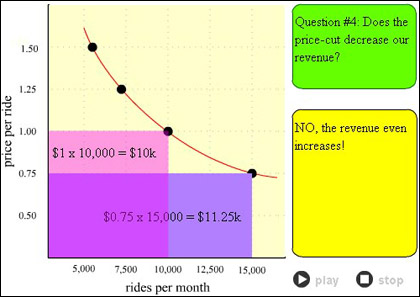
For those that don't already know, I teach a night course in the Principles of Microeconomics. 'Night course' means that I cover a weeks worth of material in one evening, a 3-hour marathon class (I do provide breaks; I'm not a slave driver yet). This week we talked about perfect competition, specifically whether perfectly competitive markets are good or bad. It's a really exciting lecture, because we get to see how all of the decisions in competitive markets perfectly match the desires of the people involved, and how no possible change to such a market exists that can make society better off (for a decent overview of the topic, you might try this site). We're getting into the part of the course I really like to teach.

After class, I had a student (who is originally from China) ask if people from different religions would disagree with anything I was presenting. It's a great question, particularly when we get to the topic of Welfare Analysis. There are plenty of arguments against positive neoclassical economics (what we teach freshmen) by other schools of thought - Austrians, Marxists, Feminists, even Behavioralists. But not many specifically religious positions would question the description of the world economists offer.

When it comes to determining if the world economists describe is good or bad, though, lots of opinions open up. Devout Muslims would say that the system of interest rates common to market economies is immoral. Many mainstream Christians would say that the problem with markets is that the encourage greed (or Avarice if you're a pre-Vatican II Roman Catholic). I don't know with much certainty, but I suspect Buddhists would object to treating many goods and services like commodities. Personally, I find no religious objection to any of those things. In fact, like most economists I think interest rates for investment (loans for consumption are another matter) are good, and there are relatively few goods or services I think shouldn't be traded (I'll let you guess which ones they are).

But I do have problems with neoclassical welfare analysis. My objection is a bit subtler, though. I have no problem believing that competitive markets lead to resource movements that perfectly reflect the desires of the people (up to, and possibly including, the issue of income distribution). But I am not comfortable with the jump that says this is necessarily the best society can be. Implicit in this view of the world is the assumption that what people want and what is best for them are the same. Now, I just finished reading Judges, and I'm not getting a "people only want what's best" vibe.

There are a lot of self-destructive desires in the world, and this is the danger that would run rampant in a world where all markets where perfect with no intervention by the government. While in a lot of circumstances I think there is good justification for saying that people may be wrong about what's best for them, but no one else knows better. There are a lot of circumstances where I (as one who believes the world is the creation of a God who has not kept silent) think that is incorrect, too. I don't tell my students this, because they're hanging on for intellectual dear life as it is. But it is worth thinking about.

Markets can be perfect without being infallible. This concludes our meta-lesson.

Of Apophenia and Augury, Part II

"The Chief is... currently missing," Leon said.
"So sad," Captain Zwingli said. "Sounds like you're on your own. Doctor West, anything we should explain to local officials?"
"Nothing we can tell them without bring up more questions than answers," Dr. West said. "No reason to cause confusion."
"I gave up my weapon, I at least need to know what you're doing to keep these citizens safe!" Leon said.
"Do you see all these soldiers?" Captain Zwingli asked. "They'll contain things, as ordered."
"And what are we containing?"
"Them." Dr. West pointed into the tent, where half a dozen zombies lie strapped down, struggling clumsily against their restraints. "We don't want anyone to get injured unnecessarily, and we certainly don't want a panic."
"You have them inside the camp?!?" Leon said.
"Why don't you say it a little louder?" Captain Zwingli said. "They need to be here so we can monitor how quickly they spread. Now why don't you go direct some traffic and leave the heavy lifting to the professionals."

Amid the crowd, Liv saw the injured woman and one of the men from their transport stumbling against the fence nearby.
"This woman's hurt! Is there a doctor nearby?" Liv yelled above the din of frightened people. "Reed? Get one of the doctors!"
Reed looked up and saw the two passengers. The woman straightened up slowly, looked into the man's vacant eyes, then turned. Both began walking toward Liv and the children.

"And if one of these 'patients' breaks loose? It's pretty crowded over there, you know," Leon said.
"The soldiers have orders to fire on anyone exhibiting revenant behavior," Dr. West said. "There are guards all around these tents. There's no scenario in which they could get to the crowd."
"Revenant??" Leon asked. "What the hell is that?"
"That's science talk for zombies," Captain Zwingli said. "You did get that that's what we're up against, right? The walking dead, like in one o' them movies."
"Not precisely," Dr. West said.
"Look I don't care what they are right now," Leon said, not quite convincingly. "Are you sure you can contain them? There are worse things for these people than just dying, right now."
"Yes, I suppose that's true," Doctor West said. "More true than you know, really."
"Anyway, if we actually have to euthanize them, one head shot from the live ammo in those trucks," Captain Zwingli gestured to two trucks between a humvee and the energy equipment truck," right over there does them nicely."

The pair stumbling toward the crowd stared blankly at Liv.
"Are you alright?" Liv asked.
"Liv, get the kids away from them," Reed said. He reached into his pocket, pulling out the revolver he had concealed and loaded several rounds into it.
The third injured man, the one who had spoken earlier, ran out from the crowd toward the woman. "Nancy," he said, "did the doctors see you??"

"The live ammo's in storage? What are all the soldiers using??" Leon asked.
"Riot control," Captain Zwingli said, "as per our orders."
"You're using rubber bullets?!? That bleeping airman was serious?!?!?!" Leon ran toward the crowd of refugees.

Nancy grabbed the man's arm, throwing him against fence and biting him. The other man moved toward the crowd and moaned.
"Hey! There's a fight over here! Break it up!" A dozen civilians descended on the couple against the fence. Amid the crowd, the second man tried to grab Liv.
"Liv!" Reed raised his pistol and rushed forward.
"Look out! That guy's got a gun!"
"...Get off of him, lady, break it up!..."
"...GYAAAHHHH! he bit me!..."
"...Dizzy... UUNNGHH..."
Reed reached his family and shot the zombie in the chest. Screams from the crowd. The zombie stumbled back and fell, but just as quickly began to get up.
"Reed!" Leon shouted as he ran up. "The head!"
Liv wrapped her arms around her children's faces, turning them away from the gore.
Reed fired once. The zombie fell dead.
Screams and moans billowed from the crowd by the fence. As soldiers moved in, the crowd began to spread out, all eyes vacant. The soldiers began firing on the crowd, but the zombies merely stumbled back.
"Leon!" Kurt shouted as he tossed Leon his pistol. Kurt had apparently never stored it as ordered.
"We've got to get out of here," Leon said to Kurt and Reed. "Something is not right about this!"
"Agreed. Airman Russell, do they leave the keys in those trucks?" Reed asked, pointing at the energy equipment trucks.
"Yes," Kurt said. "You lead, we follow."
"We need to help some of these people!" Liv said.
"Get your kids on the truck," Leon said. "We'll round up whoever we can."
Bullets and screams were flying freely. Leon and Reed managed to move a couple dozen people toward a Humvee and a nearly empty weapon truck as the soldiers distributed the guns. Kurt and a few more piled into one of the equipment trucks. They drove straight through the now unmanned gate as the sun started to rise.

The three vehicles kept driving through the deserted suburbs. Up ahead, they saw a group of roughly a dozen refugees walking along the road.
"Reed, I think that's the Reddings!" Liv said. Reed slowed the truck as they approached and leaned out the window.
"Mr. Redding, were you in one of the camps?" Reed said.
"No," Mr. Redding said. "Rose got us out of the house and moving before the soldiers came through."
"They managed to find Walter and us in time," Daisy Newman said, holding her daughter. "Walter, it's Reed Wright! Is your family OK?"
"We're all here, thanks. About thirty of us managed to escape," Reed said. "It was bad."
"Where are you headed from here?" Rose asked.
"We're sort of playing by ear right now," Reed said. "They seem to be following my lead, but I have no idea where to take these people."
Walter Newman walked up beside Daisy. "Sounds like you're going to need us as much as we'll need you, Reed. We have a plan."

Of Apophenia and Augury, Part I

The family was herded into the back of a military transport truck with a few of their neighbors. Gun shots continued to sound in the warm night. The truck pulled away from the houses and drove to the highway nearby, where it met up with two other transports. The truck stopped and idled as the driver got out and met with the drivers of the other two.
"What's the hold up?" One driver asked.
"We're headed back toward downtown," another said. "Listen, we picked up a bleeping cop who wants to talk to 'somebody in charge.' Either of you headed back in?"
"I'm almost full," The first driver said. "Have him and any casualties hop on the back of mine, I'll go ahead and go in. This bleeping operation's gonna take all bleeping night." And no, the soldiers didn't say bleeping.
The drivers went back to their respective trucks. The Wright family (Reed, Liv, Wayne, and Eileen), still clad in their pajamas, children fighting back tears of fear, sat in the back of the truck with neighbors they barely knew and the soldiers who had rescued them from their own home. The gate at the back of the truck was lowered as a Hispanic man in a wrinkled city police uniform climbed into the truck with them, followed by three injured civilians.
"Thanks," the policeman said. "You three OK?"
"The two of us are OK, I think," said one of the men, "but she seems pretty bad, got a big gash in her arm. Let's hope we can get her to a doctor quick."
"Will someone please tell us what's going on?" Another passenger said. "These soldiers just broke into our house and told us to come with them!"
"I haven't been able to get any straight answers," The officer said.

When everyone was situated, the truck began moving again. The officer tried to start a conversation with the soldiers.
"I don't suppose you guys care to say what's going on either?" The officer asked. "Like why people are being attacked, or how you were ready to respond so quickly?"
"We're not FEMA," a soldier with a pistol said.
The officer laughed. "Thank you! That's the first answer I've gotten that wasn't some 'not authorized to discuss it' BS." The officer did say 'BS,' censoring his own speech after noticing the Wright family's children listening. "Sgt. Leon Romero," he said.
"Airman Russell," the soldier with the pistol said.
"Yeah, let's just get cozy," the other soldier said contemptuously. "Nice to meet you, the name's royal chief master sergeant bleeping awesome. We don't care who you are!"
"Hey!" Leon said. "There are kids listening, Junior Birdman." The soldier started to stand, but Airman Russell slapped a hand across the other soldier's chest, pushing him back down. Reed glanced at Russell's insignia, noticing that he was of higher rank than the other airman.
"Airman Russell?" Liv said. "I just want to thank you for protecting my husband earlier."
"Yeah, two to the head!" The airman basic said. "He's gonna get an earful for that bit of genius later."
"I noticed that was the only one you actually stopped," Reed said. "How come your rifle barely held them off?"
The airman basic frowned. "Rubber bullets," he said. Liv scoffed, clearly unconvinced. Russell remained silent, but seemed uncomfortable with the conversation.
"You don't say much, do you Airman Russell?" Leon asked.
"Nope," Russell responded.
Leon smiled. "You got a first name, Airman?"
"Kurt," Airman Kurt Russell responded. "No relation."
"Really?" Reed said. "Cause now that you say it, you look just like the actor."
"So I hear," Kurt said.
"How about you, friend?" Leon said.
"My name's Reed, this is my wife Liv, and my children Wayne and Eileen."
"Nice to meet you," Leon said.

The truck came to a stop for a moment, then pulled forward slowly. The passengers saw a make-shift checkpoint box and a high, chain-link fence pass behind them. The truck came to a stop and everyone exited the truck, the two airmen going first. An Air Force officer approached Leon.
"Sergeant, I'll be escorting you to speak to the Captain," the Lieutenant said. "But first I'll need you to relinquish your weapon."
"Excuse me?" Leon said incredulously. "You want my sidearm?"
"Yes sir, I have to insist," The Lieutenant said. "Senior Airman, please take the Sergeant's weapon." Kurt stepped forward and held out his hand to Leon.
Leon looked around. They were clearly in a military operated camp, probably set up exclusively to process civilians before taking them to a more permanent location. There was nothing to gain from making a scene. Leon handed over his gun.
"Armory tent," the Lieutenant said. Kurt marched off.
Leon turned to Reed. "Look after them. I'll catch up with you if I find out anything worth passing on." Leon and the Lieutenant walked toward a cluster of tents.
"This way," the airman basic said to Reed. The Wright family was led to a crowd of civilians, mostly also in their pajamas.

The Lieutenant delivered Leon to his superior officer presently. The Captain, who was standing next to a tent with several medical professional types wandering about, did not take notice of them. He seemed entirely engrossed directing transport trucks to their staging areas.
"Captain Zwingli? This is the police officer who wanted to see you," the Lieutenant said.
"Get that equipment in position for setup in the morning!" Captain Zwingli said. The truck parked next to several others directly opposite the main gate. Captain Zwingli then turned to Leon and the Lieutenant. "The Air Force says these camps need to be able to run on autonomous power, which would be fine by me; but since the whole bleeping world has gone green, they give us solar panels and some kind of bleeping windmills rather than gas generators. Bleeping nonsense, I say!"
"Great," Leon said. "What's going on?"
"That will be all, Lieutenant," Captain Zwingli said. "Now who are you?"
"I'm a Sergeant out of the sixth precinct, badge number 1013-..."
"I'm not impressed," Captain Zwingli said flatly. "Where's your Chief of Police?"
"The Chief is... currently missing," Leon said.
"So sad," Captain Zwingli said. "Sounds like you're on your own. Doctor West, anything we should explain to local officials?"
"Nothing we can tell them without bring up more questions than answers," Dr. West said. "No reason to cause confusion."
"I gave up my weapon, I at least need to know what you're doing to keep these citizens safe!" Leon said.
"Do you see all these soldiers?" Captain Zwingli asked. "They'll contain things, as ordered."
"And what are we containing?"
"Them." Dr. West pointed into the tent, where half a dozen zombies lie strapped down, struggling clumsily against their restraints.

Life Changing Arts

There's a meme going around the Facebook. (A SIDE: I've recently been informed that the word 'meme' was coined by one Richard Dawkins, a man with few fans in my social circles. This does not compel me to use a different word.) The basic idea is to list the 15 music albums that 'changed your life.' Now, I like music, but I couldn't come close to listing 15 songs that have truly 'changed my life,' much less 15 whole albums. And it would seem a betrayal of reader interest for me to list 15 albums that I thought were 'pretty sweet.'

That said, I love the idea of admitting that our experience of art and media shapes who we are and how we relate to the world. I'm not just talking music, although that's a big part of it. I'm thinking changing the glasses we use to view the world through books, movies, music, paintings, theatrical performances, culinary experiences, etc. Things that somehow made the world a bigger place afterwards. What moves us and makes us think reveals a lot about who we really are.

Given the power of art in all these forms, I'd like to offer a list of 15 'media experiences' that really did 'change my life.' I'd also like to learn about similar experiences from the readers of this blog, so please feel free to post your own in the comments or link to your own blog entries on the subject. (A SIDE: I'm not a fan of arbitrary rules. Don't feel bound to list exactly 15 unless you find this constraint helpful in some way.)

In no particular order-

1. Putting On Airs (Album): This was the first music I ever spent my own money on, and my first expression of preference for a particular musical style (Irish traditional).

2. The Hunger for Significance by R.C. Sproul (Book): The Image of God actively enters my thoughts regarding every human relationship I have because of this book.

3. Thy Mercy My God (Song): This is the first song to ever truly drive me to tears. I had never really felt truth in my gut until I sang this song with Wade and the RUF team playing.

4. Spaghetti by Andrew Johnson (Culinary Arts): A little balsamic vinegar and rosemary opened my mind to one of my current favorite pasttimes. I love food.

5. The Chicago Tribune building (Architecture): Seeing the Tribune building dissappearing into the fog (or smog, I was never sure which it was) made me care about my physical environment for the first time.

6. Star Trek Deep Space Nine (TV Series): I always suspected that the world was not full of black hats and white hats, but with good and evil within the same people, warring with each other and each having wins and losses. But I believed it when I saw it portrayed in this show.

7. Grace Unknown by R.C. Sproul (Book): The simple sense of this book is the reason I am a reformed Presbyterian. That's pretty worldview shaping.

8. Genesis (Holy Book): I know it's kind of cheating to include a book of the Bible, but everything in my experience brings me back to thinking about what the world was made to be, why aren't the way they're supposed to be, and how God is making all things new again.

9. Prices and Information by W. Robert Reed (Book): This book convinced me that markets are as much a part of human nature as language. The logic of this book changed how I teach, study, and interpret the news.

10. She Must and Shall Go Free (Album): Jesus Christ loves his Church with a deep, burning passion that will not let her destroy herself. This album helped redefine love for me.

11. Josh Groban at the Ford Center (Concert): I had never experienced the mesmerizing power of a live musical performance before this. To be immersed in music is a good thing.

12. The Fellowship of the Ring (Movie): These characters were real to me before the movie, but Peter Jackson made them vivid and alive. This movie (and the others in the trilogy) didn't just capture my imagination, it expanded it.

13. Conspiracy Theory (Movie): As odd as it sounds, I was not interested in seeing this movie until I had a dream informing me it would be great. I pay attention to my dreams in part because this is one of my favorite movies of all time.

14. That Hideous Strength by C.S. Lewis (Book): This book captures my beliefs about logic and human reason. It also captures why I think aliens, monsters, and magiks aren't as far fetched as many 'logical' people believe.

15. The Dark Knight Returns by Miller, Janson, and Varley (Comic Book): I had set aside superheroes since childhood until I picked this up. I realized that comic heroes could be art that tested our values and held a mirror to our humanity.

There you have it. My 15 life changing albums. And by albums I mean artistic experiences. Or something like that.

So I Had to Write a Scholarship Essay


Prompt: “Given the opportunity, support, and funding, what one thing would you do to make the world a better place?”

Making the world a better place is a lofty goal, though somewhat broad. It is a bit like making wishes: I could say I would end war, or that I would end hunger, or that I would establish a colony on the moon for the preservation of humanity. The difficulty in answering such broad questions is that it is easy to say “I would do this if…” It is quite another thing to say “I will do this because…” Yet the most accurate answer I can give to the question of what I would do is to say what I will do to make the world a better place: Conduct research, teach young minds, raise a family, and generally pursue my own calling.

I believe one of the greatest things I could do to improve the world is to expand the knowledge and understanding of how we, as human beings, relate to that world and to each other within that world. My own research involves economic growth and development. It is often the goal of many to relieve the poverty and hunger that characterizes the majority of humanity to this day. While this is a grand goal, it cannot be achieved unless we first understand why some have become rich while others have remained poor. There are a vast array of conflicting beliefs about why this is the case, and an equal number of corresponding remedies. Yet history teaches us that unless we know and understand the true nature of the disease, we likely prescribe a cure in vain. What the world needs to end hunger and poverty is research, and this is something we can do now.

Many also wish to end ignorance and fear in the world. These are not problems that can go away quickly or easily. Ignorance can only be combated by learning, and learning demands teaching. Not all teaching takes place in formal environments, but the University is a setting where learning can be nurtured and new lessons can be applied. As a University teacher I will have the opportunity to open young minds to logic and to reasoning and to explanations of the world they had not previously considered. What the world needs to end ignorance is teaching, and this is something we can do now.

Still others wish to put an end to war. In world of finite resources this seems an impossible task. Yet if our children can learn from us to love our neighbors as ourselves, to love our enemies, to value them as human beings even when we dislike or disagree with them, then war will never seem to them a solution. Our children will look at us to see whether these things are true. If I love my wife, my daughter will notice. What the world needs to end war is family, and this is something we can do now.

We all want people to have full lives, enjoyable lives, meaningful lives. For this to happen we should spend less time trying to discover what the world needs, and more time doing what each of us is meant to do. Howard Thurman said that “what the world needs is people who have come alive.” People come alive when they pursue their own callings, regardless of what the pursuit of wealth or ‘keeping up with the Joneses’ tells them to do. To live full lives we must do what we were made to do, and this is something we can do now.

It is not enough to say what we would do if only we had this or that. I do not believe we were made only to wish that things were different. I do not believe our high goals of what is good, and right, and just, should only be pursued if this happens first or those resources become available to us. We must find what we ought to do, and then find what we need to do it.
 

© Metadoxy
Revolution Elements by Blozard. Original WP theme by Jason Schuller | Distributed by Deluxe Templates