The Ascent of Money by Niall Ferguson

Money allows us to move value, especially the value of our labor and perishable products, across space and time. Banking allows us to move money across space and time. Bonds and stocks go beyond banks and allow us to finance longer term investments, an essential component of economic progress and wealth creation; of course, they also allow us to gamble with both our own and other people's money. Betting on the future is risky, which is why we have insurance markets; and few bets are as important for both financial health and living standards as betting on houses. All these components come into play in the global financial history Niall Ferguson weaves together in The Ascent of Money.

The book was written as the financial panic, housing bust, and global recession of 2008 were still snowballing. Ferguson offers a historical perspective on what he considers the key markets influencing the unfolding crisis. From the clay tablets of Mesopotamia to the silver mines of Cerro Rico to the international exchange machinations of George Soros, the book walks a sweeping path through thousands of years to the first few months of that fateful year.

The style of the book is, unsurprisingly, a bit rushed, but generally enjoyable. Ferguson freely bounces between the ludicrously anecdotal and the abstractly mathematical. Consider this passage, introducing the founders of the Scottish Minsters' Widows' Fund (now the insurance & pension fund Scottish Widows):
We tend to think of Scottish clergymen as the epitome of prudence and thrift, weighed down with an anticipation of impending divine retribution for every tiny transgression. In reality, Robert Wallace was a hard drinker as well as a mathematical prodigy, who loved to knock back claret with his bibulous buddies at the Rankenian Club, which met in  what used to be Ranken's Inn. Alexander Webster's nickname was Bonum Magnum; it was said to be 'hardly in the power of liquor to affect Dr. Webster's understanding or his limbs'. Yet no one was more sober when it came to calculations of life expectancy.
With my Presbyterian background, I had to chuckle; I'm like to think that Ferguson, himself a Scot, must have done so when he wrote it.

On the whole, I was quite pleased with the book. I actually assigned it as required reading for my money and banking students before I had finished it, and am looking forward to in-class discussion on it in a few weeks. On the other hand, I also learned that there is a 6-hour BBC miniseries version, so a number of students might not read it at all. I'm still undecided if that's a bad thing or not.

I recommend the book to anyone who wants a broad historical background to understanding either the recent recession or modern finance. There are other sources with more detail and more focus, and as I mentioned earlier, the flow suffers a bit from trying to release the book in medias res. But I get the sense that this is Ferguson doing what he does best, and he's quite good at it.

Theories of International Politics and Zombies by Daniel Drezner

When I heard about this book, I was convinced it was something I needed to read, but had no idea when I'd have the time or funding to do so. Fortunately for me, my friend (and now soon-to-be military chaplain) Matt Moynihan decided to buy the book and give it to me. Thanks, Moyni! My review falls after the jump break.

Doctor Who, the Popular Musical

Below the fold (jumpbreak? I never know what to call it...) are some videos featuring one of my current favorite shows and a couple of my current favorite bands.

Reading Scripture and the Conservative/Liberal Divide

My wife provided a link to this article at Christianity Today, which discusses some new research on the relationship between regular Bible reading on whether the reader leans conservative or liberal on various topics. Some of the key findings (find more at the link):
Frequent Bible reading has some predictable effects on the reader. It increases opposition to abortion as well as homosexual marriage and unions. [...] But [...] For each increased level of Bible-reading frequency, support for the Patriot Act decreased by about 13 percent. [...] As might be expected, respondents who were more politically liberal were prone to disagree with the statement, "The government should punish criminals more harshly." Unexpectedly (at least given the conservative stereotype), the more frequently people read the Bible, the more they too are prone to disagree with the statement. [...] the more someone reads the Bible, the more likely he or she is to believe science and religion are compatible.[...] contrary to liberal media stereotypes, those who are most engaged in their faith (by directly and frequently reading its source material) are those who are most supportive of social and economic justice.
The article interprets this as causal: more frequent Bible reading makes otherwise conservative Christians more liberal. I think there is some sense to this interpretation. It's hard to read large segments of the Bible and think of it as more about rules and instructions than stories and people. And it's very hard to read those stories and still think of people as either good guys who follow the rules or bad guys who bring God's wrath upon them. The Bible doesn't really have many black hats, and even fewer white hats.

But it sounds like the study doesn't actually pin down the direction of causation in this way, I can think of good reasons it could go differently. In particular, if you're a slightly more liberal person in a conservative church environment, you will more frequently leave a sermon wondering "but does it really say that?" This provides motivation to read the Bible for yourself rather than just taking a pastor or teacher's word for it.

So my instinct is that sorting out the degree of cause in each direction is far from simple. Nevertheless, it's an important correlation, and one that holds even after controlling for a number of other important relationships. What do you think? Does reading the Bible regularly moderate your views? What about other people you know?

Matt Yglesias Is Right and Wrong

As Matt Yglesias discussed a few days ago, he has a problem with public choice economics:
While of course I agree with many of the specific observations made under the banner of public choice (public officials often do corrupt and self-interested things), I don’t really “get” public choice and think I never will. The basic theory [...] seems to go like this:
1) Spread cynicism about public officials.
2) …
3) Libertarianism!
The psychological and sociological links here seem clear enough. Both libertarian political ideology and spreading cynicism about public officials serve to raise the status of businessmen and lower the status of politicians and bureaucrats. But as a political agenda it doesn’t work at all.
He goes on to provide plenty of good reasons why cynicism is problematic as a guiding principle for political decisions. He's right.

But he's completely wrong in thinking that what he's talking about is public choice economics. Perhaps a trip to Wikipedia could have cleared this up. Public choice is not a political agenda. It's descriptive, applying the analytical tools of economics to the decision-making process of political bodies. It's core premise is that politicians are no less (and no more!) oriented toward their own best interests than any other human being.

It's true that public choice is often used as a part of the case for libertarianism, but only because advocates all too often assume that politics has the uncanny ability to attract only the most altruistic idealists into its ranks. Public choice makes the case, rather, that political institutions can just as easily attract those seeking economic rents... or at the very least those whose motives look very like the motives of any other consumer or firm manager.

So Yglesias is right that if we are trying to tell political figures how they can look out for the well-being of society we shouldn't expect public choice economics to give us the answers. But then we wouldn't offer advice on generating bigger externalities to polluters, either. If we want to be able to predict how the political system will deal with something, though, we might want to model the actual decision-makers, and public choice provides an under-utilized means of doing that. For that matter, if we want to construct institutions that limit the ability of politicians to indulge their self-interest, public choice can help us there, too, although it will also tell us why such institutional changes are difficult to achieve.

In the end, it seems like what Matt Yglesias doesn't really get is the difference between prescriptive policy and descriptives science.

And by 'Life As Usual' I Meant...

... that I'll be on hiatus for the next four months. Apparently.

Not to go all Randy Quaid in Independence Day on you, but:


Yep. The plan is to post on a semi-regular basis, probably only about once a week.

So what's been keeping me busy this whole time? Well, let's see:
  • My family and I have moved to California
  • I am now a full time faculty member teaching three different courses
  • So my time has been pretty full with teaching, evaluation, and settling into life on the west coast
  • Also, I have a two-year-old daughter and an amazing and creative wife, so why wouldn't I be keeping busy?
I'm hoping to continue living up to the blog's tag line of "exercises in self-awareness," but I will probably be keeping it simpler overall. I'll be commenting on items from the Internet that get me thinking, posting links and videos, and with any luck I'll be putting some book reviews up as well!

Thanks for continuing to hang around even though nothing's been happening. Feel free to post requests or ideas in the comments. You can also look me up on Twitter or the Google+.

News in Brief

I just got my Ph.D. in Economics. Pretty pleased about it, to be honest. Life as usual to return presently. That is all.

Linkdump: Immigration


The Wall Street Journal recommends some fiction for your library, which I have not read, but sounds interesting. (Cannot be excerpted, check out the article for very brief reviews)

The Economist says more legal immigration is low-hanging fruit.
At a time when America is concerned about excess housing supply and anxious to boost its innovative capacity it is madness that so many willing immigrants, including high-skilled workers, including those educated in America, find it difficult to impossible to gain permission to work in the country on a stable, long-term basis.
Annie Lowry agrees.
The pro-super-immigrant data abounds. According to the Hamilton Project, immigrants are 30 percent more likely to start a business than U.S.-born citizens. Immigrants with college degrees are three times as likely to file patents as the domestically born. And all that entrepreneurial gusto really adds up. Economist Jennifer Hunt of McGill estimates that the contributions of immigrants with college degrees increased the U.S.'s GDP per capita by between 1.4 and 2.4 percent in the 1990s.
Despite these success stories, the United States still discourages foreign-born entrepreneurs. The H1-B visa program allows employers to bring in highly skilled workers but grants only 85,000 new temporary visas per year. Many recipients need to leave the country when their contracts end, giving them no incentive to put down roots and start businesses. The student visa program also allows in tens of thousands of the most talented, driven students from overseas, only to push most of them out again once their education is finished.
Bryan Caplan directs us to Tino Sanandaji on the negative political effects of allowing more immigration.
Though ignored by proponents of the ethnic-diversity-and-redistribution, minorities also get to vote, and they vote overwhelmingly for the left. This effect is dominant when we are discussing free migration, because with open borders in a world where 700 million people have told Gallup they would like to migrate right now, sooner or later the immigrants will become the majority of voters and make the political preferences of the natives irrelevant.
And now, some cartoons from the Internet:*

 *Yes, this is overkill on the pithy graphics. Yes, political cartoons oversimplify issues. I still think they're worth including.

Cultural and Economic Development

I have no words.
What happens when a culturally and economically 'backwards' territory is suddenly made a part of a great economic powerhouse? If you're a follower of Aid Watch (and, really, you all should be), you know that the answer is 'mostly bad things.' Part of the problem, of course, is the fact that who gets to decide what constitutes 'backwards' is a pretty important question, and one with almost no good answers. But supposing we can identify a truly inferior culture-economy, that still doesn't mean the economically powerful can make things better by swooping in like a hero in red and blue.

This post by Vivek Nemana illustrates the point nicely. The antebellum American South was both entrenched in a social system that was morally deficient and locked into an industrial system that was economically counterproductive. (I realize not all my readers will agree. I stand by the strength of this statement.)
The South was heavily invested in racial subjugation – slavery directly accounted for over a quarter of the GDP. The region spent an enormous amount of resources to justify slavery, hiring silver-tongued apologists like John C. Calhoun to spin slavery as humane. In this light, slavery was an economic institution that was designed for racially hegemonic society.
Presumably, then, the North was doing the South a favor by overthrowing its destitute system and replacing it with a system based on sound property rights and the promise of true freedom for everyone, not just the landed gentry... right?
While the Civil War radically restructured Southern laws to promote racial equality and property rights, the hegemonic bonds were resistant to change. [...] As the legacy of slavery wound its way into postbellum Southern society and politics, it hindered the way freedom and property rights should have boosted the economy, denying the South the full bounty of American development.
In other words, "the very insertion of these new freedoms and property rights into a society designed for slavery [...] led to the divergent development of North and South." Improving economic and political conditions aren't enough to produce lasting prosperity, and fixing one part of a system can actually make the people under the system worse off.

(As an aside, this post really got me thinking about the economic destructiveness of even a little bit of racism, especially this sentence: "Gary Becker once wrote that people lose out on the potential gains from trade if one group is able to indulge in 'tastes for discrimination' against another." It ties in closely with a post at another blog from Jonathan Wight on the nature of property rights: "Property rights do not bestow limitless abilities on owners, and property rights come with responsibilities.")

All this brings me to an article at the Financial Times. Essentially, the article discusses how we should compare cites like Vancouver to cities like NYC, and what sort of values we express by preferring one over the other. I just don't know how to react to it. The author wants to argue for the organic, unplanned outcomes of a place like NYC over the zoned and top-down oriented nature of Vancouver. But I'm left not sure what to do with some of the elements of the argument.
In fact, it can often be exactly the juxtaposition of wealth and relative poverty that makes a city vibrant, the collision between the two worlds. Where parts of big cities have declined, through the collapse of industries or the fears about immigration that led to what urbanists have termed the “donut effect” (in which white populations flee to the suburbs, leaving minorities in the centres), there is space to be filled by artists and architects, by poorer immigrants arriving with a drive to make money and by the proliferation of food outlets, studios and galleries. These, in turn, attract the wealthy back to the centre, at first to consume, and then to gentrify.
Is he saying diversity is a good thing? That wealthy elites should not isolate themselves? I think that's a great point. But is he also saying that the wealthy should keep a few poor folk around because they run tasty food trucks? Because they offer a culture worth fixing (my wife hates the word 'gentrify,' btw)? That's something else entirely.
In a strange way the everyday conflict with the (unliveable) city can also become part of the attraction.
Again, whether I can get on board with this depends crucially on whether we're talking about opening ourselves to learn from those different from us, or whether the goal is to bring our (clearly superior) ways to influence the 'backwards' folks of the inner city.
Mumbai is probably the greenest big city there is – slums like the million-strong Dharavi use minimal land, energy and water.
Once again, does this mean that we should be willing to have some poor people around because it is good for the environment, or that economic growth for the poorest around us is worth being less green, or that striking the balance between economic and environmental stewardship is hard?

At the end of the day, how we relate to the people and city around us depends an awful lot on if we are developing full and complex relationships with them, with plenty of give-and-take and holistic engagement, or if instead we are setting out to gentrify the backwards natives. And for those of us who educate others vocationally, I think it's a call to special reflection and introspection.

Death of a Sinner

[...] a middle-eastern religious fundamentalist extremist [...]
Thoughts on the news about Osama bin Laden from Pastor Ed Eubanks of Hickory Withe Presbyterian Church:
I understand the need and importance of the operation against Osama bin Laden, and recognize and even appreciate the significance of his removal from terrorist activity. [...] Surely everyone knew that this-- death by firearm, or bomb, or missile, in the face of military aggression-- was the reasonable and eventual end of this man, whose entire life seemed to be singularly-focused on wreaking fear, grief, and death upon as many of those with whom he disagreed as possible.
But Ed also sees something seriously wrong with how we've responded, including the following:
The United States is not the Promised Land. The Old Testament promises for the nation of God's people do not apply to America. The American military forces are not the army of the Lord. And Christians, our citizenship in the U.S., however important, is secondary to our citizenship in the true Kingdom of God (and no they are not the same!). Consequently, Christians ought not feel free to cry out that the killing of Osama bin Laden is a victory for Christ!
Rejoicing at a degree of justice being fulfilled is one thing. Rejoicing at the death of a man who deserved God's wrath and curse no more than we did is something else entirely. the same David, the man after God's own heart who actually did  live in the Promised Land, the man who prayed for deliverance from his enemies and justice on God's enemies, wept for the deaths of Saul and Absalom.

The real kick in the gut, for me, was his last bullet, which included the following:
How many of the Christians who are celebrating the death of Osama bin Laden ever prayed for his conversion and repentance? If we know ourselves and what we have been redeemed from, we long for the redemption of others. If all we feel for others is contempt and condemnation, perhaps we don't know and recognize the depth and degree of our own redemption.
There have been some strongly held opinions on all sides expressed online about the death of Osama bin Laden. I've seen what nearly looked like battle lines drawn on the Facebook, of all places, over how good Christians should be rejoicing at the death of this wretched man. But as my friend Neal F. put it,
Bin Laden's death (should this prove true) is a somber reminder that we all deserve hell for our sins. "But for the grace of God, there go I." Neither you nor I did anything more than OBL to deserve God's love. Let us not rejoice in a fellow human being experiencing the punishment of hell, but rather let us appreciate the reconciling work of Christ to take away the sin of the world.
I say rejoice at a small taste of God's justice, yes. But rejoice for the death of an image bearer of God? Rejoice at part of the fate I have earned for myself falling on someone who has not received the same grace as I? Rejoice at the power of the gun to change the shape of this broken, poisoned world? Rejoice that the sword has not departed from our house?

No. Osama bin Laden was an evil man, and the world is probably safer without him. But will I revel in another death? No. No I will not. God does not rejoice in the death of the wicked, and neither should we.

Truth Claim of the Day

[...] even the American experience suggests that the anti-monarchical temper Oppenheimer invokes is ultimately artificial and unnatural, a triumph of theory over instinct and idealism over human nature. In their hearts, most people want a king and queen.
Please, discuss. The context can be found here (NYT blog, so keep track of your twenty).

Linkdump: The Schooling Bubble?

There go my prospects!
Arnold Kling thinks schooling is mostly about signaling respect for hierarchy.
There is no cheap alternative to educational credentials if you want to signal respect for hierarchy. Looking for an alternative signal is fundamentally self-defeating. Any attempt to evade the educational credential system inherently signals a lack of respect for hierarchy!

Steven Levitt thinks schooling pays off.
Of all the topics that economists have studied, I would say one we are most certain about are the returns to education. [...] someone who graduated from college will earn about 30 percent more on average than someone who only graduated from high school. And if anything, the returns to education have gotten larger over time. They’re as big as they have ever been.
Peter Thiel thinks people are borrowing too much to pay for schooling, in any case.
Like the housing bubble, the education bubble is about security and insurance against the future. Both whisper a seductive promise into the ears of worried Americans: Do this and you will be safe. The excesses of both were always excused by a core national belief that no matter what happens in the world, these were the best investments you could make. Housing prices would always go up, and you will always make more money if you are college educated.
Like any good bubble, this belief– while rooted in truth– gets pushed to unhealthy levels. Thiel talks about consumption masquerading as investment during the housing bubble, as people would take out speculative interest-only loans to get a bigger house with a pool and tell themselves they were being frugal and saving for retirement. Similarly, the idea that attending Harvard is all about learning? Yeah. No one pays a quarter of a million dollars just to read Chaucer. The implicit promise is that you work hard to get there, and then you are set for life.  It can lead to an unhealthy sense of entitlement. “It’s what you’ve been told all your life, and it’s how schools rationalize a quarter of a million dollars in debt,” Thiel says.
Schumpeter at the Economist thinks the schooling bubble is worth writing about twice.
Paul Krugman has pointed out that, contrary to popular wisdom, expounded relentlessly by the OECD among other august bodies, technological progress may reduce the demand for high-end jobs, not just low-end jobs. Computer software is now employed to perform tasks that used to require armies of lawyers, engineers or highly educated workers.
[...] My third article is also from Slate. This suggests that applications for law school have dropped by more than 11% since last year, in part because students are beginning to realise that it makes no sense to pile up hundreds of thousands of dollars in debt in order to join the legion of unemployed lawyers. 
And the gist of the second:
THIS year American student-loan debt surpassed credit-card debt for the first time.
Scott James at Forbes thinks there are ways to make schooling worth while.
This new set of schools is increasing the value of their delivered content via a Professor + Practitioner teaching model. This P+P teaching team combines a full academic PhD (required for accreditation) with an expert practitioner (who does that type of work as a day job). Think back to the Operations class you took; how much more valuable would it have been to hear both the viewpoints of an academic plus a manager with 30 years of experience in the trenches at General Electric?
[...] Not everyone is meant to – or aspires to – attend a four-year degree program. In fact, some of the brighter high school students are wise enough to see the amount of debt they would be saddled with after a four-year program, and take a pass on it. As more motivated and smart students opt out of the four-year college program altogether, the idea of a re-skilling college seems more viable.

Medicine, Food, and Health

Since health care has been in the public eye recently, I thought I'd post some links and a few thoughts on the nature and possible solutions to rising costs of medical insurance and medical care.

First we have James Hamilton outlining some key issues in the public health care problem:

And there are three ways to determine which medical services don't get provided.
  • (a) The government can limit the procedures it will pay for and the people who are eligible to receive them.
  • (b) The insurance company or other third party can limit the procedures they will pay for and the people who are eligible to receive them.
  • (c) If (a) and (b) both say no and you don't have the money yourself to pay for it, then you do not receive the treatment.
Each of those options is morally troubling to many of us. But reality forces us to choose some mix of the three. Pretending that there are no tough choices just digs us deeper into a debt that can't be repaid.
When facing the intersection of difficult moral and economic decisions, I know what you're all wondering: What would Robin Hanson do? Unsurprisingly, the supreme advocate of "health care isn't about health" would cut medical spending... in half:
King Solomon famously threatened to cut a disputed baby in half, to expose the fake mother who would permit such a thing. The debate over medicine today is like that baby, but with disputants who won’t fall for Solomon’s trick. The left says markets won’t ensure everyone gets enough of the precious medical baby. The right says governments produce a much inferior baby. I say: cut the baby in half, dollar-wise, and throw half away! Our “precious” medical baby is in fact a vast monster filling our great temple, whose feeding starves our people and future. Half a monster is plenty.
Am I being too allegorical? Then let me speak plainly: our main problem in health policy is a huge overemphasis on medicine. The U.S. spends one sixth of national income on medicine, more than on all manufacturing. But health policy experts know that we see at best only weak aggregate relations between health and medicine, in contrast to apparently strong aggregate relations between health and many other factors, such as exercise, diet, sleep, smoking, pollution, climate, and social status. Cutting half of medical spending would seem to cost little in health, and yet would free up vast resources for other health and utility gains. To their shame, health experts have not said this loudly and clearly enough.
What's that? Medicine costs a lot, but doesn't improve health? How can this be??? As Mark Bittman points out, it's because a huge portion of what we're spending money on is 'lifestyle diseases':
A sane diet, along with exercise, meditation and intangibles like love prevent and even reverse disease. A sane diet alone would save us hundreds of billions of dollars and maybe more.
This isn’t just me talking. In a recent issue of the magazine Circulation, the American Heart Association editorial board stated flatly that costs in the U.S. from cardiovascular disease — the leading cause of death here and in much of the rest of the world — will triple by 2030, to more than $800 billion annually. Throw in about $276 billion of what they call “real indirect costs,” like productivity, and you have over a trillion.
So what does this have to do with food, as my title suggests? Well, much of the problem of 'lifestyle diseases' comes from diets steeped in fast food and sixty-four ounce soft drinks, shelf-stable ready-to-eat meals, and feed lot meats, among other things. Things that even the providers of these services will say should not be consumed 'in excess,' yet the average American diet includes far more of them than anyone (with the possible exception of the sellers of these services) considers advisable. And, as Jill Richardson reminds us, there are reasons to think government food policy is part of the problem:
As for the direct payments, since those are based on historic production, there is still an incentive for max yield and max production, it's just a less immediate one because you'll receive the benefits from it later. It depends on which years the USDA bases your direct payments on, and if they allow you to change which years they use to tabulate your payments. [...]
The WTO says that we can't have market-distorting subsidies so our government is trying to get away from our traditional subsidy system. So they essentially outsourced - privatized - their subsidies. The government now subsidizes crop insurance, which farmers can choose to buy (or not) but it seems like a good many - if not most - buy it. If you don't buy crop insurance, you're ineligible for any disaster relief from the government, should you need it.
Rather than trying to defend everything in the above links (and I disagree strongly with some points), here are some general thoughts of mine on the subject.

Large agricultural firms like Monsanto, along with cooperatives of smaller players and anyone else in the business who manages to accumulate enough funding, spend enormous amounts of money on lobbying the right people at the local, state, and national levels. Some of that lobbying influence buys them subsidies, some of it buys them insurance, some of it buys them protectionist legislation restricting international competition, some of it buys them the ability to obscure information about food products, etc. Ultimately what it buys them is small advantages of one commodity over another (what matters here is not whether ag prices in general are up or down, but whether corn and soy are cheaper than they would have been compared to other beans, sweeteners, and sources of calories) on the one hand, and freedom to market food products they develop without revealing more information about the products than they would like on the other.

Farm subsidies, to the extent they exist, are a problem, whether they are the biggest problem or not. Eliminating them actually saves taxpayers money, although it would hurt those receiving the transfer and their favorite politicians. Sales taxes on food (and by this I mean ingredients, not prepackaged food products) bring in revenue, but can also provide advantages to food producers willing to cut corners (and able to obscure it). The same is true for tariffs on foreign agriculture. Government is a non-trivial part of the problem here, and when we factor in the effect of 'lifestyle diseases' on programs like Medicare, these programs are almost certainly a net loss for taxpayers.

But ultimately the problem isn't government. Ultimately the problem isn't even 'Big Agriculture' (despite the personification of the corporate system via the use of capital letters clearly demonstrating that it's just evil). The problem is consumers. 'Big Ag' is like any other business--it's selling what the people want to buy (granted, it's also trying to keep people wanting the same kinds of things). Part of this is an information problem. We don't put much work into buying high quality meats because it's almost impossible to determine the exact conditions under which the animals were raised. We buy prepackaged foods because buying fresh costs more, and no easy mechanism exists for comparing the quality of the foods. Counting calories, checking food pyramids, watching for 'organic' labels, and any other simple metrics can be manipulated, and can lead us astray as easily as point us in the right direction. If there's no way to insure quality, nobody will ever pay what it takes for the highest quality, which means nobody sells the highest quality and a lower quality becomes the new highest quality (and the cycle begins again).

But most of the problem is a matter of priorities. We don't believe the quality differences out there are worth paying for (and because we think this way, we are often correct). We want our food to last in our refrigerators and cupboards, and we don't think about (or necessarily even believe in) a tradeoff between shelf life and nutritional content. We have no interest in learning how gut flora work until we already have Seliac disease. We consider it inconvenient to worry about feeding children things their digestive systems are unprepared to process. We don't want to have to sort out whether what we're eating was fried in trans fats / hydrogenated corn-soybean-canola oils, or if we can find a version cooked with unprocessed animal fats or tropical oils. Like James Bond taking care of his liver, we have other things on our minds.

And until our preferences change--preferences over the kind of lifestyle we want to lead, and the kinds of foods that go with it--McDonald's and Walmart will continue to sell us the products we want at the lowest cost they can manage; 'Big Ag' will continue to lobby for withholding information that would mostly worry, bewilder, and frustrate us out of our grocery aisles; government will continue to provide small bonuses to a few domestic producers in a few industries over others, and especially over world competition; and the costs associated with chronic, lifestyle-related health problems will continue to rise. It's just basic economics.
We have met the true burger king, and he is us.

Four on Education

Brad DeLong offers his thoughts on economics education:
Rethinking, I conclude that there is something subtle wrong with the undergraduate curriculum after all. What is taught in the classroom seems, largely, not bad. But what is retained after college seems to me, at least, to be horrible. What fraction of college-educated Americans have taken Econ 1? And what do they remember from it well enough to use? Tracking little--much less than I would hope or expect.
DeLong also offers Grant Gilmore's thoughts on the strange duty of academics:
We do something called teaching. But we all know from bitter personal experience that nothing is, or can be, taught once we get beyond the communication to small children of the basic mysteries on which civilization depends - how to read, how to write, how to count. [...] It may be that we can stimulate, or irritate, an occasional student into undertaking this arduous task - but, if we do so, it will be much more by accident than by our own design.
Scott Adams recommends hands on entrepreneurial training for most of us:
One day the managers of The Coffee House [a student-run, college-subsidized bar where Adams worked] had a meeting to discuss two topics. First, our Minister of Employment was recommending that we fire a bartender, who happened to be one of my best friends. Second, we needed to choose a leader for our group. On the first question, there was a general consensus that my friend lacked both the will and the potential to master the bartending arts. I reluctantly voted with the majority to fire him.
But when it came to discussing who should be our new leader, I pointed out that my friend—the soon-to-be-fired bartender—was tall, good-looking and so gifted at b.s. that he'd be the perfect leader. By the end of the meeting I had persuaded the group to fire the worst bartender that any of us had ever seen…and ask him if he would consider being our leader. My friend nailed the interview and became our Commissioner. He went on to do a terrific job. That was the year I learned everything I know about management.
Finally, Edge.org offers a massive list of possible answers to the question 'What scientific concept would improve everybody's cognitive toolkit?' A few examples:
Thanks to Karl Popper, we have a simple and powerful tool: the phrase "How Would You Disprove Your Viewpoint?!"- Howard Gardner
There is a widely used notion that does plenty of damage: the notion of "scientifically proven". Nearly an oxymoron. The very foundation of science is to keep the door open to doubt. Precisely because we keep questioning everything, especially our own premises, we are always ready to improve our knowledge. Therefore a good scientist is never 'certain'. Lack of certainty is precisely what makes conclusions more reliable than the conclusions of those who are certain: because the good scientist will be ready to shift to a different point of view if better elements of evidence, or novel arguments emerge. Therefore certainty is not only something of no use, but is in fact damaging, if we value reliability.  - Carlo Rovelli
It is not hard to identify the discipline in which to look for the scientific concept that would most improve everybody's cognitive toolkit; it has to be economics. No other field of study contains so many ideas ignored by so many people at such great cost to themselves and the world. The hard task is picking just one of the many such ideas that economists have developed.  - Dylan Evans, whose check is in the mail
The media cast about for the proximate causes of life's windfalls and disasters. The public demands blocks against the bad and pipelines to the good. Legislators propose new regulations, fruitlessly dousing last year's fires, forever betting on yesterday's winning horses. A little-known truth: Every aspect of the world is fundamentally unpredictable. - Rudy Rucker
The phrase "correlation is not a cause" (CINAC) may be familiar to every scientist but has not found its way into everyday language, even though critical thinking and scientific understanding would improve if more people had this simple reminder in their mental toolkit.  - Sue Blackmore
(I could go on, but just take a look at the links)

UPDATE: Fourth link did not post. It should be working now.

Money, Money, Money

Here's a bit from macroeconomics: In 2008, per person income in the United States was nearly four times that in our neighbor Mexico, more than ten times that in India, and one-hundred twenty-five times that in the Democratic Republic of the Congo. In the United States we have an adult literacy rate of ninety-nine percent, compared to twenty-six percent in Mali.

And here's one from micro: Two products that start out selling for the same price could come to differ for any combination of four reasons: If more people value and want to buy good A or fewer people want to produce and sell good A, its price will go up; but if fewer people want to buy good A or more people want to produce and sell good A, its price will go down. If people care about doing work they enjoy, then the fact that one job gets paid more than another could either mean people want to buy the product of the higher-paid job more (maybe some people value the product more), or it could mean they enjoy doing the higher-paid job less (maybe it takes a lot more to get people to deal with the drudgery / risk involved).

When I think of personal finance and income, these are the things that come to my mind. The vast majority of the wealth I have is mine simply because of where I was born. Any extra wealth I have that comes from my job has more to do with choosing a field most others would find mind-numbingly dull than it does with how much use I am to the corporations of the world, and neither of these has anything useful to say about any sort of inherent personal value. All the things that put me in the position I am in were given by God, anyway, and the more I have to covet the more God requires I give up for others.

In my mind, to hear that someone else makes more money than me sounds a lot like hearing they have a larger shoe size than me. If it matters at all, the ones with more money have a moral obligation to use it in the interests of those around them with less, in the same sense that someone with a bigger bit of floating debris after a shipwreck ought to share it with other survivors.

All this is background to the fact that I tend to be rather nonchalant, and even flippant, about matters of money. It never occurs to me that talking about how much money I make isn't polite, or that mentioning where my expected payscale ranks compared to those around me is the uncouth work of a braggart. How can one brag about the size of one's shoes, or the buoyancy of one's debris? I ask myself. But the fact that it doesn't bother me doesn't make it OK for me to treat others as if they're silly to let it bother them. I am not the arbiter of truth or seriousness, and the world isn't wrong just because it doesn't see things the way I do. On the contrary, ignoring other people's thoughts and feelings, especially when I don't think or feel the same way, is no way to live in community; it is, however, a perfect way to fail at loving my neighbor.

So if I have bragged about money to any of you before, I am sorry. I was wrong, although I hope you'll believe me when I say there was neither malice nor pride behind it. I was "merely" thoughtlessness, which of course isn't really less wrong. I'm trying to be better. I hope you'll bear with me.

"I repent
...of the way I believe that I'm living right
By trading sins for others that are easier to hide
Oh I am wrong and of these things
I repent"
-- Derek Webb (and, all too rarely, me)

Social Insurance and the Church

Nicer than your average insurance office.
I'm a bit late on this, but here is a fascinating post by Frances Woolley:
The Catholic church is one of the world's oldest insurance companies. [...] Religion as social insurance, Christian style, works as follows: individuals tithe, or give 10 percent of their income, to the church. In exchange, the church provides alms for the poor, that is, a minimal guarantee against destitution.
[...] being independent of the established church meant cutting oneself off from the (sometimes expensive and inefficient) social insurance services it provided. Hence these religions preached responsibility, both for oneself and for others in need. Some of the most iconic British brands, such as Clarks and Cadburys, as well as international companies such as Bethleham Steel, were founded by non-conforming Quakers. To generalize from the savings behaviour of these groups to society in general would be dangerous.[...]
In Europe, Canada, and to a lesser extent the US, government-provided social insurance has replaced that provided by religion. 
It's a great post, well worth reading the whole thing. It got me thinking, anyway. Taking it as given that the Church should be caring for the poor, but hasn't been for some time now, is it wrong for the state to try to fill this gap? Does one God ordained institution have the right to fulfill the duties of another when that other is unable or unwilling to do so? I'm thinking specifically about care of widows and orphans, in which the Church is specifically called to perform the duties normally left to the head of the family.  Anyway, interesting thoughts.

Breakup Songs

Because a few recent songs focusing on the end of a relationship are just quality products. The music videos are below the fold/jump/whateveritscalled. (warning: language. For real. In the second song, mostly, but the song's just no good without them.)

Mechanics and Mystics, Less Seriously

Everything I Know I Learned From Sesame Street (apparently). Check out this video of a Mechanic and a Mystic interpreting a large blue circle. I'll let you guess which one is which.

For the Mechanic who loves working in the kitchen, here's a cutting board specially tuned to the mechanic's mindset.

Our New Computer Overlords

Three links on how computers will replace our white-collar labor force long before robots steal our blue-collar jobs.

The first comes from Paul Krugman:
Anyway, I decided to write the piece around a conceit: that information technology would end up reducing, not increasing, the demand for highly educated workers, because a lot of what highly educated workers do could actually be replaced by sophisticated information processing — indeed, replaced more easily than a lot of manual labor.
[...] In my mind this raises several questions. One is whether emphasizing education — even aside from the fact that the big rise in inequality has taken place among the highly educated — is, in effect, fighting the last war. Another is how we have a decent society if and when even highly educated workers can’t command a middle-class income.
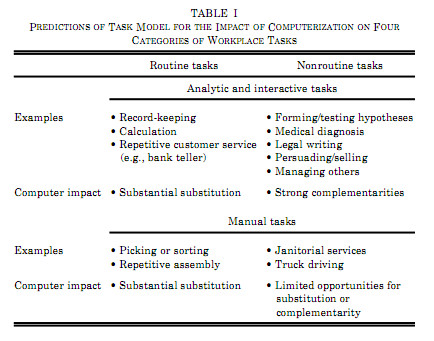
The second also comes from Paul Krugman, and I particularly like it for this table:
"This is real, and it calls some of our favorite platitudes into question," Krugman says.

Brad DeLong, on the other hand, has an excellent post in which economics and history triumph over cynicism (and yes, it's a lot like intellect and romance over brute force and cynicism):
We have already gone through the great transformation by which the general business of life--growing and processing our food, building our shelter, weaving our clothes, and telling ourselves stories for information and entertainment--has been extroardinarily [sic], comprehensively automated. And yet we have found things to do.
 Either way, I'd say this is the best argument yet for the long term viability of a career in the humanities!

Life-Saving Immorality?

Your taxpayer dollars at work.
Brad DeLong thinks that taxing people in order to prevent an asteroid from destroying the human race is entirely appropriate and moral. He quotes Bob Murphy, on the other hand, as disagreeing:
[T]here is a general moral prohibition against violating another person's rights.... Volokh's... point should be obvious: Just because an asteroid threatens to destroy all human life, that alone is not sufficient to justify violating people's rights. [...] The reason DeLong finds Volokh's views "insane" is that Volokh has elevated his precious political principles to such a height that they trump the survival of the human race. What an ideologue!
DeLong summarily rejects this sort of thinking, summarizing his view as follows:
[...] the sabbath was made for humanity; humanity was not made for the sabbath.
Commentor Daniel Kuehn has a lot to say in response to this position, and particularly to the logic of the position:
If you start where they do - axiomatically defining what a "right" is and defining "immorality" as being the violation of that right - then both the Volokh and Murphy version of the argument follows naturally.
The problem is not the logic itself - that logic is simple enough. The problem is their decision to apply that logic to this circumstance. Deductive logic is a tool - we have long since passed the point where we can claim that it deserves any deeper epistemological priority. [...]  Logic is not a tool for them, as most careful thinkers know it should be. For them it is a path, not to truth contingent on assumptions [I would prefer to refer to this as consistent reasoning or logical validity - N], but to some deeper absolute truth. [...] So to expand on your concluding thought, deductive logic is a tool for humanity, and not the other way around.
Tad Brennan points out that, far from being a primarily political debate, the conflict here is between purely deontological ethics and purely consequentialist ethics, and that the latter lends itself to some problems, as well:
If you eschew lexically-ordered side-constraints, then you have a very pure form of consequentialism. And that's not a bad thing! Some of my best friends espouse pure consequentialism! 
But pure consequentialism can generate some pretty repellent hypotheticals of its own (catalogued by Bernard Williams and others: false conviction of the innocent; harvesting organs from the unwilling; torture of children; etc. etc.).
When people recoil from the consequences of pure consequentialism and consider adopting categorical prohibitions on, e.g., the torture of children, this does not seem to me ipso facto insane.
Finding the right balance of ethical views for the Christian is never as simple and easy as it seems, which is why Christian maturity is a big deal. But this is a circumstance when, again, I don't think Christianity came come down on the side of moral libertarianism.

PS - For those looking for a quick summary of deontology vs. consequentialism in terms we can all understand, may I suggest Mark White, aka The Comics Professor, on the morality of Captain America, Iron Man, and Spiderman!

Japanese Earthquake-Tsunami Links

One week after the fact, I don't have a lot to say about the disaster, other than it is terrible. Please be praying for the people in Sendai and areas even closer to the epicenter.

I do, however, have some summary information I have been following.

Here is an amazing visual before and after comparison.

Ilan Noy provides a way to think about the economic impact of a disaster.

James Hamilton expands on this discussion of the economic impact, including some links of his own.

Will Wilkinson offers his summary of the economic disaster literature.

Christopher Beam on the lack of looting.

Bill McBride has several links on the nuclear concerns.

Robin  Hanson argues for a counter-intuitive response to the nuclear dangers.

Laura Freschi wants you to think carefully about your aid donations.

Finally, here's a brief video showing some of the impact of the Tsunami:

Talking about Sex

(The title alone should really boost my pageviews, right?)

Actually, I don't have much to say, but Ross Douthat and Matthew Schmitz do.

Here's Douthat:
Did the social trends of the last 50 years bring about “unprecedented gender equality”? Absolutely. Did they bring about “unprecedented personal fulfillment”? Well … for some people they did. But it’s very easy to find indicators that paint a more complicated picture. [...]
The crucial question, to my mind, is whether all of the social changes that swept America in the 1960s and the 1970s are a package deal. [...] Many progressives and feminists have committed themselves to an absolute defense of everything that changed during the sexual revolution, out of a fear that one concession will cost women every gain.
And here's Schmitz:
the failure of American men to compete academically with their female peers has created a gender imbalance that leaves women at a disadvantage in the sexual marketplace. It is a particularly bitter irony that the societal neglect of the young American male has now become a significant threat to the happiness and well-being of the young American female. If we are to “take back the night,” we may have to first recapture a compelling vision of masculinity that makes education and achievement attractive to a lost generation of young men.
[...]Indeed, our current preoccupation with keeping sex sanitary, salutary, and unencumbered by anything resembling a moral judgment has led to a narrow focus on preventing pregnancy and sexually transmitted infections, and an effective denial of the regret and depression that follow many sexual encounters. Facing up to the psychological problems associated with casual sex (which are far more common among women) will require the medical profession to decide whether it is possible to withhold judgment without denying necessary care.
Both articles are well worth reading.

Hell or Bell?

I am referring, of course, to the forthcoming book Love Wins by pastor Rob Bell of Mars Hill Bible Church. As something of a follow up to a previous post which generated a lively discussion, I thought I'd link to a couple of articles on the Christian doctrine of hell and the people who believe it.

The first article, written by Eric Reitan, is on the controversy surrounding Rob Bell:
Justin Taylor, vice president of editorial at Crossway, quickly posted a fierce condemnation—based solely on advance material. “It is unspeakably sad,” writes Taylor, “when those called to be ministers of the Word distort the gospel and deceive the people of God with false doctrine.”
The main point of the article isn't so much whether Bell is right or wrong, as we don't even know his actual argument yet. Rather, it is about how we react to those who disagree with us about admittedly Very Important Things.
One of the more conservative people in the audience (we’ll call him Jim) said rather forcefully that Jesus only saves those who explicitly ask Him to be their Lord and Savior. When I said I disagreed with that view, Jim replied, “Then you disagree with God.”[...]
This disposition of humility does not become fanaticism, however, until it is paired with arrogance: the refusal to recognize that their beliefs about God’s word could be wrong. The fanatic treats a challenge to their own beliefs as if it were a challenge to the word of God.
Of course, the article does deal with some of the substance of the rejection of universalism, making a point I tried to in my previous post:
Can you really preach biblical inerrancy and dismiss universalism? What, then, do you do with John 12:32 where Jesus says, “But I, when I am lifted up from the earth, will draw all men to myself”? What do you do with Romans 5:18 (“Consequently, just as the result of one trespass was condemnation for all men, so also the result of one act of righteousness was justification that brings life for all men”)? What about Romans 11:32 (“For God has bound all men over to disobedience so that he may have mercy on them all”)? Or I Corinthians 15:22 (“For as in Adam all die, so in Christ all will be made alive”)? Or I Corinthians 15: 28? Or Colossians 1:19-20? Or Lamentations 3:31-32?  
Presumably, Piper and Taylor have to say that when the Bible says “all,” it doesn’t really mean “all.” The plain meaning of these passages has to be rejected, some strained interpretation offered, in order to reconcile them with the hell-centric passages they favor (and yes, there is a litany of such passages as well).
Which is to say, taking the Bible as Truth is a much more complex process than we care to admit. Either we accept that some passages apparently contradict each other, and our finite minds don't know how to fully reconcile them, or we have to pick and choose which words to take at closer to face value than others. There are better and worse ways to do the latter, but if we are to build a systematic theology out of Scripture, it has to be done.

The second article is by Tim Keller of Redeemer Pres (PCA) in New York City. Keller offers his defense of the centrality of the doctrine of hell to Christianity:
The doctrine of hell is crucial-without it we can't understand our complete dependence on God, the character and danger of even the smallest sins, and the true scope of the costly love of Jesus.[...]
We must come to grips with the fact that Jesus said more about hell than Daniel, Isaiah, Paul, John, Peter put together. Before we dismiss this, we have to realize we are saying to Jesus, the pre-eminent teacher of love and grace in history, "I am less barbaric than you, Jesus--I am more compassionate and wiser than you." Surely that should give us pause! Indeed, upon reflection, it is because of the doctrine of judgment and hell that Jesus' proclamations of grace and love are so astounding.
Now, as I pointed out with reference to universalism of Carlton Pearson, the real argument isn't whether Hell in the sense of a place of divine punishment for sins exists. The meaningful argument is whether or not the duration of a persons existence there is perpetual. To this, Keller says
Hell is therefore a prison in which the doors are first locked from the inside by us and therefore are locked from the outside by God (Luke 16:26.) Every indication is that those doors continue to stay forever barred from the inside.
I suppose Keller doesn't see the word "all" in the passages cited in the other article as indications the doors do not stay barred forever. Carlton Pearson disagrees.

I find myself agreeing with both articles. I believe hell is real, and while I think there is significant merit to thinking of the unregenerate life on earth as a foretaste of hell (just as life with the Holy Spirit is a foretaste of heaven), I believe the main thrust of Scripture is that hell is real, terrible, and permanent. However, I'm not convince failure to assert the last adjective of that sentence disqualifies you from God's Kingdom (Did the thief on the cross understand the permanence of hell?). I think it is a virtue to be willing to listen to those who name the name of Christ, assert the trustworthiness of His Word, and disagree on this point.

The folly of what Eric Reitan calls fanaticism (and most of the world refers to these days as fundamentalism) comes from treating everything we think is true as a fundamental. Scripture is amazingly brief in the specific things it tells us to believe that we might be saved. Yes, I believe there are direct implications of those core beliefs. Most of you know I have no shortage of opinions on spiritual matters. But the point is, what I think is a direct implication is not the same thing as "God said so." "Confess that Jesus is Lord, and believe that God raised him from the dead" is not negotiable. But the more areas where I am willing and able to be wrong without losing faith in that, the more teachable I will be. Doesn't mean I have to be blown about; as I said, I'm not convinced by Pearson or what little I've read of Bell. But it means I listen. To do otherwise is, in my view, a failure to put the true fundamentals in their rightful place. It's to believe in what my campus minister used to call "Jesus Plus" something.

There are many idols out there for us to follow. One of them says that divine punishment doesn't exist, or doesn't ultimately matter. It ignores the long history of God's people, and the teachings of wise leaders of the Church. Another says my view of divine punishment is the only one that could ever be true, and everyone else is trying to trick you out of God's arms. It adheres to the words of wise humans as tightly as it adheres to the words of the Creator of the Universe.

I hope we can all do our best to avoid "Jesus Plus."

Keep those comments coming, everyone, I'm totally listening!

A Summary of Mystic Thinking?

Story-telling encourages context-dependent thinking, although not necessarily in [a precise] manner.
Slightly modified from Marginal Revolution; I think saying story-telling tends to be more inaccurate than argument is, itself, inaccurate (or at least imprecise!).

This brings up all sorts of thoughts for me. Is the political left more accepting of Mystics than the political right? Is there a connection between left-wing politics, mystical thinking, and the stronghold of liberal intellectualism that is the humanities (at least, that's what we're always told about the humanities)?

And for the record, no, context-dependent / narrative thinking is not the same as sloppy thinking. As Joel has argued before, it's probably better suited to different kinds of questions than precise / mathematical thinking is. Mystics are those who are better at context-dependent, narrative thinking and tend to think the questions it is suited for are the most important ones. Mechanics are much better at pure logical and mathematical thinking, and tend to downplay the importance of questions where mechanical thinking doesn't cut it.

And I'll re-emphasize, once again, that most of how God chooses to communicate with us is through narrative, metaphor, and other context-dependent modes of thinking rather than through logical constructs and syllogistic arguments. I find it hard not to believe that the imprecision is intentional. I am also convinced that most people (and by extension most students these days) lean more toward mystic than mechanic, but the opposite is true for professors. This matters a lot for how we teach our students, a fact I continually have to remind myself of, and hopefully won't forget during my teaching presentation tomorrow.

Obituary

For those who don't know, my grandmother passed away last Tuesday evening of pancreatic cancer.  The funeral was this past Thursday.  I had the chance to say goodbye over the phone about half an hour before she died. She was surrounded by family members, and true to form, she waited until everyone was with her and safe to pass on; five minutes after the last person arrived she took her last breath. For those interested, here is the obituary.

Martha Patricia Hutcheson was born on October 16, 1919 in Dormont, PA to parents James Parks Hutcheson and Lucy Leota (Denning) Hutcheson. Martha attended schools and was a graduate of Bethel High School in 1937 in Bethel, Pa. She then enrolled in business school and worked in her father's office for five years. As she worked along side her father over these years, she saved up enough money to pursue her passion for flying, and became a true pioneer in women's aviation. In 1943 Martha helped to train pilots for the Army Air Corps for World War II. Following the war, Martha continued to instruct pilots who were training under the G.I.Bill. One of these pupils was Aaron Wise, whom she married in January of 1947. To this union, four children were born. Martha was the quintessential home maker, making each and every holiday, birthday, and occasion into a very special event for all the family to enjoy and remember. The family recalls her Thanksgiving dinners, the stockings at Christmas, and the joy her grandchildren brought her. Also, the many dresses, costumes, and last minute sewing projects that she so skillfully made. Martha enjoyed a strong faith and loved hosting a ladies bible study. After 52 years of marriage, her loving husband Aaron passed away in 1999. Martha is survived by her children, [...] Nine grandchildren, Three Great Grandchildren, and a sister [...].

Free Trade

Does free trade always benefit everyone, or are there winners and losers? Is protectionism really such a bad thing? Here are a few links on free trade.

In response to a NYT column by Harvard Economics Professor Greg Mankiw, some thoughts by KPC's Angus, and a follow up by Mungowitz. Tyler Cowen linked to the original post, and thus some of the discussion takes place in the comments here.

Mark Thoma worries about trade creating inequality, even if it does make society wealthier on average.

Craig Newmark discusses teaching students about free trade.

On these, in particular, pretty much every link contains additional links well worth looking into. Does that make these meta-links?

And a few for Economists

Paul Krugman prefers intuition over mathematics. Since I'm somewhat familiar with his work, I'm sure mathematics doesn't generally hurt, of course.

Turns out Krugman uses intuition to double check whether the math is silly. At OU we call this the "laugh test": if the conclusion makes you laugh, it doesn't matter how many proofs are in the paper.

Instrumental variables can, over time, be proven worthless. To me this suggests (1) instruments that seem appropriate only for a very specific context are probably the best, and (2) demonstrating causality from observations remains really hard, and will likely remain so.

Finally, one from an economist, but of more general interest: David Henderson's philosophy of teaching is love (which makes his sound a lot better than mine, huh?).

It's a Hard Life for the Humanities

A few links for those pursuing (or having previously pursued) the difficult road of a terminal degree in any field of the humanities, and I know a few of you read this blog.

Stanley Fish discusses the future of "humanist educators." The punchline:
It looks like the only way humanist educators and their students are going to get to the top is by hanging on to the coattails of their scientist and engineering friends as they go racing by.
Reasons to avoid grad school, mostly oriented toward humanities degrees. I like that "your office is gonna suck" is on the list.

If you do go, though, here are some blogs you might want to check out.

Speculative Fiction?

WANTED: Interdisciplinary Starship Pilot
Robin Hanson wonders about what kids are learning. In particular, are students focusing too much on their own disciplines, consequently losing the ability to think in an interdisciplinary fashion? Are students losing their ability to deal with deeper, meta- questions?  And, as Hanson brings up, if they are is this necessarily a bad thing?
I’d like to believe that we are in fact doing our students and the nation a disservice by marginalizing such skills. Unfortunately, I simply have little evidence with which to support such a judgment. [...] Just how many people should be thinking about what problems are important and why?
Bryan Caplan wonders where new jobs are really going to come from (he originally mused on this topic back in July). This time he considers Scott Sumner's answers:
Here's what I think most people still want:
1.  A bigger and nicer house, with granite counter-tops.
2.  More restaurant meals.
3.  More fun vacations.
That means we need more construction workers, and granite miners (quarriers?)  We need more cooks and waiters.  We need more hotel receptionists and maids.  More people to work on Carnival cruise ships.  I think our workforce is skilled enough to fill those jobs. 
I'd love to hear some reader thoughts and predictions on these topics. What will the jobs of the future be? And what sort of schooling will students need to do them? Should we be devoting more of our wealth to interdisciplinary schooling and liberal arts, and if so is the reason for business or pleasure?

News Bulletin: C.S. Lewis Not an Evangelical, Therefore Dangerous

Use caution when reading this man's works.
My friend Gabe pointed me (via a tweet by John Piper: "Kevin DeYoung is more reliable than C.S. Lewis. Yes he is. Not an overstatement.") to this this article by Pastor Kevin DeYoung. DeYoung argues that Lewis' Mere Christianity is a bit *too* mere:
Later Lewis says that “Christ was killed for us” and “His death has washed out our sins” but “any theories we build up as to how Christ’s death did all this are, in my view, quite secondary” (59). This impatience of careful thinking about the atonement is bad enough, but then Lewis goes on to make clear that he rejects the understanding of the atonement evangelicals (and the Bible I would say) find most central and most glorious. [...]
He does believe in a substitutionary theory of the atonement, but he rejects penal substitution. He admits that penal substitution is not quite as silly as it once sounded, but he still does not accept it. Instead, he argues that Christ pays a debt (which is true), but not as a punishment for our sakes.
DeYoung's extra-biblical terminology strongly influences his worldview (a pretty good sign that he is a mechanic, and thus thinks rather differently than a mystic like Lewis), so much that it gives him tunnel vision as to what Lewis could actually be saying. A careful reading of Lewis' statements about penal substitution makes clear that he is not at all familiar with the idea of a covenantal representative, and without covenant headship penal substitution *is* is silly idea. 

DeYoung's second complaint is about Lewis' inclusivism:
Lewis, by contrast, believed in what we might roughly call “anonymous Christians.” That is, people may be saved through Christ without putting explicit faith in Christ.
There are people who do not accept the full Christian doctrine about Christ but who are so strongly attracted by Him that they are His in a much deeper sense than they themselves understand. There are people in other religions who are being led by God’s secret influence to concentrate on those parts of their religion which are in agreement with Christianity, and who thus belong to Christ without knowing it. For example, a Buddhist of good will may be led to concentrate more and more on the Buddhist teaching about mercy and to leave in the background (though he might still say he believed) the Buddhist teaching on certain other points. (178)
No matter how much we may like Lewis, this is simply a profound misunderstanding of the Spirit’s mission (and a rejection of John 14:6). 
DeYoung could use as prooftexts references like "no man comes to the Father except through me," and then logically argue that it must have certain implications for those who have never heard of Jesus. Lewis, on the other hand, might cite as prooftexts statements like "just as condemnation for all people came through one transgression, so too through the one righteous act came righteousness leading to life for all people," and then make his case from there.

The point is that they are both prooftexting, a use of Scripture that looks like something Christ and the apostles did but is actually quite wrong, and they are both extrapolating from Scripture, meaning neither position is unambiguously supported. They're treating their personal conclusions as if they were premises, which any logic teacher should cringe at. And Lewis would argue, I think rightly, that the salvation of a person does not depend on which logical thread a believer finds more convincing. (And just in case you are wondering, I tend to disagree with Lewis on this point. But what DeYoung presents is a poor argument against it.)

So I'd say they're on equally reliable intellectual footing, but where Lewis interprets those he considers wrong with charity, DeYoung sees errors (and is harsh with the one making it) both when they are present and when they aren't. I'll stick with Lewis.

Heaven and Hell, Not So Much?

Turns out it's paved with crappy asphalt like every other road.
Slacktivist is not convinced that Hell works the way we think it does (if it exists at all?).
These three passages aren't the only basis for the belief in Hell as eternal fiery torment, but they provide the strongest evidence to support the idea. And as you can see, this evidence is not really that strong. These passages certainly don't provide any sort of basis for the idea that Hell ought to be a central or essential core belief that shapes our faith, or our concept of God, or our concept of one another or of the meaning of our lives. That's not what these stories are about.
On the other hand, heaven doesn't sound all that heavenly:
Take away every sinful attitude, every capacity for contempt, disdain and disregard and everything that might mute or muzzle conscience. Then take away every physiological or psychological impediment to memory and empathy. Do you see what I mean by terrifying? [...]
And this is Heaven we're talking about -- not Hell, not purgatory. This is our common notion of reward, not of judgement, and yet it seems as though it might be judgement enough -- an almost unbearable judgement, survivable only if accompanied by an overwhelming and overflowing mercy.
Speculation, only speculation. A guess and a wild guess at that.
 If you're looking for more anti-fundamentalist thinking (and not just Christian, for that matter), you might consider watching The Man from Earth.

Looks Like

Just a quick bit that I'd never really noticed before. For those of you of a Reformed and Presbyterian background, hopefully this will make you laugh.

Have you ever noticed that Tedd and Paul Tripp (pictured below)


Look an awful lot like Mario and Luigi?


 Spooky.

Monologue

Here are a few links on communicating from the podium.

First, a speech without a slide show. Dr. Martin Luther King, Jr., did not need a PowerPoint presentation to make his audience see what he wanted them to see.
We all know MLK, Jr., was an expert at using words as a paintbrush. Seeing it in graphic form, though, shows just how frequently he resorted to visual language to hammer home his point. So next time you have to give a PowerPoint presentation or an address on the state of the country, remember: Think pink. Metaphorically speaking, of course.
When it comes to using PowerPoint, then, do it right or not at all.
The organisation makes . . . again, shall we just say the sort of consumer goods you and I use every day. We had already LEARNT, as evidenced by an eye-straining array of coloured graphics, that the MARGINS in the grommets division had been LEVERAGED by a FULL THREE PERCENTAGE POINTS, while TURNOVER in bent widgets . . .
Enough. The whole bloody thing took up 55 minutes of my life, as I can testify, because my watch was easily the most fascinating object in the room.
Interested in examples of good speeches? Here you go.
 

© Metadoxy
Revolution Elements by Blozard. Original WP theme by Jason Schuller | Distributed by Deluxe Templates