Showing posts with label economics. Show all posts

Fear the (Baby) Boom and Bust

The people running this site, "The Can Kicks Back," suggests that economic inequality, government and student debt, and median income stagnation all have the same root cause: essentially, it blames the baby boomers.

Normally, when confronting broad, sweeping arguments like this one, my instinct is to discredit the over-the-top claims with actual data. In this case, though, it's actually kind of hard to argue with.

First of all, we have the fact that Baby Boomers did not have the same mentality of thrift as their parents; it's not all that surprising, given that their parents lived through the Great Depression and Second World War, and they didn't. Nevertheless, you can see the generational shift in the data:
The graph measures savings as a proportion of current-dollar per-person income, from 1929 to 2012. Not surprisingly, there's a huge drop during the Great Depression, suggesting that people were using most of their income to feed themselves. Then there's a big, huge jump during the Second World War. Partially that was enforced by government rationing, partially it was social pressure to support the war effort, and (I suspect, although I'd need more data to back this up) partially it was rebuilding savings that had been depleted during the previous decade.

But what's important for this argument comes after that. There's a gradual rise in the share of income saved after the war, but that rise flattens out beginning in the late 1960s--when the first Baby Boomers are entering the workforce. The last of the Baby Boomers started entering the workforce in the early 1980s, and we see a drop in the savings rate at that time, followed by a downward trend (perhaps related to the retirement of the Boomers' parents). The discrete jump up in 2008 is most likely related to current-dollar incomes falling faster than savings can respond.

In short, it is at least a plausible theory that Baby Boomers significantly consumed out of their parents stored wealth without replenishing it.

One possible response to depleting stores of wealth, especially when planning for retirement, would be to consume less; another would be to simply borrow against future earnings. The latter category is a better description of the Baby Boomer strategy.

Forbes makes the case that the current system of government entitlement spending (which the Baby Boomers are starting to draw as benefits) pays out far more than the recipients ever payed in:
Senator Tom Coburn (a physician in private life) has estimated that the average American couple contributes approximately $110,000 to Medicare over their working careers and receives over $330,000 of Medicare benefits. On Feb. 20, USA Today cited Urban Institute data pegging those same figures at $88,000 and $387,000, respectively. There are differing estimates of the size of the gap, but clearly Medicare suffers from an unsustainable funding deficit.
The conservative estimate is that Boomers will be drawing $3 for every dollar payed in. If this were a long-term investment that might not be bad; but Medicare isn't an investment, it's a pay-as-you-go system ultimately funded by taxes. It's a system in which Boomers give up a dollar in taxes during their working years, and receive $3 in new taxes (or borrowing against future taxes) later.

According to Thomas Firey, a commentator at Cato, it doesn't get better when we look at Social Security:
In contrast, the Boomers will get a bargain. When they entered the workforce in the late 1960s, they paid only 6.5 percent of their earnings to Social Security and nothing to Medicare. For about half of their working years, the Boomers paid 10 percent or less to Social Security and less than 1.25 percent to Medicare. Only from 1990 on, when the Boomers had earned paychecks for a quarter-century, did they start paying 12.4 percent to Social Security and 2.9 percent to Medicare — the same percentage we Gen-X/Yers have paid our whole lives.
That’s the Boomers’ bargain: They’ve paid less of their earnings into Social Security than we Gen-X/Yers, yet they’ll receive more in benefits than we will and we’ll pick up the tab.
So when Baby Boomers complain to me about how they've paid a lot of taxes and have earned their government payouts, I have trouble keeping my cool. To be fair, Boomers have accomplished some major gains for America during their time in charge. Boomers presided over the rise of civil rights and feminism, essentially extending the benefits of their position to many who had previously been cut off from the wealth created by their parents.

But it doesn't help that the Boomers complaining about how high their taxes (and, tellingly, the extension of rights to those they consider undeserving or immoral) have been are consistently living in states that, on net, are heavily subsidized by others:
New York transferred over $950 billion to the rest of America's fiscal union from 1990 to 2009. But relative to the size of its economy, Delaware made the biggest contribution, equivalent to more than twice its 2009 GDP.
So if you are a Baby Boomer in Oklahoma or South Carolina complaining about your taxes, you could always do the ethical thing: First, refuse two-thirds of your medicare dollars and (a bit under) half of your Social Security dollars; then, call your representatives and tell them to give Texas, California, and Minnesota back their tax dollars. I won't be as upset as the "The Can Kicks Back" people if you don't, but until you're willing to do, don't expect any sympathy from me.

(The title of this post comes from the legendary Keynes/Hayek rap battle.)

The Ascent of Money by Niall Ferguson

Money allows us to move value, especially the value of our labor and perishable products, across space and time. Banking allows us to move money across space and time. Bonds and stocks go beyond banks and allow us to finance longer term investments, an essential component of economic progress and wealth creation; of course, they also allow us to gamble with both our own and other people's money. Betting on the future is risky, which is why we have insurance markets; and few bets are as important for both financial health and living standards as betting on houses. All these components come into play in the global financial history Niall Ferguson weaves together in The Ascent of Money.

The book was written as the financial panic, housing bust, and global recession of 2008 were still snowballing. Ferguson offers a historical perspective on what he considers the key markets influencing the unfolding crisis. From the clay tablets of Mesopotamia to the silver mines of Cerro Rico to the international exchange machinations of George Soros, the book walks a sweeping path through thousands of years to the first few months of that fateful year.

The style of the book is, unsurprisingly, a bit rushed, but generally enjoyable. Ferguson freely bounces between the ludicrously anecdotal and the abstractly mathematical. Consider this passage, introducing the founders of the Scottish Minsters' Widows' Fund (now the insurance & pension fund Scottish Widows):
We tend to think of Scottish clergymen as the epitome of prudence and thrift, weighed down with an anticipation of impending divine retribution for every tiny transgression. In reality, Robert Wallace was a hard drinker as well as a mathematical prodigy, who loved to knock back claret with his bibulous buddies at the Rankenian Club, which met in  what used to be Ranken's Inn. Alexander Webster's nickname was Bonum Magnum; it was said to be 'hardly in the power of liquor to affect Dr. Webster's understanding or his limbs'. Yet no one was more sober when it came to calculations of life expectancy.
With my Presbyterian background, I had to chuckle; I'm like to think that Ferguson, himself a Scot, must have done so when he wrote it.

On the whole, I was quite pleased with the book. I actually assigned it as required reading for my money and banking students before I had finished it, and am looking forward to in-class discussion on it in a few weeks. On the other hand, I also learned that there is a 6-hour BBC miniseries version, so a number of students might not read it at all. I'm still undecided if that's a bad thing or not.

I recommend the book to anyone who wants a broad historical background to understanding either the recent recession or modern finance. There are other sources with more detail and more focus, and as I mentioned earlier, the flow suffers a bit from trying to release the book in medias res. But I get the sense that this is Ferguson doing what he does best, and he's quite good at it.

Matt Yglesias Is Right and Wrong

As Matt Yglesias discussed a few days ago, he has a problem with public choice economics:
While of course I agree with many of the specific observations made under the banner of public choice (public officials often do corrupt and self-interested things), I don’t really “get” public choice and think I never will. The basic theory [...] seems to go like this:
1) Spread cynicism about public officials.
2) …
3) Libertarianism!
The psychological and sociological links here seem clear enough. Both libertarian political ideology and spreading cynicism about public officials serve to raise the status of businessmen and lower the status of politicians and bureaucrats. But as a political agenda it doesn’t work at all.
He goes on to provide plenty of good reasons why cynicism is problematic as a guiding principle for political decisions. He's right.

But he's completely wrong in thinking that what he's talking about is public choice economics. Perhaps a trip to Wikipedia could have cleared this up. Public choice is not a political agenda. It's descriptive, applying the analytical tools of economics to the decision-making process of political bodies. It's core premise is that politicians are no less (and no more!) oriented toward their own best interests than any other human being.

It's true that public choice is often used as a part of the case for libertarianism, but only because advocates all too often assume that politics has the uncanny ability to attract only the most altruistic idealists into its ranks. Public choice makes the case, rather, that political institutions can just as easily attract those seeking economic rents... or at the very least those whose motives look very like the motives of any other consumer or firm manager.

So Yglesias is right that if we are trying to tell political figures how they can look out for the well-being of society we shouldn't expect public choice economics to give us the answers. But then we wouldn't offer advice on generating bigger externalities to polluters, either. If we want to be able to predict how the political system will deal with something, though, we might want to model the actual decision-makers, and public choice provides an under-utilized means of doing that. For that matter, if we want to construct institutions that limit the ability of politicians to indulge their self-interest, public choice can help us there, too, although it will also tell us why such institutional changes are difficult to achieve.

In the end, it seems like what Matt Yglesias doesn't really get is the difference between prescriptive policy and descriptives science.

News in Brief

I just got my Ph.D. in Economics. Pretty pleased about it, to be honest. Life as usual to return presently. That is all.

Linkdump: Immigration


The Wall Street Journal recommends some fiction for your library, which I have not read, but sounds interesting. (Cannot be excerpted, check out the article for very brief reviews)

The Economist says more legal immigration is low-hanging fruit.
At a time when America is concerned about excess housing supply and anxious to boost its innovative capacity it is madness that so many willing immigrants, including high-skilled workers, including those educated in America, find it difficult to impossible to gain permission to work in the country on a stable, long-term basis.
Annie Lowry agrees.
The pro-super-immigrant data abounds. According to the Hamilton Project, immigrants are 30 percent more likely to start a business than U.S.-born citizens. Immigrants with college degrees are three times as likely to file patents as the domestically born. And all that entrepreneurial gusto really adds up. Economist Jennifer Hunt of McGill estimates that the contributions of immigrants with college degrees increased the U.S.'s GDP per capita by between 1.4 and 2.4 percent in the 1990s.
Despite these success stories, the United States still discourages foreign-born entrepreneurs. The H1-B visa program allows employers to bring in highly skilled workers but grants only 85,000 new temporary visas per year. Many recipients need to leave the country when their contracts end, giving them no incentive to put down roots and start businesses. The student visa program also allows in tens of thousands of the most talented, driven students from overseas, only to push most of them out again once their education is finished.
Bryan Caplan directs us to Tino Sanandaji on the negative political effects of allowing more immigration.
Though ignored by proponents of the ethnic-diversity-and-redistribution, minorities also get to vote, and they vote overwhelmingly for the left. This effect is dominant when we are discussing free migration, because with open borders in a world where 700 million people have told Gallup they would like to migrate right now, sooner or later the immigrants will become the majority of voters and make the political preferences of the natives irrelevant.
And now, some cartoons from the Internet:*

 *Yes, this is overkill on the pithy graphics. Yes, political cartoons oversimplify issues. I still think they're worth including.

Medicine, Food, and Health

Since health care has been in the public eye recently, I thought I'd post some links and a few thoughts on the nature and possible solutions to rising costs of medical insurance and medical care.

First we have James Hamilton outlining some key issues in the public health care problem:

And there are three ways to determine which medical services don't get provided.
  • (a) The government can limit the procedures it will pay for and the people who are eligible to receive them.
  • (b) The insurance company or other third party can limit the procedures they will pay for and the people who are eligible to receive them.
  • (c) If (a) and (b) both say no and you don't have the money yourself to pay for it, then you do not receive the treatment.
Each of those options is morally troubling to many of us. But reality forces us to choose some mix of the three. Pretending that there are no tough choices just digs us deeper into a debt that can't be repaid.
When facing the intersection of difficult moral and economic decisions, I know what you're all wondering: What would Robin Hanson do? Unsurprisingly, the supreme advocate of "health care isn't about health" would cut medical spending... in half:
King Solomon famously threatened to cut a disputed baby in half, to expose the fake mother who would permit such a thing. The debate over medicine today is like that baby, but with disputants who won’t fall for Solomon’s trick. The left says markets won’t ensure everyone gets enough of the precious medical baby. The right says governments produce a much inferior baby. I say: cut the baby in half, dollar-wise, and throw half away! Our “precious” medical baby is in fact a vast monster filling our great temple, whose feeding starves our people and future. Half a monster is plenty.
Am I being too allegorical? Then let me speak plainly: our main problem in health policy is a huge overemphasis on medicine. The U.S. spends one sixth of national income on medicine, more than on all manufacturing. But health policy experts know that we see at best only weak aggregate relations between health and medicine, in contrast to apparently strong aggregate relations between health and many other factors, such as exercise, diet, sleep, smoking, pollution, climate, and social status. Cutting half of medical spending would seem to cost little in health, and yet would free up vast resources for other health and utility gains. To their shame, health experts have not said this loudly and clearly enough.
What's that? Medicine costs a lot, but doesn't improve health? How can this be??? As Mark Bittman points out, it's because a huge portion of what we're spending money on is 'lifestyle diseases':
A sane diet, along with exercise, meditation and intangibles like love prevent and even reverse disease. A sane diet alone would save us hundreds of billions of dollars and maybe more.
This isn’t just me talking. In a recent issue of the magazine Circulation, the American Heart Association editorial board stated flatly that costs in the U.S. from cardiovascular disease — the leading cause of death here and in much of the rest of the world — will triple by 2030, to more than $800 billion annually. Throw in about $276 billion of what they call “real indirect costs,” like productivity, and you have over a trillion.
So what does this have to do with food, as my title suggests? Well, much of the problem of 'lifestyle diseases' comes from diets steeped in fast food and sixty-four ounce soft drinks, shelf-stable ready-to-eat meals, and feed lot meats, among other things. Things that even the providers of these services will say should not be consumed 'in excess,' yet the average American diet includes far more of them than anyone (with the possible exception of the sellers of these services) considers advisable. And, as Jill Richardson reminds us, there are reasons to think government food policy is part of the problem:
As for the direct payments, since those are based on historic production, there is still an incentive for max yield and max production, it's just a less immediate one because you'll receive the benefits from it later. It depends on which years the USDA bases your direct payments on, and if they allow you to change which years they use to tabulate your payments. [...]
The WTO says that we can't have market-distorting subsidies so our government is trying to get away from our traditional subsidy system. So they essentially outsourced - privatized - their subsidies. The government now subsidizes crop insurance, which farmers can choose to buy (or not) but it seems like a good many - if not most - buy it. If you don't buy crop insurance, you're ineligible for any disaster relief from the government, should you need it.
Rather than trying to defend everything in the above links (and I disagree strongly with some points), here are some general thoughts of mine on the subject.

Large agricultural firms like Monsanto, along with cooperatives of smaller players and anyone else in the business who manages to accumulate enough funding, spend enormous amounts of money on lobbying the right people at the local, state, and national levels. Some of that lobbying influence buys them subsidies, some of it buys them insurance, some of it buys them protectionist legislation restricting international competition, some of it buys them the ability to obscure information about food products, etc. Ultimately what it buys them is small advantages of one commodity over another (what matters here is not whether ag prices in general are up or down, but whether corn and soy are cheaper than they would have been compared to other beans, sweeteners, and sources of calories) on the one hand, and freedom to market food products they develop without revealing more information about the products than they would like on the other.

Farm subsidies, to the extent they exist, are a problem, whether they are the biggest problem or not. Eliminating them actually saves taxpayers money, although it would hurt those receiving the transfer and their favorite politicians. Sales taxes on food (and by this I mean ingredients, not prepackaged food products) bring in revenue, but can also provide advantages to food producers willing to cut corners (and able to obscure it). The same is true for tariffs on foreign agriculture. Government is a non-trivial part of the problem here, and when we factor in the effect of 'lifestyle diseases' on programs like Medicare, these programs are almost certainly a net loss for taxpayers.

But ultimately the problem isn't government. Ultimately the problem isn't even 'Big Agriculture' (despite the personification of the corporate system via the use of capital letters clearly demonstrating that it's just evil). The problem is consumers. 'Big Ag' is like any other business--it's selling what the people want to buy (granted, it's also trying to keep people wanting the same kinds of things). Part of this is an information problem. We don't put much work into buying high quality meats because it's almost impossible to determine the exact conditions under which the animals were raised. We buy prepackaged foods because buying fresh costs more, and no easy mechanism exists for comparing the quality of the foods. Counting calories, checking food pyramids, watching for 'organic' labels, and any other simple metrics can be manipulated, and can lead us astray as easily as point us in the right direction. If there's no way to insure quality, nobody will ever pay what it takes for the highest quality, which means nobody sells the highest quality and a lower quality becomes the new highest quality (and the cycle begins again).

But most of the problem is a matter of priorities. We don't believe the quality differences out there are worth paying for (and because we think this way, we are often correct). We want our food to last in our refrigerators and cupboards, and we don't think about (or necessarily even believe in) a tradeoff between shelf life and nutritional content. We have no interest in learning how gut flora work until we already have Seliac disease. We consider it inconvenient to worry about feeding children things their digestive systems are unprepared to process. We don't want to have to sort out whether what we're eating was fried in trans fats / hydrogenated corn-soybean-canola oils, or if we can find a version cooked with unprocessed animal fats or tropical oils. Like James Bond taking care of his liver, we have other things on our minds.

And until our preferences change--preferences over the kind of lifestyle we want to lead, and the kinds of foods that go with it--McDonald's and Walmart will continue to sell us the products we want at the lowest cost they can manage; 'Big Ag' will continue to lobby for withholding information that would mostly worry, bewilder, and frustrate us out of our grocery aisles; government will continue to provide small bonuses to a few domestic producers in a few industries over others, and especially over world competition; and the costs associated with chronic, lifestyle-related health problems will continue to rise. It's just basic economics.
We have met the true burger king, and he is us.

Four on Education

Brad DeLong offers his thoughts on economics education:
Rethinking, I conclude that there is something subtle wrong with the undergraduate curriculum after all. What is taught in the classroom seems, largely, not bad. But what is retained after college seems to me, at least, to be horrible. What fraction of college-educated Americans have taken Econ 1? And what do they remember from it well enough to use? Tracking little--much less than I would hope or expect.
DeLong also offers Grant Gilmore's thoughts on the strange duty of academics:
We do something called teaching. But we all know from bitter personal experience that nothing is, or can be, taught once we get beyond the communication to small children of the basic mysteries on which civilization depends - how to read, how to write, how to count. [...] It may be that we can stimulate, or irritate, an occasional student into undertaking this arduous task - but, if we do so, it will be much more by accident than by our own design.
Scott Adams recommends hands on entrepreneurial training for most of us:
One day the managers of The Coffee House [a student-run, college-subsidized bar where Adams worked] had a meeting to discuss two topics. First, our Minister of Employment was recommending that we fire a bartender, who happened to be one of my best friends. Second, we needed to choose a leader for our group. On the first question, there was a general consensus that my friend lacked both the will and the potential to master the bartending arts. I reluctantly voted with the majority to fire him.
But when it came to discussing who should be our new leader, I pointed out that my friend—the soon-to-be-fired bartender—was tall, good-looking and so gifted at b.s. that he'd be the perfect leader. By the end of the meeting I had persuaded the group to fire the worst bartender that any of us had ever seen…and ask him if he would consider being our leader. My friend nailed the interview and became our Commissioner. He went on to do a terrific job. That was the year I learned everything I know about management.
Finally, Edge.org offers a massive list of possible answers to the question 'What scientific concept would improve everybody's cognitive toolkit?' A few examples:
Thanks to Karl Popper, we have a simple and powerful tool: the phrase "How Would You Disprove Your Viewpoint?!"- Howard Gardner
There is a widely used notion that does plenty of damage: the notion of "scientifically proven". Nearly an oxymoron. The very foundation of science is to keep the door open to doubt. Precisely because we keep questioning everything, especially our own premises, we are always ready to improve our knowledge. Therefore a good scientist is never 'certain'. Lack of certainty is precisely what makes conclusions more reliable than the conclusions of those who are certain: because the good scientist will be ready to shift to a different point of view if better elements of evidence, or novel arguments emerge. Therefore certainty is not only something of no use, but is in fact damaging, if we value reliability.  - Carlo Rovelli
It is not hard to identify the discipline in which to look for the scientific concept that would most improve everybody's cognitive toolkit; it has to be economics. No other field of study contains so many ideas ignored by so many people at such great cost to themselves and the world. The hard task is picking just one of the many such ideas that economists have developed.  - Dylan Evans, whose check is in the mail
The media cast about for the proximate causes of life's windfalls and disasters. The public demands blocks against the bad and pipelines to the good. Legislators propose new regulations, fruitlessly dousing last year's fires, forever betting on yesterday's winning horses. A little-known truth: Every aspect of the world is fundamentally unpredictable. - Rudy Rucker
The phrase "correlation is not a cause" (CINAC) may be familiar to every scientist but has not found its way into everyday language, even though critical thinking and scientific understanding would improve if more people had this simple reminder in their mental toolkit.  - Sue Blackmore
(I could go on, but just take a look at the links)

UPDATE: Fourth link did not post. It should be working now.

Money, Money, Money

Here's a bit from macroeconomics: In 2008, per person income in the United States was nearly four times that in our neighbor Mexico, more than ten times that in India, and one-hundred twenty-five times that in the Democratic Republic of the Congo. In the United States we have an adult literacy rate of ninety-nine percent, compared to twenty-six percent in Mali.

And here's one from micro: Two products that start out selling for the same price could come to differ for any combination of four reasons: If more people value and want to buy good A or fewer people want to produce and sell good A, its price will go up; but if fewer people want to buy good A or more people want to produce and sell good A, its price will go down. If people care about doing work they enjoy, then the fact that one job gets paid more than another could either mean people want to buy the product of the higher-paid job more (maybe some people value the product more), or it could mean they enjoy doing the higher-paid job less (maybe it takes a lot more to get people to deal with the drudgery / risk involved).

When I think of personal finance and income, these are the things that come to my mind. The vast majority of the wealth I have is mine simply because of where I was born. Any extra wealth I have that comes from my job has more to do with choosing a field most others would find mind-numbingly dull than it does with how much use I am to the corporations of the world, and neither of these has anything useful to say about any sort of inherent personal value. All the things that put me in the position I am in were given by God, anyway, and the more I have to covet the more God requires I give up for others.

In my mind, to hear that someone else makes more money than me sounds a lot like hearing they have a larger shoe size than me. If it matters at all, the ones with more money have a moral obligation to use it in the interests of those around them with less, in the same sense that someone with a bigger bit of floating debris after a shipwreck ought to share it with other survivors.

All this is background to the fact that I tend to be rather nonchalant, and even flippant, about matters of money. It never occurs to me that talking about how much money I make isn't polite, or that mentioning where my expected payscale ranks compared to those around me is the uncouth work of a braggart. How can one brag about the size of one's shoes, or the buoyancy of one's debris? I ask myself. But the fact that it doesn't bother me doesn't make it OK for me to treat others as if they're silly to let it bother them. I am not the arbiter of truth or seriousness, and the world isn't wrong just because it doesn't see things the way I do. On the contrary, ignoring other people's thoughts and feelings, especially when I don't think or feel the same way, is no way to live in community; it is, however, a perfect way to fail at loving my neighbor.

So if I have bragged about money to any of you before, I am sorry. I was wrong, although I hope you'll believe me when I say there was neither malice nor pride behind it. I was "merely" thoughtlessness, which of course isn't really less wrong. I'm trying to be better. I hope you'll bear with me.

"I repent
...of the way I believe that I'm living right
By trading sins for others that are easier to hide
Oh I am wrong and of these things
I repent"
-- Derek Webb (and, all too rarely, me)

Our New Computer Overlords

Three links on how computers will replace our white-collar labor force long before robots steal our blue-collar jobs.

The first comes from Paul Krugman:
Anyway, I decided to write the piece around a conceit: that information technology would end up reducing, not increasing, the demand for highly educated workers, because a lot of what highly educated workers do could actually be replaced by sophisticated information processing — indeed, replaced more easily than a lot of manual labor.
[...] In my mind this raises several questions. One is whether emphasizing education — even aside from the fact that the big rise in inequality has taken place among the highly educated — is, in effect, fighting the last war. Another is how we have a decent society if and when even highly educated workers can’t command a middle-class income.
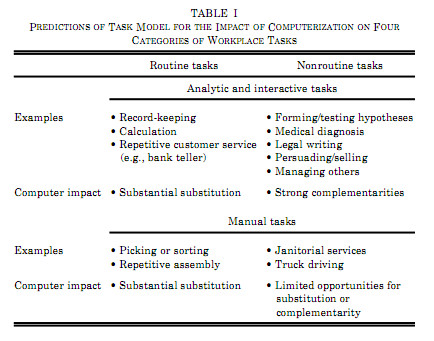
The second also comes from Paul Krugman, and I particularly like it for this table:
"This is real, and it calls some of our favorite platitudes into question," Krugman says.

Brad DeLong, on the other hand, has an excellent post in which economics and history triumph over cynicism (and yes, it's a lot like intellect and romance over brute force and cynicism):
We have already gone through the great transformation by which the general business of life--growing and processing our food, building our shelter, weaving our clothes, and telling ourselves stories for information and entertainment--has been extroardinarily [sic], comprehensively automated. And yet we have found things to do.
 Either way, I'd say this is the best argument yet for the long term viability of a career in the humanities!

Free Trade

Does free trade always benefit everyone, or are there winners and losers? Is protectionism really such a bad thing? Here are a few links on free trade.

In response to a NYT column by Harvard Economics Professor Greg Mankiw, some thoughts by KPC's Angus, and a follow up by Mungowitz. Tyler Cowen linked to the original post, and thus some of the discussion takes place in the comments here.

Mark Thoma worries about trade creating inequality, even if it does make society wealthier on average.

Craig Newmark discusses teaching students about free trade.

On these, in particular, pretty much every link contains additional links well worth looking into. Does that make these meta-links?

Speculative Fiction?

WANTED: Interdisciplinary Starship Pilot
Robin Hanson wonders about what kids are learning. In particular, are students focusing too much on their own disciplines, consequently losing the ability to think in an interdisciplinary fashion? Are students losing their ability to deal with deeper, meta- questions?  And, as Hanson brings up, if they are is this necessarily a bad thing?
I’d like to believe that we are in fact doing our students and the nation a disservice by marginalizing such skills. Unfortunately, I simply have little evidence with which to support such a judgment. [...] Just how many people should be thinking about what problems are important and why?
Bryan Caplan wonders where new jobs are really going to come from (he originally mused on this topic back in July). This time he considers Scott Sumner's answers:
Here's what I think most people still want:
1.  A bigger and nicer house, with granite counter-tops.
2.  More restaurant meals.
3.  More fun vacations.
That means we need more construction workers, and granite miners (quarriers?)  We need more cooks and waiters.  We need more hotel receptionists and maids.  More people to work on Carnival cruise ships.  I think our workforce is skilled enough to fill those jobs. 
I'd love to hear some reader thoughts and predictions on these topics. What will the jobs of the future be? And what sort of schooling will students need to do them? Should we be devoting more of our wealth to interdisciplinary schooling and liberal arts, and if so is the reason for business or pleasure?

This Could Have Been Three Posts...

... if I had time to provide decent comments on each item, that is.  Instead of delving into my thoughts about the following links, though, I'll just put them up Marginal Revolution style.

Psychohistory, the sci-fi version of what I do for a living. For those with some knowledge of the history of macroeconomics, you'll notice that as early as 1942, Asimov saw the importance of the Lucas Critique, something economists didn't latch on to until 1976.
while one cannot foresee the actions of a particular individual, the laws of statistics as applied to large groups of people could predict the general flow of future events. [...] The character responsible for the science's creation, Hari Seldon, established two axioms:
  • that the population whose behaviour was modeled should be sufficiently large
  • that the population should remain in ignorance of the results of the application of psychohistorical analyses
That last bullet point is the one macroeconomists took nearly 35 years to figure out.

A mind-boggling "How to Deceive with Statistics" entry. The nature of averages suggests that your friends are cooler than you. The money quote:
Let’s imagine a small department offering three courses for the semester. One is a survey course with 80 students, one an upper-level course with 15 students, and one a seminar with five students. Now what is the average class size? Clearly, it is (80 + 15 + 5)/3, or 33.3 students. This is the number the department is likely to publicize.

But once again, let’s adopt the perspective of the average person and reexamine these numbers. Eighty of the 100 students find themselves in a class with 80 students, 15 find themselves in a class of 15 students, and five in a class of five students. Thus, the average student’s class size is (80 × 80 + 15 × 15 + 5 × 5)/­100, or 66.5 students. This number is less likely to be publicized by the department.
Did that just blow your mind? It did mine.

Theories of International Relations and Zombies. How is this *not* something I need to read?  A nice discussion by the author is available here. Max Fisher at the Atlantic Wire, capturing a lot of why I find zombies so fascinating, has this to say:
[...]the beauty of zombie theory is that it applies too [sic] all sorts of emerging trans-national security threats, including those we have yet to anticipate or imagine.
Yes. Zombies are really just a proxy for disasters and crises of a scale and nature we can't quite foresee.  Namely, the zombie apocalypse.  If someone wants to buy this book for me, I will put a detailed review up on this blog with a shout out / link to the website of your choice.

What Zombies Are For

 People think that zombie stories are about humans doing what it takes to survive. They’re not. Zombie stories are, it turns out, about humans doing what they mistakenly think they need to do to survive. As it turns out, they’re wrong.
This is the gist of a post at OverThinkingIt.com, one of my favorite group blogs, on what really drives zombie fiction.
Every zombie war is a war of attrition. It’s always a numbers game. And it’s more repetitive than complex. In other words, zombie killing is philosophically similar to reading and deleting 400 work e-mails on a Monday morning or filling out paperwork that only generates more paperwork, or following Twitter gossip out of obligation, or performing tedious tasks in which the only true risk is being consumed by the avalanche.
That's Chuck Klosterman at the New York Times offering his take on the attractiveness of the zombie apocalypse.

I think both these articles make good points, but I would add a dimension they don't quite address.  I think one aspect that really captures people's interest is the deep seated paranoia of it all. Zombies are just ordinary folk who turned on you, and anyone can, at any time, cease being your best friend and come after your flesh. On top of that, we have to consider that in any good zombie story, the zombies are not the real enemy. Zombies are hardly ever evil, after all; they're more a force of nature, a disease or a storm to be endured. No, to have true evil in a zombie apocalypse you have to have other people:
Beware of your fellow survivors. Sometimes, they may be the biggest threat to your survival. Other humans who want your supplies or who have lost their minds in the disaster could try to kill you. Never let everyone know about all of your supplies, and never let your guard down completely.
What do you do when you can't rely on your community?*  I think this is a fear a lot of people feel deeply, but don't quite know how to express. And like all unexpressed fears, it expands and fills us up unless we have an outlet for it, like zombie stories.  For me, I see the zombie apocalypse as the Great Disaster: our civilization cannot possibly survive it; at best the human race might survive to build a new one.  If we do survive, we have a chance to repeat the same mistakes or learn from them and try to create a utopia.  Most likely, we will try to create heaven in our own image and end up with a hellish dystopia for a troubles, but that's another strain of fiction for another time.

So how do we deal with a disaster from which there is no bouncing back? If we really think those around us could betray us at any time, can we ever come together to build something with the resources we have left? How bad do things have to get before our greed and fear and need to come out on top keeps everyone on the bottom?

Oddly enough, those are some of the main questions of my research as a development economist.  Maybe we should take zombies a bit more seriously after all!
*Add to this OTI's observation that our defensive paranoia is always wrong--we need community to survive, we need to let someone else save us--and you're dangerously close to every Apocalypse bearing a gospel message. One with shotguns.

Are Recessions Possible?

The obvious answer seems to be 'yes.' The more difficult question is 'how?' WARNING: what follows is a more technical musing than I usually post here. I'll try to keep it as close to the principles level of accessibility as possible, but I won't be offended if those of you who are less economically interested skip this one.

The problem is that, at the macroeconomic level, there is an accounting identity that says INCOME=EXPENDITURE.  All of the income in an economy in a given period has to be spent on something.  All your income, after all, is just somebody else's spending, and all your spending is somebody else's income.  Every seller in one market is a buyer in another, and every buyer in one market is a seller in another (and yes, this even holds when some people live off other people's money, although it gets more complicated to sort out how).

This leads to something called Say's law, which basically says that if there are more sellers than buyers in one market (such as in the labor market when we have unemployment), there has to be some other market where there are more buyers than sellers, a shortage.  It's the only way for the accounting identity to be true, and it's true by definition.

So how can we have a recession, where it seems there are more sellers than buyers everywhere?  I've been thinking about this recently because of some recent discussion at EconLog (here, here, and here, for examples) about that very question. Scott Sumner and Nick Rowe argue that the excess demand has to be for money.  People want to hang on to (not to spend, but to have in their pockets) more of the good we use in exchange than they can get their hands on.  Brad DeLong and Paul Krugman, on the other hand, think there is excess demand for "safe assets," essentially places investors can store their value without any real risk that they'll walk away with less than when they started. Money is OK at this, but not great; a better option is typically government bonds, particularly when our faith in the quality of supposedly safe private firms is shaken.

Arnold Kling of EconLog, on the other hand, thinks we are in the middle of what he calls a recalculation, in which people find themselves working on things no longer in demand (more sellers than buyers) and don't yet know where the demand has gone. To my understanding, his story is basically that the recession, as we usually talk about it, is a myth. We don't have more sellers than buyers everywhere; it's just easy to see where we have more sellers than buyers, but it takes more time to figure out which markets have more buyers than sellers.

Well, the thing about markets is that when there's a shortage, it's a chance for some business to raise its prices and still sell more, thus making a ton of money. Sellers who want to make money (and don't they all?) in order to consume things they like (and don't we all?) will leave the market where there are too many sellers and enter the market where there aren't enough. Shortages and surpluses should always be rather brief.  Sumner and Rowe have an answer for this: the money market isn't normal, there's a single supplier of money, the Fed (and there are good reasons to have a single supplier as I've discussed in this series). DeLong and Krugman have a similar defense: the best safe assets are supplied by the government, and are thus influenced more by political pressure than market pressure.

What I haven't seen from the Recalculation Story (or, to use Kling's latest phrase, Patterns of Sustainable Specialization and Trade) is an explanation for why market adjustments are so slow. He has talked before about why economic busts happen much more quickly than booms, but that's not really what I'm after. What I want to know is why is the information that we have excess supply in many, many markets so easily obtained by everyone (this is what creates the unemployment in his story, after all), but information about where supply isn't keeping up with demand is so very hard for entrepreneurs to obtain. 

Is it that entrepreneurs have to borrow money to chase demand quickly, but it's hard to borrow during recessions? Is it that information transmits most quickly out of markets with many established firms (and if so, why)? Is it government intervention, particularly temporary attempts to undo the shift in demand?  I just really don't get what in Kling's view is holding entrepreneurs back, and make no mistake, if we don't have something holding entrepreneurs back, then recessions are just not possible.
Bad #6!  Let that entrepreneur go!

Truth Claim of the Day

People who favor monetary and fiscal expansion worry about a 1930's scenario. People who favor restraint worry about a 1970's scenario.
Please, discuss. The context is here.

(Yes, I know this is a cheap excuse for a blog post. I'll try to do better for Thursday.)

The Labor Market

I've been putting a lot of work into it, and thus have been unable to post for a while. This could continue for another week or two.  I apologize for the inconvenience, as I know you are all desperate to hear my ponderings on all matters. The truth is all the topics I planned to comment on before my recent job market blitz are now so stale that I will probably have to find new ones.

In the meantime, though, I thought some of you might find this piece at VoxEU interesting. It offers a plausible explanation and some additional evidence that increased immigration (legal or otherwise) does not hurt wages in the host country. On the contrary, if anything they seem to increase wages for native workers:
Several studies find that immigrants do not harm the wages and job prospects of native workers. This column seeks to explain these somewhat counterintuitive findings by emphasizing the scope for complementarities between foreign-born and native workers. Examining 14 European countries from 1996 to 2007, it finds that immigrants often supply manual skills, leaving native workers to take up jobs that require more complex skills – even boosting demand for them. Immigrants replace “tasks”, not workers.
Non-economists may find the material a bit dry, but I did want to offer their explanation:
In a recent working paper (D’Amuri and Peri 2010), we provide a potential explanation for this phenomenon, analysing European labour markets and immigration over the period 1996-2007. Our paper follows a similar analysis one of us did for the US (Peri and Sparber 2009). Rather than considering the labour market as made up of homogeneous and identical workers with potentially different skill levels, we consider that production is divided into a series of tasks that can be organised in a continuum spanning from simple-routine and prevalently manual tasks to complex-interactive and prevalently cognitive tasks.
Companies have to perform a range of these tasks in order to produce goods or services; hence the increased supply of some of them may increase the demand for others. For instance, for a construction company the supply of more construction workers performing manual tasks (such as installing dry-walls and raising foundations) generates the need for more construction supervisors, technicians, engineers, clerks, and sale representatives (as the company grows) who typically perform more interactive and complex tasks. As these tasks are all needed to produce final goods (they are “complementary” with each other), if immigrants and native workers specialise in different segments of the task-specialisation spectrum, then more immigrants can generate higher demand for natives.
This work is hardly the final word on the matter, but the simple fact that differences between workers matter means simple supply-demand logic isn't good enough to sort out the effect of more immigrant workers on native workers. The empirical evidence in the literature is pretty strong, so the burden of proof is really on those who want to say immigration hurts natives, rather than the other way around.

Truth Claim of the Day

Japanese politics is less competitive and Japanese rent-seeking is less competitive than in the United States.  Sustained near-zero growth in the United States would mean that interest groups tear apart the social fabric and grab too lustily at the social surplus.  Whether we like it or not, we are "built to grow" and we use the fruits of that growth to buy off interest groups as we go along.  Japan in contrast has greater capacity to stifle these grabs for new redistributions because their politics is more of an insider's game.
In other words, American society is arranged such that we must "grow or die"; other countries might not be. Please, discuss. The context can be found here.

Hail Democracy?

Authoritarian regimes [...] cannot aspire to continued economic innovation or to global economic leadership.
That's the take home message from an article by Harvard economist Dani Rodrik. If that were all he said, I'd say he was playing fast and loose with the facts, since all of the top growing countries over the last fifty years or so have had very little democratic influence in their governments:
Of course, Rodrik knows this better than I do. So, being a good economist, he hedges his claims:
When we look at systematic historical evidence, instead of individual cases, we find that authoritarianism buys little in terms of economic growth. For every authoritarian country that has managed to grow rapidly, there are several that have floundered. For every Lee Kuan Yew of Singapore, there are many like Mobutu Sese Seko of the Congo. [emphasis added]
As a friend working in the sciences once said, "data is not the plural form of anecdote." If what we're interested in is whether or not having a dictator or one-party government helps the country grow, we need to look at all countries, not just the top performers. That data looks something like this:
Low levels of democracy do give us the highest growth rates, but they also give us the lowest. If I were to plot a line on that graph, it would be sloping up, showing that on average, more democracy leads to more growth.

Now, we know that correlation isn't causation, so let's not get too carried away with this relationship. In fact, there's a lot of work suggesting that when you try to get at the real, causal relationship, more or less democracy doesn't seem to make much of a difference for how well a country grows. And further, we have some good reasons to believe dictators should generally hurt economic growth, so the fact that there are any really high growth authoritarian systems means something strange is going on.  So when looking for the economic superpowers of the future, I don't think we should be too quick to, as Rodrik says, "turn instead to countries like Brazil, India, and South Africa, which have already accomplished their democratic transitions and are unlikely to regress."

But Rodrik is right to consider the simple "democracy is related to better growth" position the correct default. As William Easterly (the source of the nice table and graph) notes, we can't just say the graph shows we need to have good dictators (who will lead to better growth) and fewer bad ones (who will lead to stagnation). If we label countries with the best growth "good dictatorships" and those with the worst "bad dictatorships" we're just begging the question. Unless we know in advance what made the top growers grow and what made the bottom ones fail, we can't very well pick out which dictators now will help their people and which will hurt.  On average, they're gonna do more harm than good.

Don't Be Too Certain

There's a fascinating graphic from Catherine Rampell that's been making the rounds on the economics blogs:
SmallBizProblems.jpg
So what's the biggest problem facing business right now? Paul Krugman points out that it's insufficient demand, and
[...] the best thing government could do to help business would be to spend more, increasing demand. The fact that it's not going to happen doesn't change the fact that it's the simple truth.
Unsurprisingly, Brad DeLong agrees with Krugman, and adds that anyone who disagrees is clearly incompetent.

Tyler Cowen, however, doesn't see it as that clear-cut:
I didn't read this graph the same way. I saw poor sales as a "biggest problem" for fifteen percent (or so) of small businesses in periods of full or near-full employment. I also see "poor sales" as a "biggest problem" for about thirty percent of small businesses today. That change -- about fifteen percent of the total -- struck me as relatively small and indeed puzzlingly small, if indeed we are in a liquidity trap and weak AD is the overwhelmingly dominant problem. [...] I do think weak AD is an important problem to be addressed, I just don't think the absolute levels here imply "end of story."

Russ Roberts adds (like the good Austrian economist that he is) that if taxes plus regulation were a single category, it would take over the top spot from poor sales. Finally, the award for best additional information goes, as it often does, to James Hamilton:
The statement that businesses aren't hiring is simply false. According to the Bureau of Labor Statistics' Job Openings and Labor Turnover Survey, the U.S. private sector hired 3.9 million new workers every month, on average, over the first 7 months of 2010.

But if that's true, then why isn't total employment booming? The answer is that, according to the same JOLTS data, some 3.8 million workers quit or lost their jobs each month on average during Jan-July. [...] the fact that small changes in net employment figures mask a dynamic economy in which there are huge gross changes in employment status for individuals and firms is quite indisputable.
Firms are firing a lot of people, probably because of poor sales. Firms are also hiring a lot of people, just not enough to mask the firings.

So what's the take-away point of all this?

I have to go back to Chris's fascinating post on the rhetoric of the "third way." Although I hate to contend with someone who quotes Lewis, this sort of thing is precisely why we should be reluctant to pick one side to fight for: reality involves a lot more dimensions than partisans can allow themselves to consider. In particular, once we've identified the "most important problem" that needs fixing, we tend to act far more certain in our own conclusions than the evidence allows. We should this pitfall whenever we find it in ourselves.

I know I'll get some flak for this, but I would contend avoiding certainty (in this sense) even extends to spiritual matters, if only because we need to avoid placing our confidence in a favorite interpretation of Scripture rather than in Christ himself. Humility requires that we be willing to let go of a firmly held position and accept "middle things" if we learn we're wrong. If that's true even in matter's of God's Word, how much more true is it for empirical matters like economic and political arguments.

Holding a view like this basically insures I'll never get a job with the CEA or NEC, but then who wants to be Larry Summers, anyway?
This man is always right. Right?

Reich's Real Lesson

My friend Chris, never short of good questions and interesting articles, asked my opinion of Robert Reich's recent piece on the recession. I should perhaps start by admitting a certain presumption in critiquing the work of an academic much more accomplished than myself. He certainly knows more about the ins and outs of the American labor market than I do. But in the post, he ventures into the realm of macroeconomics and economic growth; here I think I still have the home-field advantage.

I'm hoping to make this into an educational opportunity. Like most educational opportunities, though, and especially those where the educator is unpaid, this is going to take some time. I'm going to try not to spend too much of my own time on this, which means I won't be economizing on words like I should. Sorry in advance. I'll try to compensate by including just enough snark to keep you awake; it's not wrong if it's for a good cause, right? My running commentary is below the jump break.


© Metadoxy
Revolution Elements by Blozard. Original WP theme by Jason Schuller | Distributed by Deluxe Templates