This post was prompted by
this review of Ron Paul's
End the Fed and a subsequent online discussion. By virtue of my economics background, a friend asked me to chime in on why Ron Paul's solution to various economic problems should be discarded as easily as his opponents suggest. Part 1, in which I discuss the origins and nature of modern money, is
here.
Now that we have an understanding of what central banks are about controlling, we need to see some history of the problems banking systems have faced and how they've tried to solve them. To facilitate this discussion, I'm again drawing from Walton and Rockoff's
History of the American Economy tenth edition.
Once colonial governments started issuing paper as a substitute for gold and silver (recall that Britain had extracted most of the gold from colonial circulation, making money transactions harder to manage), they found it hard to stop. This led to the market value, or the rate of exchange between colonial paper money and the metal money of Europe, differing substantially from the face value printed on the paper. This was no problem for either colonists or English merchants as long as transactions were based on the market value, ignoring face value. But colonial governments required all merchants in the colonies to accept the paper at face value; essentially, colonial legal tender laws cheated foreign merchants, because when they got back to England the paper would only exchange for the market value. Eventually the British government made it illegal for colonies to force private payments in paper at face value. The colonists were none too happy with these new rules, so (
SPOILERS) they had a revolution.
(Yes, I know the
Revolutionary War was precipitated by much, much more than not being allowed to cheat British merchants anymore. But that was a non-trivial part of it, despite its exclusion from the Bob Jones curriculum.)
 In hindsight, not the best curriculum I've ever used.
Of course, paper money that is not backed by a commodity has its own problems, which the colonies discovered while using this system during the Revolutionary War (and subsequently during the War of 1912 and the Civil War). Even when paper money is issued but is not backed by a more trusted form of money, it still has a market value in terms of all other goods: we economists call them
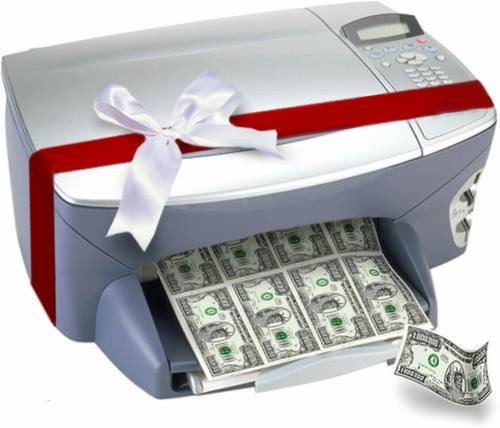
prices. When governments just print money to pay off debts, the market value of money falls, meaning prices of all goods have to go up; in other words, we have
inflation. Inflation can be a problem since it affects money's ability to function as a store of value, since the market value is falling. Because money functions as the unit of account, lenders that don't account for inflation lose out, since they are paid back with money based on its face value rather than its market value.
If inflation is low and relatively constant, contracts and loans can easily be written to compensate for these issues. However, If inflation is very high and variable, then people won't want to use money as a store of value or unit of account, making it less desirable in exchange. In other words, money ceases to be money since people don't believe it's money anymore.
 It's kinda like fairies in that way.
Similar problems occur when prices fall, too, which is called
deflation. Actually, deflation can be even more costly than inflation because deflation tends to steal value from borrowers rather than lenders. Since borrowers tend to be poorer already, surprise deflation very quickly leads to failed businesses, foreclosed farms and homes, and general economic decline. Although not always the case, deflation is associated with slowed economic growth or recession since in order to function effectively as a medium of exchange, the money in circulation needs to grow at roughly the same rate as the real economic activity it is designed to facilitate. And because high deflation causes losses on the side of the poor, it can leads to economic panic and bank runs easier even than high inflation.
But I digress. After the Revolutionary War, the inflationary problems with paper convinced the US government to use a metal standard. Actually, they used a sort of double standard: gold was used for high-denomination money, while silver was used for low-denomination money. The US Mint decided to assign a face value exchange rate between gold and silver at 15 to 1, the prevailing market value at the time. But market values change, and it didn't take long for silver to be "overvalued" relative to its market price in gold (or alternatively, gold was "undervalued"). The face value / market value problem led to gold be exported to Europe, sold for silver, and the silver re-imported. In practical terms, then, the US system became a silver-only standard as the overvalued metal drove out the undervalued (a principle economists call
Gresham's Law after a guy named
Gresham).
At this stage, the individual states tried to help smooth out wrinkles in the monetary system by chartering corporations known as commercial banks with the power to issues their own notes (redeemable, of course, for gold or silver). It turned out that banks had a tendency to over-issue the notes, just as the colonial governments had, and it was somewhat risky to accept notes printed by banks on the other side of the state (the banks couldn't operate across state lines). Because of this, these commercial bank notes would usually have to be converted to local currency at a risk-compensating discount, which varied depending on distance, how well established the bank was, and so on.
Alexander Hamilton's solution to the problem of having a reliable medium of exchange was the first Bank of the United States. This one bank would regulate the face value of paper money, it would produce money that was easily and credibly exchangeable across state lines, and its strong-handed influence and ability to lend to banks that are temporarily short on deposits (the
lender of last resort power) would help avoid major inflations, deflations, and bank panics. That, and by buying Treasury bonds when the government needed temporary funds (like in wartime) Hamilton hoped the Bank could prevent the government from just printing money.
The main objections to the bank were that (1) it wasn't in the constitution, (2) it threatened personal liberty, and (probably most importantly) (3) it benefited the North but not the agricultural South (and later the West). These objections didn't prevent George Washington, corporate stooge, from signing the first Bank's 20 year charter in 1791. The bank worked pretty much as Hamilton had envisioned, and the US economy functioned pretty well until the opposition finally won out by refusing to renew the charter in 1811. Then along came the War of 1812, and the government had no Bank to borrow money from. So what did it do?
Yeah, pretty much.
Deciding (after the fact, of course) that Politicians + Printing Presses = Bad News, Congress granted a 20 year charter to the second Bank of the United States in 1816. The second Bank decided to regularly present state banks with their notes in exchange for metal, which effectively reigned-in the banks' desire to over-print notes. The second Bank also acted more systematically as lender of last resort preventing several banking panics from building up.
Unfortunately, Andrew Jackson hated the Bank. Possibly because
Jackson was a player-hater. He vetoed the Bank's charter renewal on the grounds that the Bank (A) was unconstitutional, and (B) was too influenced by foreigners and people from the north-east. The Bank, Jackson thought, helped the rich at the expense of the poor, as evidenced by the fact that interest rates were too high and inflation rates too low. Ironically, Wall Street helped Jackson oppose the Bank, because the Bank had been raining on Wall Street's parade. Inflation did rise near the end of the second Bank's charter (brought on by gold and silver inflow from Mexico, mostly), though. This, combined with new federal laws requiring payments for government lands be in gold, led to runs on the gold and silver reserves of the state banks. In the absence of a lender of last resort, this led to the
depression of 1837, which lasted at least two years, and by some accounts until 1843.
The government maintained the bimetal standard until the Civil War, when both north and south quickly abandoned it in favor of unbacked paper to pay war debts. After the war, the government decided to return to a metal standard, this time just using gold. A few states experimented in free banking, meaning anyone who met some simple standards could start a bank; it worked well as long as the gold requirements for starting a bank fell into a narrow band, but worked more disastrously if the state required too much or too little of new banks. The gold standard led to a steady deflation from 1865 to 1896, but only a few years in the mid-1870s and early 1890s were recession years.
Of course, that didn't stop the poor, especially in the South and West, from favoring increased inflation through coining silver, which became a major issue in the Presidential election of 1896, between William "I like northern factories and my front porch" McKinley and William Jennings "You shall not crucify mankind upon a cross of gold" Bryan. You can read all about it in a little book called the
Wonderful Wizard of Oz.
Front porch won.
At this point, you can begin to see some of the ups and down the monetary system in the US has taken. I apologize for the length of this post, but I think it's important to get the broad sweep of how money and banking worked pre-Federal Reserve. Next week we'll consider some of Ron Paul's claims as mentioned in the review, thinking about the claims in terms of our understanding of the nature of money and the history of the US monetary system.




 Posts
Posts