Showing posts with label story. Show all posts

Breakup Songs

Because a few recent songs focusing on the end of a relationship are just quality products. The music videos are below the fold/jump/whateveritscalled. (warning: language. For real. In the second song, mostly, but the song's just no good without them.)

Our New Computer Overlords

Three links on how computers will replace our white-collar labor force long before robots steal our blue-collar jobs.

The first comes from Paul Krugman:
Anyway, I decided to write the piece around a conceit: that information technology would end up reducing, not increasing, the demand for highly educated workers, because a lot of what highly educated workers do could actually be replaced by sophisticated information processing — indeed, replaced more easily than a lot of manual labor.
[...] In my mind this raises several questions. One is whether emphasizing education — even aside from the fact that the big rise in inequality has taken place among the highly educated — is, in effect, fighting the last war. Another is how we have a decent society if and when even highly educated workers can’t command a middle-class income.
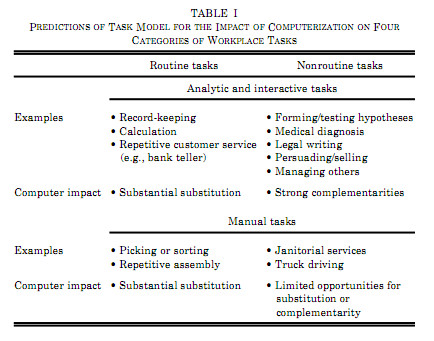
The second also comes from Paul Krugman, and I particularly like it for this table:
"This is real, and it calls some of our favorite platitudes into question," Krugman says.

Brad DeLong, on the other hand, has an excellent post in which economics and history triumph over cynicism (and yes, it's a lot like intellect and romance over brute force and cynicism):
We have already gone through the great transformation by which the general business of life--growing and processing our food, building our shelter, weaving our clothes, and telling ourselves stories for information and entertainment--has been extroardinarily [sic], comprehensively automated. And yet we have found things to do.
 Either way, I'd say this is the best argument yet for the long term viability of a career in the humanities!

Japanese Earthquake-Tsunami Links

One week after the fact, I don't have a lot to say about the disaster, other than it is terrible. Please be praying for the people in Sendai and areas even closer to the epicenter.

I do, however, have some summary information I have been following.

Here is an amazing visual before and after comparison.

Ilan Noy provides a way to think about the economic impact of a disaster.

James Hamilton expands on this discussion of the economic impact, including some links of his own.

Will Wilkinson offers his summary of the economic disaster literature.

Christopher Beam on the lack of looting.

Bill McBride has several links on the nuclear concerns.

Robin  Hanson argues for a counter-intuitive response to the nuclear dangers.

Laura Freschi wants you to think carefully about your aid donations.

Finally, here's a brief video showing some of the impact of the Tsunami:

Obituary

For those who don't know, my grandmother passed away last Tuesday evening of pancreatic cancer.  The funeral was this past Thursday.  I had the chance to say goodbye over the phone about half an hour before she died. She was surrounded by family members, and true to form, she waited until everyone was with her and safe to pass on; five minutes after the last person arrived she took her last breath. For those interested, here is the obituary.

Martha Patricia Hutcheson was born on October 16, 1919 in Dormont, PA to parents James Parks Hutcheson and Lucy Leota (Denning) Hutcheson. Martha attended schools and was a graduate of Bethel High School in 1937 in Bethel, Pa. She then enrolled in business school and worked in her father's office for five years. As she worked along side her father over these years, she saved up enough money to pursue her passion for flying, and became a true pioneer in women's aviation. In 1943 Martha helped to train pilots for the Army Air Corps for World War II. Following the war, Martha continued to instruct pilots who were training under the G.I.Bill. One of these pupils was Aaron Wise, whom she married in January of 1947. To this union, four children were born. Martha was the quintessential home maker, making each and every holiday, birthday, and occasion into a very special event for all the family to enjoy and remember. The family recalls her Thanksgiving dinners, the stockings at Christmas, and the joy her grandchildren brought her. Also, the many dresses, costumes, and last minute sewing projects that she so skillfully made. Martha enjoyed a strong faith and loved hosting a ladies bible study. After 52 years of marriage, her loving husband Aaron passed away in 1999. Martha is survived by her children, [...] Nine grandchildren, Three Great Grandchildren, and a sister [...].

What Zombies Are For

 People think that zombie stories are about humans doing what it takes to survive. They’re not. Zombie stories are, it turns out, about humans doing what they mistakenly think they need to do to survive. As it turns out, they’re wrong.
This is the gist of a post at OverThinkingIt.com, one of my favorite group blogs, on what really drives zombie fiction.
Every zombie war is a war of attrition. It’s always a numbers game. And it’s more repetitive than complex. In other words, zombie killing is philosophically similar to reading and deleting 400 work e-mails on a Monday morning or filling out paperwork that only generates more paperwork, or following Twitter gossip out of obligation, or performing tedious tasks in which the only true risk is being consumed by the avalanche.
That's Chuck Klosterman at the New York Times offering his take on the attractiveness of the zombie apocalypse.

I think both these articles make good points, but I would add a dimension they don't quite address.  I think one aspect that really captures people's interest is the deep seated paranoia of it all. Zombies are just ordinary folk who turned on you, and anyone can, at any time, cease being your best friend and come after your flesh. On top of that, we have to consider that in any good zombie story, the zombies are not the real enemy. Zombies are hardly ever evil, after all; they're more a force of nature, a disease or a storm to be endured. No, to have true evil in a zombie apocalypse you have to have other people:
Beware of your fellow survivors. Sometimes, they may be the biggest threat to your survival. Other humans who want your supplies or who have lost their minds in the disaster could try to kill you. Never let everyone know about all of your supplies, and never let your guard down completely.
What do you do when you can't rely on your community?*  I think this is a fear a lot of people feel deeply, but don't quite know how to express. And like all unexpressed fears, it expands and fills us up unless we have an outlet for it, like zombie stories.  For me, I see the zombie apocalypse as the Great Disaster: our civilization cannot possibly survive it; at best the human race might survive to build a new one.  If we do survive, we have a chance to repeat the same mistakes or learn from them and try to create a utopia.  Most likely, we will try to create heaven in our own image and end up with a hellish dystopia for a troubles, but that's another strain of fiction for another time.

So how do we deal with a disaster from which there is no bouncing back? If we really think those around us could betray us at any time, can we ever come together to build something with the resources we have left? How bad do things have to get before our greed and fear and need to come out on top keeps everyone on the bottom?

Oddly enough, those are some of the main questions of my research as a development economist.  Maybe we should take zombies a bit more seriously after all!
*Add to this OTI's observation that our defensive paranoia is always wrong--we need community to survive, we need to let someone else save us--and you're dangerously close to every Apocalypse bearing a gospel message. One with shotguns.

Are Recessions Possible?

The obvious answer seems to be 'yes.' The more difficult question is 'how?' WARNING: what follows is a more technical musing than I usually post here. I'll try to keep it as close to the principles level of accessibility as possible, but I won't be offended if those of you who are less economically interested skip this one.

The problem is that, at the macroeconomic level, there is an accounting identity that says INCOME=EXPENDITURE.  All of the income in an economy in a given period has to be spent on something.  All your income, after all, is just somebody else's spending, and all your spending is somebody else's income.  Every seller in one market is a buyer in another, and every buyer in one market is a seller in another (and yes, this even holds when some people live off other people's money, although it gets more complicated to sort out how).

This leads to something called Say's law, which basically says that if there are more sellers than buyers in one market (such as in the labor market when we have unemployment), there has to be some other market where there are more buyers than sellers, a shortage.  It's the only way for the accounting identity to be true, and it's true by definition.

So how can we have a recession, where it seems there are more sellers than buyers everywhere?  I've been thinking about this recently because of some recent discussion at EconLog (here, here, and here, for examples) about that very question. Scott Sumner and Nick Rowe argue that the excess demand has to be for money.  People want to hang on to (not to spend, but to have in their pockets) more of the good we use in exchange than they can get their hands on.  Brad DeLong and Paul Krugman, on the other hand, think there is excess demand for "safe assets," essentially places investors can store their value without any real risk that they'll walk away with less than when they started. Money is OK at this, but not great; a better option is typically government bonds, particularly when our faith in the quality of supposedly safe private firms is shaken.

Arnold Kling of EconLog, on the other hand, thinks we are in the middle of what he calls a recalculation, in which people find themselves working on things no longer in demand (more sellers than buyers) and don't yet know where the demand has gone. To my understanding, his story is basically that the recession, as we usually talk about it, is a myth. We don't have more sellers than buyers everywhere; it's just easy to see where we have more sellers than buyers, but it takes more time to figure out which markets have more buyers than sellers.

Well, the thing about markets is that when there's a shortage, it's a chance for some business to raise its prices and still sell more, thus making a ton of money. Sellers who want to make money (and don't they all?) in order to consume things they like (and don't we all?) will leave the market where there are too many sellers and enter the market where there aren't enough. Shortages and surpluses should always be rather brief.  Sumner and Rowe have an answer for this: the money market isn't normal, there's a single supplier of money, the Fed (and there are good reasons to have a single supplier as I've discussed in this series). DeLong and Krugman have a similar defense: the best safe assets are supplied by the government, and are thus influenced more by political pressure than market pressure.

What I haven't seen from the Recalculation Story (or, to use Kling's latest phrase, Patterns of Sustainable Specialization and Trade) is an explanation for why market adjustments are so slow. He has talked before about why economic busts happen much more quickly than booms, but that's not really what I'm after. What I want to know is why is the information that we have excess supply in many, many markets so easily obtained by everyone (this is what creates the unemployment in his story, after all), but information about where supply isn't keeping up with demand is so very hard for entrepreneurs to obtain. 

Is it that entrepreneurs have to borrow money to chase demand quickly, but it's hard to borrow during recessions? Is it that information transmits most quickly out of markets with many established firms (and if so, why)? Is it government intervention, particularly temporary attempts to undo the shift in demand?  I just really don't get what in Kling's view is holding entrepreneurs back, and make no mistake, if we don't have something holding entrepreneurs back, then recessions are just not possible.
Bad #6!  Let that entrepreneur go!

The Nature of Conflict

Economist Robin Hanson has an interesting way of framing how we look at conflict between groups:
 Our fight, of [A] against [B] over [C], is but one battle in the ancient war over [F], along the great divide between [D] and [E]. Many do not realize how many of our apparently mundane conflicts are, in reality, battles in this ancient war. Today is a crucial day in this war, so we must not give up, and we must not lose hope, or someday [D] may lose [F] forever. Fight, fight!
(there are further comments at EconLog, if you're interested)  Hanson notes several group membership divides that can be used for [D] and [E], including "tyrants vs. freedom-lovers, rich vs. poor, faithful vs. heathen, urban vs. rural folk, men vs. women,[...]" and many others. Although it's never spoken of in these terms, I would say a lot of unnecessary conflict occurs along the Mechanics vs. Mystics divide, although most of the time we either like to frame it differently (Hanson's "intellectuals vs. ignoramuses" is a favorite of mechanics, while his "artists vs. undiscerning" seems preferred by mystics). This is an aspect Hanson doesn't explore, although I'm sure he would find it interesting: we often talk about the divide between [D] and [E], not because it is the real dividing line we care about, but because it sounds more important than the divide between [M] and [N].  When we notice and accept that a conflict is along mechanic vs. mystic lines, it becomes a lot easier to communicate and a lot harder to cling to being the "winner" of the conflict.

Aside from that admittedly minor contribution, I find it slightly terrifying to admit this is how many, many Christians I know think about their relationships with the non-Christian world. There is a divide between [D] Christendom and [E] Everybody else (Babylon?), and the war is over [F] civil society / American culture / our Christian nation / etc. Now, I'm not denying that this divide exists, nor that it is important. But I vehemently deny any version of the Christian worldview that says " Today is a crucial day in this war, so we must not give up, and we must not lose hope, or someday Christendom may lose civil society / American culture / our Christian nation / etc forever." If we believe Christianity, then we believe that Christ is God, and that no enemy can even vaguely approximate Him. He cannot lose anything He prefers to win!  Fear of losing something, anything, to the secular world simply doesn't compute with Christianity, and thus Hanson's 'ancient war' framing cannot rightly reflect a Christian view of the 'great divide.'

Again, this doesn't mean I think Christians shouldn't stand up for what they believe is right in public forums. Far from it. But we need to remember that we're not fighting a battle against an entrenched foe who may yet win the day if our courage fails.  We are spreading the world---with the gentle bedside manner of an oncologist (or the compassionate friend of an addict)---that sunrise is almost here, and will soon be here whether we want to keep our drunken nighttime revelry going or not. The change of seasons is not a war we need to win; it is a part of the nature of the world that we do well to keep in mind. And so it is with the victory of Christ.

The Man of Steel: A Fanboy Wishlist

In case you didn't know this about me, I like comic books. Not all comic books, of course, but I do like superheroes and the interesting questions they allow me to explore. I like the greats from the 1980s, work by Frank Miller and Alan Moore. I really liked Batman Begins, and I really liked The Dark Knight.  Superman Returns, not so much. (yes, I'm more of a DC guy)

So I've been thinking recently about what kind of Superman movie I'd like to see now that Christopher Nolan is supervising the project (although he won't be directing). I wrote a partial script for a Superman movie while I was taking a sci-fi film class as an undergrad. Yes, it was my final project; yes, I got an A; and yes, I know how cool it is too game the system by getting upper-division honors credit to watch and write about Blade Runner. The script focused on the alienness and humanity of Superman in the context of a Nazi death camp; if I had to sum it up in a sentence, I'd say "the last son of Krypton finds his humanity fighting for what's right, as a brilliant German scientist (reminiscent of Mengele) loses his humanity fighting for what he thinks is right."

But that's not the movie we're going to get, and no doubt all the better for the box office hopes of The Man of Steel. No, Superman generally needs to live in a modern context for the big screen. So given that restriction, I thought I'd waste my time and yours (not much of it, don't worry) talking about what I'd like to see in the upcoming movie, even it's never going to happen.

First let me say what I don't want to see:


I was a huge fan of the first year of Smallville, although it lost a lot of its appeal for me after that. I like Tom Welling as a young Clark Kent, and I've got nothing against Erica Durance as Lois. But no. Please, please no.

Now that we've got that out of the way, I think I can best communicate what I'd be looking for with some cast and crew ideas before presenting the premise of the movies (yes, as per the modern standard, there must be three in the series). Due to length, I'll put it below the jump.

Losing LOST

Word is that tonight is the series finale of LOST. Now, I haven't been watching since season four, but I loved the first couple seasons so much that this still seems like a sad time. Therefore, in honor of the show, I have a few videos reminding all of us why the show was so great. Hit the jump for a tribute.

The Mighty Warrior

As I was reading this post at OverthinkingIt.com, it occurred to me that I was woefully unaware of the classic samurai pictures of Akira Kurosawa. I'd seen Seven Samurai once before, and knew it well enough to recognize that Perich was on to something magical by rewriting Star Wars Episode I, but that was it. I had always wanted to see Rashomon since it was one of the first movies to tell the same story from many different perspectives (a devise I rather enjoy), so I decided to see if the Netflix Watch Instantly menu included any of these movies.

I was pleased to discover they had not one or two, but five on hand. So while I still haven't seen Kurosawa's Shakespearean adaptations Throne of Blood or Ran, I can now say that I've seen a good share of the movies that inspired generations of American nerds to take Japanese in college.

One of the things I picked up on is how well made the movies are. Kurosawa had a knack for making his characters' personalities clear without making them one-dimensional or boring. He took time to reveal the identities of all seven samurai as they defend the villagers, and he built up the romantic B plot in a way that felt true. The use of swipes could have been choppy and annoying, but it never was (I hardly noticed it, actually).

I was also quite surprised at how good these actors are. Kurosawa uses four or five of the same actors in every one of his Samurai movies, it seems, but every time they come across as clear and distinct characters. I was particularly impressed by Tatsuya Nakadai, who played two different principle soldier enemies against Toshirô Mifune's character Sanjuro, and yet managed to keep the characters distinct; Unosuke is downright creepy in Yojimbo, while Muroto is scary but maintains a strange sense of dignity.

But what I really noticed was how Kurosawa portrays samurai. The samurai in Rashomon is not an admirable character, being upstaged by the common bandit Tajomaru (the samurai gets killed over and over in the retelling of the story, and I don't even remember his name). However, his pride and poise in adversity are starkly contrasted with many of the samurai in Seven Samurai. Heihachi joins the band because he is broke, Gorobei joins because he finds the leader (Kambei) an interesting character, and Kyuzo joins simply as an opportunity to hone his swordsmanship. Samurai seem to be a rag-tag lot in Kurosawa's mind.

The first truly noble samurai who demonstrates the power one would expect of the great heroes of Japanese legend is General Rokurota Makabe in The Hidden Fortress. Makabe is devoted to saving Princess Yuki, willing to give up his life or the lives of his loved ones to protect her. Although he manipulates the two peasants into helping them, Makabe is always honorable, even in how he treats the enemy General. Here, perhaps, is the ultimate picture of what a samurai should be... except Makabe begins the story as a failure. He has to rescue the princess precisely because he failed to defeat the invading army. And in the post-World War II age, perhaps that is how many Japanese saw the samurai and their culture: honorable, but defeated from the beginning.

Yet the most powerful expression of the samurai comes in the unnamed hero of Yojimbo and Sanjuro. Well, perhaps I shouldn't say unnamed. He gives his family name as Kuwabatake in the first film and Tsubaki in the second, in both cases simply picking the name of something he's looking at. In both he says his given name is Sanjuro, but this actually just means Thirty-something. He even says in the dialogue in both films "but I'm nearly forty." So he has a label for the sake of the movie, but it's quite clear that he's making it up.

Anyway, Sanjuro is a classic mercenary who follows a moral code. In the first movie, he destroys the gambling clans that are destroying the town purely  by accident. During the opening credits he is a wandering ronin, and he chooses which path to follow by throwing a stick in the air and seeing which way it points when it lands. He makes just enough money to stay fed, and everything else he does seems to be for sport. He fights for the good guys when he can identify them (as in Sanjuro), but has no trouble stirring up trouble when it suits him. As the Chamberlain's wife says, he is like a naked sword: he cuts well, but often cuts when he should have stayed sheathed. "Killing people is a bad habit," she says to him, and he seems to agree. It doesn't stop him from continuing, though, as it wouldn't stop most people.

Maybe that's Kurosawa's message about samurai after all. Samurai can make a fascinating subject because of the drama and spectacle, but in the end they're just human beings like the rest of us.

(As a special bonus, I'm putting a video of Sanjuro's bad-assery below the jump.)

Blogging Finals Week: Friday

Friday was holy-crap-I'm-so-busy day. This was our last day of dumpster diving the college student apartments, and it was raining. Not a drizzle, a proper rain like they had nearly every summer afternoon while I was in Oxford. We didn't manage to go everywhere we wanted, but we did manage to find a pair of flowery sorority-girl galoshes (why would you throw these away on the one day it was raining?), a third of a pack of CDRs, and some soggy hangers. Not that great a haul, but add to it the toaster oven, coffee table, baby booster chair (with tray!), and wooden bookshelf, and it was pretty good overall.

We made it home for lunch, and then went to the Graduate College reception at the new National Weather Center south of campus. I was happy to go, because I was one of two recipients for this year's Provost's Graduate Assistant Teaching Award. Aside from the fact that they gave me money for having done my job, I suspect I'll be very glad to have it on my CV when I apply for teaching positions next fall. They were really welcoming to my family, including a nursing 1 year old. I'm not a big fan of events that exist solely to congratulate people, but this one was pretty good (not to mention short).

After that, we came home for a bit before going to help a friend--and another friend--move out of their apartment. My wife is an organizer and go-getter from way back, so while I held the baby (who was teething and running a temperature all day), Jessie helped them organize, clean out, package up, and dispose of their remaining gear. We took some of their unwanted stuff home for the garage sale, including a bunch of napkins and a blender pitcher (without lid or blender). Which would have been fine, except when I was getting the baby out of the car when we got home I cut my finger on the blade of one of those items. And it wasn't the napkins.

Anyway, once the bleeding stopped and I was bandaged up, we settled in to the evening. I put the baby to sleep around 7:30 or so, then came out to help some other friends unload stuff for the garage sale (it's seriously gonna be big, folks). In a little less than an hour, I'm going to go hang for a bit with yet one more friend who just graduated with his PhD in Social Psychology. That is, if Lucy sleeps well (teething babies have hard lives).

Tomorrow I plan to finish my grading, make some progress on a paper I am trying to get published, and help more people fill my garage with their unwanted leavings (which will be totally rad and you should come next week and buy them all!!!).

So, all told, finals week still manages to be a very busy time.

Truth Claim of the Day

What the world’s religions share is not so much a finish line as a starting point. And where they begin is with this simple observation: Something is wrong with the world. [...] So religious folk agree that something has gone awry. They part company, however, when it comes to stating just what has gone wrong, and they diverge even more sharply when they move from diagnosing the human problem to prescribing how to solve it.
Please, discuss. The context can be found here. (thanks to Enchanted Postmodern for the suggestion)

1 Year Ago

1 year ago yesterday, I decided to make my very, very pregnant wife a nice dinner: Chicken Parmesan. Not just any chicken parmesan, though; this was a special recipe. One that involved a lot of red pepper flakes, cayenne, and a few other savory ingredients. The sauce was a spicier version of Scalini's legendary eggplant parmesan recipe, which is rumored to induce labor.

Sure enough, Jessie started having contractions that evening. They were weak, and far apart, so we decided we'd try to sleep that night and call the midwives in the morning. Around 2am, though, Jessie woke me to inform me that she just couldn't sleep, and they seemed close enough together that we should start timing them. By 3:30, we were at the midwifery cottage getting settled in, and were informed that Jessie was not far along and we should try to sleep. I managed about three or four hours, but Jessie was awakened every ten minutes or so by contractions.

What followed was a long, exhausting day. My primary duty was to be by Jessie's side, coaching her through her breathing, helping her do things like go to the bathroom, and getting anything for her she might need like chicken broth, blankets, wet wash cloths, etc. This essentially meant I needed to be alert and attentive at all times, so when the midwives asked if I wanted some coffee, I said yes.

Now, if you guys don't know this about me yet, I don't drink coffee. The closest I ever get is when there is so much sugar and chocolate in it that it can't really be called coffee anymore. I just don't do it. But on this day, 1 year ago, I drank coffee. Eight cups. Black.

I know there are people who say they don't feel the effects of coffee, but trust me, they're there. A minute or so after drinking some I could feel my alertness go up, my energy increase, my heart rate rise, and my breathing accelerate. It was a lot like being thrown into a really cold swimming pool. I basically tried to stay adrenaline charged the whole day, and every time I felt it starting to wear off, I got more. In hindsight, I probably shouldn't have been drinking that much liquid, as it meant I had to leave Jessie's side a bit more often than I should. But really, the only alternative would be for the midwives to slap me upside the head every time I got drowsy. I didn't want that.

Suffice it to say I didn't do much that day, so it all sort of blurs together. I'm sure my wife will have more and better details about some of it than I do. I remember her face as she dealt with her surges. When she handled them well, she remained serene throughout, although you could tell her body was working. Sometimes they got the better of her, and she looked like someone was scraping her back with a yard rake. I pretty much sat there, speaking in a soft, even voice, trying to help her relax and breathe since that's the best way to minimize the discomfort (thinking about discomfort makes you anxious, which makes you tense, which amazingly enough causes more pain when in labor).

Things pretty much went as they had been going for most of the day. At some point Jessie decided that a bath might be soothing, which surprised me since she normally hates bathes. Turns out that being in the water relieved a lot of pressure from her back, so that was good. I kept her in water and chicken broth as much as I could. At some point in the evening, Jessie felt a sudden change in her body and got up, bolted past me to the bathroom and threw up. I was quite concerned until she informed me that it was a pretty normal reaction when the woman "transitions" during birth. Huh.

Not long after, the midwives informed us that she was dilated enough to deliver (and was starting to get urges to push), but her water hadn't broken yet, so they said they could do it or we could wait a bit more. As I recall we decided to wait at first, but then decided to go ahead later on. We got a birthing stool, laid it on the kitchen floor, and the process began.

It all felt very sudden. Jessie was wearing a simple gown, and I was on the floor with her, holding her hand. Thunder began to rumble outside. I was repeating encouraging words and letting her squeeze my hand. And just for the record, my wife is waaaaaaay stronger than you might guess. She had to reposition several times, and was having trouble getting enough air. She was getting a bit afraid that she might burst a blood vessel or something like that. Our midwife was tremendous: calm, collected, and ready for anything. She was and is always even tempered, which we thought was annoying during our checkups; it had become comforting and important during delivery.

Then we heard that the baby was stuck on a pelvic ridge. Of course, deciding to do surgery was out of the question, so the midwife and her assistant had to hold my wife's legs in a position that would enable the midwife to help the baby along. Unfortunately for me, this involved the assistant essentially standing on my knee, which sorta hurt. Of course, I wasn't about to say anything about my own pain right then.

We need to deliver this baby right now, the midwife said with only slightly more urgency than she had been exhibiting. I didn't think much of it, as I was trying to concentrate on my wife. We had started delivery at ten o'clock at night. At 10:22 (I'm pretty sure of the number, anyway), amid a full fledged Oklahoma thunderstorm, I held little gray Lucy Marcia in my arms. I had to hold onto her for several minutes, because the midwives were quite busy even after that. Lucy was born (as many babies are) with the cord around her neck (twice), so as she was delivered the placenta detached from the uterine wall and Jessie was bleeding. The midwives had to deliver the placenta and stop the bleeding post-haste, which sounds scary, but the midwives proceeded like professionals and neither Jessie nor I felt nervous or unsafe at any point.

At this point, we were all exhausted from 18.5 hours of labor (and the coffee had run out). We stayed our first night at the birthing cottage, and left after a checkup in the morning. We loaded this little person into her own seat for the first time, looking exactly like this:


And today, this beautiful little baby, the vibrant, intelligent, puppy-and-baby-loving, ever-exploring, music fanatic whom I will smile and weep to walk down the aisle one day, looks more like this:


Happy birthday, Lucy.

Truth Claim of the Day

Witnesses saw Jesus. They told others. We have to believe other people...a long line, a very long line, of witnesses back to the truth. That's a big step of faith to trust a bunch of people going back that far. But reason itself can't really do much better. Faith is not reason, but reason is also not all its always made out to be.
Please, discuss. The context can be found here.

Truth Claim of the Day

New York Times Easter Sunday Believability Edition
In a way, the doubts that modern religious believers harbor about the resurrection of the dead may reflect, not the triumph of  rationalism over supernaturalism, but an odd symbiosis between the two.[...] People today may disbelieve in the resurrection of the dead, in other words, not because it’s too fantastic, but because it doesn’t seem fantastic enough.
Please, discuss. The context can be found here.

Love Constraining to Obedience, or just Social Pressure?

On Monday, I was on my way to campus when I saw something disconcerting. As I was waiting at a stoplight to turn left, the oncoming traffic was just starting to cross the intersection when a minivan going about 10 or 15 started crossing traffic. It just slowly rolled out into the intersection. Fortunately the cross traffic was aware enough to stop as this van just rolled on by. I got a look at the driver: an older man who looked like he was either so drunk I couldn't explain how he got himself into the car, or so tired I couldn't explain how he managed to avoid drifting into a ditch.

At this point I knew it couldn't end well, but he managed to get through the intersection without crashing, so I didn't worry about it. I was on my way to a lunch meeting, anyway, so why bother thinking about it?

After I had the chance to turn, I kept going for a bit over half a mile when I noticed the very minivan about a block and a half ahead of me. I figured he must be doing OK, but then I saw him start to drift. Slowly, drifting. To the left. Into oncoming traffic. About two seconds later, bam! He slammed into a northbound car in the northbound lane. He wasn't going fast at all, but the speed limit was 25 so the other car might have had a bit of speed. In any case, it didn't look like anyone was likely to be injured, but it was a car crash nonetheless.

My immediate response? I turned at the first available street to avoid the scene. I had somewhere to be. It didn't look like anyone would need my help. Sure, I was a witness, but there were probably plenty of others, right? And anyway, how ambiguous is a head on collision when one of the cars is in the wrong lane? I just didn't want to deal with it.

After about a block, I realized I couldn't just keep going as if nothing had happened. I had to at least see if my assistance or testimony might be of use. I looped around and found a place to park, then walked over to the scene. The cops were already there (they drive up and down that street quite a lot, really), and the driver of the other car was out of the car and seemed to be OK (the car itself was pretty banged up). At the direction of an officer I lined up with several other witnesses and waited. The driver of the minivan was out cold, it turned out, although whether that happened before the crash or not I have no idea.

As it turned out, the cops didn't need more than two witnesses, so they sent the rest of us on our way. I could have kept driving and nobody else would have been the worse for it. But something in my mind prevented me from doing so. I'm not exactly known for my strong sense of civic duty, nor for feeling burdened by social custom. And it's not like there's a Scriptural command to help assign blame in routine traffic incidents.

So why did I go back? I honestly don't know. But I'm not sorry I did.

Truth Claim of the Day

Nature is not as rational (or should we say "simple") as we might like it to be. Nor is monotheism... 
Please feel free to comment. The context is an interesting post at Enchanted Postmodern.

The Sonnschein Pipe

So, at this point you may have noticed the new header image. I enjoy estate pipes (my collection is currently sitting at 15 pipes), and this particular one, the latest addition, has a fascinating story behind it.

The pipe has metal fittings and a hinged cap, and is quite large. There's no stem, which I might remedy at some point, but I don't really mind. I don't plan to smoke this one.

You see, this pipe is around 200 years old. Inside the bowl there is a note that reads as follows:

'this Pipe was given to my grandfather (born 1811) William Sonnschein, and he said it was given him by his grandfather so that would make this pipe at least 150 years old (in 1910)
     Frank Eckert  --- grandson of William Sonnschein
Note initials on silver lid "A.S"'

I received this pipe as a gift from my wife's grandmother, who had received it from her grandfather, Frank Eckert. According to the note, he received it from his grandfather William Sonnschein, who received it from his own grandfather (presumably the "A.S." of the initials). So while I don't quite follow the math that dates the pipe to the 1760s, it's still been in the family since Jessie's great-great-great-great-great-great grandfather. Which is pretty great.

So I'd seen this at Jessie's grandmother's house before, and I was an instant fan. She's been downsizing her possessions, and I jokingly told her that if no one had spoken for the pipe I'd throw my name in. I felt kinda bad when she actually decided to give it to me, as I had sort of thought she would want to keep it as decoration until she dies (I know I would). But at this point I'm just grateful. It might be the oldest thing we own (I have a couple of ill-repaired 19th century Bibles, and one of them was published in 1811), and is definitely the piece I would take with me to the Antiques Roadshow. It's similar in shape to the Hungarian meerschaum-style metal pile found here (3rd down), although the lid is simpler on the Sonnschein pipe. It's simply classy, which is how we role at Metadoxy.

By the way, all photos, including the header, were taken by the magnificent and ever-professional Jessie. For more examples of her handiwork, check out here Etsy shop.

The Cabinet of Dr. Caligari

What makes a good story can be learned from a good sandwich. The bread is the plot: it holds everything else together, and without it there is no sandwich. It can range in quality from wonderbread to a nice focaccia from Panera or beyond. But if the bread is what's filling you up or giving the sandwich flavor, you're doing it wrong. Similarly with a good story, you need fascinating ideas to explore (the meat), characters you care about and identify with (cheese), good dialogue (dressing), and great artistry and atmosphere all around (the veggies).

The point of this allegory is that I recently decided to Netflix a number of movies I've been meaning to see for years, but never got around to. One of the first of these is The Cabinet of Dr. Caligari, a silent film from 1920. Dr. Caligari was one of the first horror movies and one of the first to employ a twist ending, mostly because it was one of the first movies ever made.

The story is pretty straightforward by  today's standards. The mysterious Dr. Caligari brings his sideshow attraction, the somnambulist Cesare, to an exhibition / fair in a small town. Our hero, Francis, and his friend Alan go to see the show, and Cesare predicts that Alan will not live to see the morning, a prediction which ultimately comes true. A murder mystery! (not that mysterious) The twist ending is somewhat telegraphed, but only because this movie was so influential that it's been reused about 5,000 times by now. Suffice it to say that in the German Expressionist world of deep shadows and crooked doorways, not everything is as it appears.


But the plot isn't what makes this movie work, and it's certainly not the characters, who are all fairly one-dimensional. What makes this movie so influential is (to use my allegory) the vegetables. It's precisely the crooked doorways, twisting paths, and general visual aesthetics (plus some pretty creepy music) that have made this one of the most influential movies of all time. For example, I had always wondered why Tim Burton's version of Batman's enemy The Penguin (from 1992's Batman Returns) looked so jacked up freaky. After the first appearance of the character Dr. Caligari, I instantly thought "he looks kinda like Tim Burton's Penguin... Ooooh!" Actually, a lot of Tim Burton's work is influenced by German Expressionism in general, and by Dr. Caligari in particular. Remember the movie Edward Scissorhands? While Edward's leather costume is reminiscent of something else, his overall look is very much like Cesare, who is also a sympathetic, childlike, and somewhat haplessly destructive character.


So I liked the movie. I'd recommend it to anyone who wants to see how a good story can be propelled with lots of atmosphere and a minimum of dialogue. I'm not a big fan of expressionism, but the ability of a movie like this to draw the viewer in (despite all the technical limitations) is impressive. The directors of our modern summer blockbusters would do well to take a few notes from director Robert Wiene's notebook.

Lovecraft and Lewis, Masters of Worldview

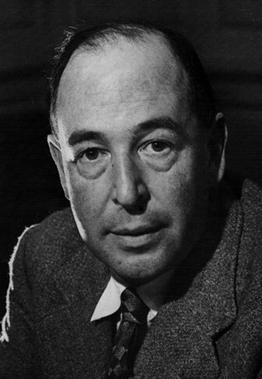
I've made no secret of my admiration for C. S. Lewis. I particularly like his non-fiction works dealing with the interaction of Christianity and the rest of life. I don't like him because I agree with his theology (he was Anglican, which I'm not, and believed in a few things like purgatory which I don't). I like him because Lewis, more than any other modern writer, understood that the Christian cannot believe the good news of Christ without it changing the way you interact with every aspect of reality. To illustrate how deeply (and sometimes subtly) this difference runs, consider the following (somewhat long) paragraph from God in the Docks:
I have every respect for those who wish women to be priestesses. I think they are sincere and pious and sensible people. Indeed, in a way they are too sensible. That is where my dissent from them resembles Bingley's dissent from his sister. I am tempted to say that the proposed arrangement would make us much more rational 'but not near so much like a Church'.
 [...] Christians think that God Himself has taught us how to speak of Him. To say that it does not matter is to say either that all the masculine imagery is not inspired, is merely human in origin, or else that, though inspired,it is quite arbitrary and unessential. And this is surely intolerable: or, if tolerable, it is an argument not in favour of Christian priestesses but against Christianity. It is also surely based on a shallow view of imagery. Without drawing upon religion, we know from our poetical experience that image and apprehension cleave closer together than commonsense is here prepared to admit; that a child who has been taught to pray to a Mother in Heaven would have a religious life radically different from that of a Christian child. And as image and apprehension are in an organic unity, so, for a Christian,are human body and human soul. [...]
[...] The point is that unless 'equal' means 'interchangeable,' equality makes nothing for the priesthood of women. And the kind of equality which implies that the equals are interchangeable (like counters or identical machines) is, among humans, a legal fiction. It may be a useful legal fiction. But in church we turn out backs on fictions. [...]
This is what common sense will call 'mystical.' Exactly. The Church claims to be the bearer of a revelation. If that claim is false then we want not to make priestesses but to abolish priests. If it is true, then we should expect to find in the Church an element which unbelievers will call irrational and which believers will call supra-rational. There ought to be something in it opaque to our reason though not contrary to it--as the facts of sex and sense on the natural level are opaque.
[...] With the Church, [...] we are dealing with male and female not merely as facts of nature but as the live and awful shadows of realities utterly beyond our control and largely beyond our direct knowledge. Or rather, we are not dealing with them but (as we shall soon learn if we meddle) they are dealing with us.
Aside from being able to apply the form of revelation to a practical decision of the Church, I like that the quote above shows that the necessity of mystics. It takes the clarity and comprehension of Lewis to explain it to someone like me.

I particularly enjoy Lewis' fiction -- the Narnia books, the Space trilogy, the Screwtape Letters, the Great Divorce, etc. --because his sharp understanding of the Christian worldview always comes through. Not that his protagonists always adhere to the Christian worldview, but the worlds in which they exist derive their essence from Lewis' character, just as Christianity says the real world derives its character from its Creator. Consider the following commentary on Heaven and Hell from The Great Divorce:
'Son,'he said,' ye cannot in your present state understand eternity...That is what mortals misunderstand. They say of some temporal suffering, "No future bliss can make up for it," not knowing that Heaven, once attained, will work backwards and turn even that agony into a glory. And of some sinful pleasure they say "Let me have but this and I'll take the consequences": little dreaming how damnation will spread back and back into their past and contaminate the pleasure of the sin. Both processes begin even before death. The good man's past begins to change so that his forgiven sins and remembered sorrows take on the quality of Heaven: the bad man's past already conforms to his badness and is filled only with dreariness. And that is why...the Blessed will say "We have never lived anywhere except in Heaven," : and the Lost, "We were always in Hell." And both will speak truly.'
Or consider this from The Lion, The Witch, and The Wardrobe:
"But where is the fourth?" asked Aslan.
"He has tried to betray them and joined the White Witch, O Aslan," said Mr. Beaver. And then something made Peter say:
"That was partly my fault, Aslan. I was angry with him and I think that helped him to go wrong."
And Aslan said nothing either to excuse Peter or to blame him but merely stood looking at him with his great golden eyes. And it seemed to all of them that there was nothing to be said.
"Please--Aslan," said Lucy, "can anything be done to save Edmund?"
"All shall be done," said Aslan, "But it may be harder than you think." And then he was silent again for some time. Up to that moment Lucy had been thinking how royal and strong and peaceful his face looked; now it suddenly came into her head that he looked sad as well.
Or perhaps the best example of the Christian worldview extended outside its usual bounds, the following excerpt from Perelandra, in which Ransom comes to the new and untarnished world:
As he let the empty gourd fall from his hand and was about to pluck a second one, it came into his head that he was now neither hungry nor thirsty. And yet to repeat a pleasure so intense and almost so spiritual seemed an obvious thing to do. His reason, or what we commonly take to be reason in our own world, was all in favour of tasting this miracle again; the childlike innocence of fruit, the labours he had undergone, the uncertainty of the future, all seemed to commend the action. yet something seemed opposed to this "reason." It is difficult to suppose that this opposition came from desire, for what desire would turn from so much deliciousness? But for whatever cause, it appeared to him better not to taste again. Perhaps the experience had been so complete that repetition would be a vulgarity--like asking to hear the same symphony twice in a day.
In every case, Lewis looked at every circumstance through the lens of Christianity. The reason, I believe, that so many of us turn to Lewis time and again for the expression of our heartfelt thoughts is precisely because Lewis' words are born out of meditation on the Kingdom of Christ and the transforming power of the Holy Spirit. Lewis puts words to what our still fallen but sanctified hearts yearn to mean.

In this sense, Lewis represents an internal consistency of thought and feeling that few authors ever achieve. However, as the title suggests (Ghost Ship Moment approaching!), I feel there is a parallel genius of the evolutionary atheistic worldview in Howard Philips Lovecraft.

Now, I have friends whom I highly respect who believe that Christianity offers the only logically consistent worldview. As a logician, I take this to be a silly claim simply because logical validity is simply not that high a bar to set, and is certainly not enough to identify the only worldview which is true. In order to be logically valid, a worldview needs only that its conclusions flow necessarily from its premises, and that none of the (stated or unstated) premises are explicitly contradictions. This does preclude some worldviews that are commonly held, particularly in reference to what the worldview asserts regarding right and wrong. But in this, Lewis himself set out the conditions that must be met for a worldview to be at least consistent in his book The Abolition of Man:
[...] wherever any precept of traditional morality is simply challenged to produce its credentials, as though the burden of proof lay on it, we have taken the wrong position. The legitimate reformer endeavours to show that the precept in question conflicts with some precept which its defenders allow to be more fundamental, or that it does not really embody the judgement of value it professes to embody.The direct frontal attack 'Why?'--'What good does it do?'--'Who said so?' is never permissible; not because it is harsh or offensive but because no values at all can justify themselves on that level. [...] Only those who are practising the Tao will understand it. It is the well-nurtured man, the cuor gentil, and he alone, who can recognize Reason when it comes. It is Paul, the Pharisee, the man 'perfect as touching the Law' who learns where and how the Law was deficient.
In order to avoid misunderstanding, I may add that though I myself am a Theist, and indeed a Christian, I am not here attempting any indirect argument for Theism. I am simply arguing that if we are to have values at all we must accept the ultimate platitudes of Practical Reason as having absolute validity: that any attempt, having become sceptical about these, to reintroduce value lower down on some supposedly more 'realistic' basis, is doomed. Whether this position implies a supernatural origin for the Tao is a question I am not here concerned with.
And this criterion, in my view, is precisely what Lovecraft satisfies while more modern atheistic apologists fail.

Lovecraft's worldview vehemently denies the existence of any supernatural Deity, instead holding that the material world is all there is, modern sciences possess the tools to identify objective reality and truth, and the nature of man and all life is driven by the process of evolution. In this sense his views are not very different from many other scientific atheists. However, Lovecraft is willing to accept two things most others this category are not: First, he makes no attempt to place himself or his own perceptions outside of the generally accepted morals and attitudes of his culture, implicitly accepting the Tao as a product of evolution which he has no need or interest in questioning; and second, he is willing to follow the premises of his worldview wherever they lead, making no attempt at imposing new assumptions along the way that prevent distasteful conclusions.

Consider the essay At the Root, on the sources of World War I (written before its conclusion):
Four years ago a large part of the civilised world laboured under certain biological fallacies which may, in a sense, be held responsible for the extent and duration of the present conflict. These fallacies, which were the foundation of pacifism and other pernicious forms of social and political radicalism, dealt with the capacity of man to evolve mentally beyond his former state of subservience to primate instinct and pugnacity, and to conduct his affairs and international or interracial relations on a basis of reason and good-will. That belief in such capability is unscientific and childishly naive, is beside the question. The fact remains, that the most civilised part of the world, including our own Anglo-Saxondom, did entertain enough of these notions to relax military vigilance, lay stress on points of honour, place trust in treaties, and permit a powerful and unscrupulous nation to indulge unchecked and unsuspected in nearly fifty years of preparation for world-wide robbery and slaughter. We are reaping the result of our simplicity.
[...]
Man's respect for the imponderables varies according to his mental constitution and environment. Through certain modes of thought and training it can be elevated tremendously, yet there is always a limit. The man or nation of high culture may acknowledge to great lengths the restraints imposed by conventions and honour, but beyond a certain point primitive will or desire cannot be curbed.[...]
Lovecraft accepts distinctions of "civilised" and "high culture", acknowledging the perceived goodness of "respect for the imponderables." Nevertheless, the slow crawl of evolution means to him that any sort of "sanctification" must be a superficial one, with all men ultimately no more sophisticated than any other beast.

Much of Lovecraft's fiction revolves around the human mind attempting to comprehend its true place in the stark, unforgiving, uncaring universe of Lovecraft's beliefs. In many cases the realization is enough to drive his protagonists to madness or even suicide rather than live with the reality of insignificance. The opening paragraph of one of his most famous works, The Call of Cthulhu, says it best:
The most merciful thing in the world, I think, is the inability of the human mind to correlate all its contents. We live on a placid island of ignorance in the midst of black seas of infinity, and it was not meant that we should voyage far. The sciences, each straining in its own direction, have hitherto harmed us little; but some day the piecing together of dissociated knowledge will open up such terrifying vistas of reality, and of our frightful position therein, that we shall either go mad from the revelation or flee from the deadly light into the peace and safety of a new dark age.
Lovecraft's writing is often difficult to read, in some ways the polar opposite of Lewis. But what Lovecraft truly masters is atmosphere, especially the eerie sense of being alone and without recourse amidst a universe that does not care what happens to you. Lovecraft described his reasoning for this focus on fear in Notes on Writing Weird Fiction:
I choose weird stories because they suit my inclination best—one of my strongest and most persistent wishes being to achieve, momentarily, the illusion of some strange suspension or violation of the galling limitations of time, space, and natural law which forever imprison us and frustrate our curiosity about the infinite cosmic spaces beyond the radius of our sight and analysis. These stories frequently emphasise the element of horror because fear is our deepest and strongest emotion, and the one which best lends itself to the creation of Nature-defying illusions. Horror and the unknown or the strange are always closely connected, so that it is hard to create a convincing picture of shattered natural law or cosmic alienage or “outsideness” without laying stress on the emotion of fear.
My personal favorite of Lovecraft's works is a masterpiece of  atmospheric horror. Just taking one relatively weak example, nearly at random, from The Colour Out of Space:
Winter came early, and was very cold. Ammi saw Nahum less often than usual, and observed that he had begun to look worried. The rest of his family too, seemed to have grown taciturn; and were far from steady in their church-going or their attendance at the various social events of the countryside. For this reserve or melancholy no cause could be found, though all the household confessed now and then to poorer health and a feeling of vague disquiet. Nahum himself gave the most definite statement of anyone when he said he was disturbed about certain footprints in the snow. They were the usual winter prints of red squirrels, white rabbits, and foxes, but the brooding farmer professed to see something not quite right about their nature and arrangement. He was never specific, but appeared to think that they were not as characteristic of the anatomy and habits of squirrels and rabbits and foxes as they ought to be. Ammi listened without interest to this talk until one night when he drove past Nahum's house in his sleigh on the way back from Clark's Corner. There had been a moon, and a rabbit had run across the road, and the leaps of that rabbit were longer than either Ammi or his horse liked. The latter, indeed, had almost run away when brought up by a firm rein. Thereafter Ammi gave Nahum's tales more respect, and wondered why the Gardner dogs seemed so cowed and quivering every morning. They had, it developed, nearly lost the spirit to bark.
Lovecraft embraces how Nature, from a truly atheistic, scientific perspective, will inevitably feel unnatural. In other works, he places a frequent emphasis on impurity of ancestral descent (and impurity in general), a focus driven by his unrepentant racism. And after all, in his view there is no real reason to repent of racism; no human being, nor plant or animal or any other form of life, deserves more particular recognition or concern beyond any other except what that granted by a sense of identity. Within Lovecraft's view, that sense of identity is owed to no one, although as in Lewis' Tao it will of course be felt with some. In some sense, Lovecraft accepts 'love your neighbor'... but he doesn't play ball on who your neighbor is.

I could go on quoting Lewis and Lovecraft until all readers abandon me (have you?). I truly enjoy both authors. One I largely agree with, while the other I vehemently deny. But in both there is a logic, a consistency of perspective, that flows through fiction and non- alike. I think it is this consistency that enables them to write so compellingly. I would have loved to see them debate each other, if for no other reason than to see two worldviews truly, honestly collide.
 

© Metadoxy
Revolution Elements by Blozard. Original WP theme by Jason Schuller | Distributed by Deluxe Templates