Showing posts with label links. Show all posts

Friday Links

Actually, this is a pretty good idea.
The new Archbishop of Canterbury wants to help not-for-profit credit unions put payday lenders out of business:
I said to him quite bluntly, ‘We’re not in the business of trying to legislate you out of existence, we’re trying to compete you out of existence’.
He’s a businessman, he took that well.
Test scores are bad at predicting performance at Google... but probably not for the reason you think:
Google likely doesn’t have much variability among those hired with respect to test scores and grades. And when there is no variability, there is no correlation with anything. [Furthermore,...] If someone is hired despite their lower test scores, it usually means some compelling compensating characteristics made that person look like a good bet. That is why the correlation between a valid selection instrument and job performance can be dramatically depressed when only looking at the hired sample.
Finally, here's a pinterest page that blurs the line between pop culture and fine art.

Linkdump: Immigration


The Wall Street Journal recommends some fiction for your library, which I have not read, but sounds interesting. (Cannot be excerpted, check out the article for very brief reviews)

The Economist says more legal immigration is low-hanging fruit.
At a time when America is concerned about excess housing supply and anxious to boost its innovative capacity it is madness that so many willing immigrants, including high-skilled workers, including those educated in America, find it difficult to impossible to gain permission to work in the country on a stable, long-term basis.
Annie Lowry agrees.
The pro-super-immigrant data abounds. According to the Hamilton Project, immigrants are 30 percent more likely to start a business than U.S.-born citizens. Immigrants with college degrees are three times as likely to file patents as the domestically born. And all that entrepreneurial gusto really adds up. Economist Jennifer Hunt of McGill estimates that the contributions of immigrants with college degrees increased the U.S.'s GDP per capita by between 1.4 and 2.4 percent in the 1990s.
Despite these success stories, the United States still discourages foreign-born entrepreneurs. The H1-B visa program allows employers to bring in highly skilled workers but grants only 85,000 new temporary visas per year. Many recipients need to leave the country when their contracts end, giving them no incentive to put down roots and start businesses. The student visa program also allows in tens of thousands of the most talented, driven students from overseas, only to push most of them out again once their education is finished.
Bryan Caplan directs us to Tino Sanandaji on the negative political effects of allowing more immigration.
Though ignored by proponents of the ethnic-diversity-and-redistribution, minorities also get to vote, and they vote overwhelmingly for the left. This effect is dominant when we are discussing free migration, because with open borders in a world where 700 million people have told Gallup they would like to migrate right now, sooner or later the immigrants will become the majority of voters and make the political preferences of the natives irrelevant.
And now, some cartoons from the Internet:*

 *Yes, this is overkill on the pithy graphics. Yes, political cartoons oversimplify issues. I still think they're worth including.

Linkdump: The Schooling Bubble?

There go my prospects!
Arnold Kling thinks schooling is mostly about signaling respect for hierarchy.
There is no cheap alternative to educational credentials if you want to signal respect for hierarchy. Looking for an alternative signal is fundamentally self-defeating. Any attempt to evade the educational credential system inherently signals a lack of respect for hierarchy!

Steven Levitt thinks schooling pays off.
Of all the topics that economists have studied, I would say one we are most certain about are the returns to education. [...] someone who graduated from college will earn about 30 percent more on average than someone who only graduated from high school. And if anything, the returns to education have gotten larger over time. They’re as big as they have ever been.
Peter Thiel thinks people are borrowing too much to pay for schooling, in any case.
Like the housing bubble, the education bubble is about security and insurance against the future. Both whisper a seductive promise into the ears of worried Americans: Do this and you will be safe. The excesses of both were always excused by a core national belief that no matter what happens in the world, these were the best investments you could make. Housing prices would always go up, and you will always make more money if you are college educated.
Like any good bubble, this belief– while rooted in truth– gets pushed to unhealthy levels. Thiel talks about consumption masquerading as investment during the housing bubble, as people would take out speculative interest-only loans to get a bigger house with a pool and tell themselves they were being frugal and saving for retirement. Similarly, the idea that attending Harvard is all about learning? Yeah. No one pays a quarter of a million dollars just to read Chaucer. The implicit promise is that you work hard to get there, and then you are set for life.  It can lead to an unhealthy sense of entitlement. “It’s what you’ve been told all your life, and it’s how schools rationalize a quarter of a million dollars in debt,” Thiel says.
Schumpeter at the Economist thinks the schooling bubble is worth writing about twice.
Paul Krugman has pointed out that, contrary to popular wisdom, expounded relentlessly by the OECD among other august bodies, technological progress may reduce the demand for high-end jobs, not just low-end jobs. Computer software is now employed to perform tasks that used to require armies of lawyers, engineers or highly educated workers.
[...] My third article is also from Slate. This suggests that applications for law school have dropped by more than 11% since last year, in part because students are beginning to realise that it makes no sense to pile up hundreds of thousands of dollars in debt in order to join the legion of unemployed lawyers. 
And the gist of the second:
THIS year American student-loan debt surpassed credit-card debt for the first time.
Scott James at Forbes thinks there are ways to make schooling worth while.
This new set of schools is increasing the value of their delivered content via a Professor + Practitioner teaching model. This P+P teaching team combines a full academic PhD (required for accreditation) with an expert practitioner (who does that type of work as a day job). Think back to the Operations class you took; how much more valuable would it have been to hear both the viewpoints of an academic plus a manager with 30 years of experience in the trenches at General Electric?
[...] Not everyone is meant to – or aspires to – attend a four-year degree program. In fact, some of the brighter high school students are wise enough to see the amount of debt they would be saddled with after a four-year program, and take a pass on it. As more motivated and smart students opt out of the four-year college program altogether, the idea of a re-skilling college seems more viable.

Medicine, Food, and Health

Since health care has been in the public eye recently, I thought I'd post some links and a few thoughts on the nature and possible solutions to rising costs of medical insurance and medical care.

First we have James Hamilton outlining some key issues in the public health care problem:

And there are three ways to determine which medical services don't get provided.
  • (a) The government can limit the procedures it will pay for and the people who are eligible to receive them.
  • (b) The insurance company or other third party can limit the procedures they will pay for and the people who are eligible to receive them.
  • (c) If (a) and (b) both say no and you don't have the money yourself to pay for it, then you do not receive the treatment.
Each of those options is morally troubling to many of us. But reality forces us to choose some mix of the three. Pretending that there are no tough choices just digs us deeper into a debt that can't be repaid.
When facing the intersection of difficult moral and economic decisions, I know what you're all wondering: What would Robin Hanson do? Unsurprisingly, the supreme advocate of "health care isn't about health" would cut medical spending... in half:
King Solomon famously threatened to cut a disputed baby in half, to expose the fake mother who would permit such a thing. The debate over medicine today is like that baby, but with disputants who won’t fall for Solomon’s trick. The left says markets won’t ensure everyone gets enough of the precious medical baby. The right says governments produce a much inferior baby. I say: cut the baby in half, dollar-wise, and throw half away! Our “precious” medical baby is in fact a vast monster filling our great temple, whose feeding starves our people and future. Half a monster is plenty.
Am I being too allegorical? Then let me speak plainly: our main problem in health policy is a huge overemphasis on medicine. The U.S. spends one sixth of national income on medicine, more than on all manufacturing. But health policy experts know that we see at best only weak aggregate relations between health and medicine, in contrast to apparently strong aggregate relations between health and many other factors, such as exercise, diet, sleep, smoking, pollution, climate, and social status. Cutting half of medical spending would seem to cost little in health, and yet would free up vast resources for other health and utility gains. To their shame, health experts have not said this loudly and clearly enough.
What's that? Medicine costs a lot, but doesn't improve health? How can this be??? As Mark Bittman points out, it's because a huge portion of what we're spending money on is 'lifestyle diseases':
A sane diet, along with exercise, meditation and intangibles like love prevent and even reverse disease. A sane diet alone would save us hundreds of billions of dollars and maybe more.
This isn’t just me talking. In a recent issue of the magazine Circulation, the American Heart Association editorial board stated flatly that costs in the U.S. from cardiovascular disease — the leading cause of death here and in much of the rest of the world — will triple by 2030, to more than $800 billion annually. Throw in about $276 billion of what they call “real indirect costs,” like productivity, and you have over a trillion.
So what does this have to do with food, as my title suggests? Well, much of the problem of 'lifestyle diseases' comes from diets steeped in fast food and sixty-four ounce soft drinks, shelf-stable ready-to-eat meals, and feed lot meats, among other things. Things that even the providers of these services will say should not be consumed 'in excess,' yet the average American diet includes far more of them than anyone (with the possible exception of the sellers of these services) considers advisable. And, as Jill Richardson reminds us, there are reasons to think government food policy is part of the problem:
As for the direct payments, since those are based on historic production, there is still an incentive for max yield and max production, it's just a less immediate one because you'll receive the benefits from it later. It depends on which years the USDA bases your direct payments on, and if they allow you to change which years they use to tabulate your payments. [...]
The WTO says that we can't have market-distorting subsidies so our government is trying to get away from our traditional subsidy system. So they essentially outsourced - privatized - their subsidies. The government now subsidizes crop insurance, which farmers can choose to buy (or not) but it seems like a good many - if not most - buy it. If you don't buy crop insurance, you're ineligible for any disaster relief from the government, should you need it.
Rather than trying to defend everything in the above links (and I disagree strongly with some points), here are some general thoughts of mine on the subject.

Large agricultural firms like Monsanto, along with cooperatives of smaller players and anyone else in the business who manages to accumulate enough funding, spend enormous amounts of money on lobbying the right people at the local, state, and national levels. Some of that lobbying influence buys them subsidies, some of it buys them insurance, some of it buys them protectionist legislation restricting international competition, some of it buys them the ability to obscure information about food products, etc. Ultimately what it buys them is small advantages of one commodity over another (what matters here is not whether ag prices in general are up or down, but whether corn and soy are cheaper than they would have been compared to other beans, sweeteners, and sources of calories) on the one hand, and freedom to market food products they develop without revealing more information about the products than they would like on the other.

Farm subsidies, to the extent they exist, are a problem, whether they are the biggest problem or not. Eliminating them actually saves taxpayers money, although it would hurt those receiving the transfer and their favorite politicians. Sales taxes on food (and by this I mean ingredients, not prepackaged food products) bring in revenue, but can also provide advantages to food producers willing to cut corners (and able to obscure it). The same is true for tariffs on foreign agriculture. Government is a non-trivial part of the problem here, and when we factor in the effect of 'lifestyle diseases' on programs like Medicare, these programs are almost certainly a net loss for taxpayers.

But ultimately the problem isn't government. Ultimately the problem isn't even 'Big Agriculture' (despite the personification of the corporate system via the use of capital letters clearly demonstrating that it's just evil). The problem is consumers. 'Big Ag' is like any other business--it's selling what the people want to buy (granted, it's also trying to keep people wanting the same kinds of things). Part of this is an information problem. We don't put much work into buying high quality meats because it's almost impossible to determine the exact conditions under which the animals were raised. We buy prepackaged foods because buying fresh costs more, and no easy mechanism exists for comparing the quality of the foods. Counting calories, checking food pyramids, watching for 'organic' labels, and any other simple metrics can be manipulated, and can lead us astray as easily as point us in the right direction. If there's no way to insure quality, nobody will ever pay what it takes for the highest quality, which means nobody sells the highest quality and a lower quality becomes the new highest quality (and the cycle begins again).

But most of the problem is a matter of priorities. We don't believe the quality differences out there are worth paying for (and because we think this way, we are often correct). We want our food to last in our refrigerators and cupboards, and we don't think about (or necessarily even believe in) a tradeoff between shelf life and nutritional content. We have no interest in learning how gut flora work until we already have Seliac disease. We consider it inconvenient to worry about feeding children things their digestive systems are unprepared to process. We don't want to have to sort out whether what we're eating was fried in trans fats / hydrogenated corn-soybean-canola oils, or if we can find a version cooked with unprocessed animal fats or tropical oils. Like James Bond taking care of his liver, we have other things on our minds.

And until our preferences change--preferences over the kind of lifestyle we want to lead, and the kinds of foods that go with it--McDonald's and Walmart will continue to sell us the products we want at the lowest cost they can manage; 'Big Ag' will continue to lobby for withholding information that would mostly worry, bewilder, and frustrate us out of our grocery aisles; government will continue to provide small bonuses to a few domestic producers in a few industries over others, and especially over world competition; and the costs associated with chronic, lifestyle-related health problems will continue to rise. It's just basic economics.
We have met the true burger king, and he is us.

Four on Education

Brad DeLong offers his thoughts on economics education:
Rethinking, I conclude that there is something subtle wrong with the undergraduate curriculum after all. What is taught in the classroom seems, largely, not bad. But what is retained after college seems to me, at least, to be horrible. What fraction of college-educated Americans have taken Econ 1? And what do they remember from it well enough to use? Tracking little--much less than I would hope or expect.
DeLong also offers Grant Gilmore's thoughts on the strange duty of academics:
We do something called teaching. But we all know from bitter personal experience that nothing is, or can be, taught once we get beyond the communication to small children of the basic mysteries on which civilization depends - how to read, how to write, how to count. [...] It may be that we can stimulate, or irritate, an occasional student into undertaking this arduous task - but, if we do so, it will be much more by accident than by our own design.
Scott Adams recommends hands on entrepreneurial training for most of us:
One day the managers of The Coffee House [a student-run, college-subsidized bar where Adams worked] had a meeting to discuss two topics. First, our Minister of Employment was recommending that we fire a bartender, who happened to be one of my best friends. Second, we needed to choose a leader for our group. On the first question, there was a general consensus that my friend lacked both the will and the potential to master the bartending arts. I reluctantly voted with the majority to fire him.
But when it came to discussing who should be our new leader, I pointed out that my friend—the soon-to-be-fired bartender—was tall, good-looking and so gifted at b.s. that he'd be the perfect leader. By the end of the meeting I had persuaded the group to fire the worst bartender that any of us had ever seen…and ask him if he would consider being our leader. My friend nailed the interview and became our Commissioner. He went on to do a terrific job. That was the year I learned everything I know about management.
Finally, Edge.org offers a massive list of possible answers to the question 'What scientific concept would improve everybody's cognitive toolkit?' A few examples:
Thanks to Karl Popper, we have a simple and powerful tool: the phrase "How Would You Disprove Your Viewpoint?!"- Howard Gardner
There is a widely used notion that does plenty of damage: the notion of "scientifically proven". Nearly an oxymoron. The very foundation of science is to keep the door open to doubt. Precisely because we keep questioning everything, especially our own premises, we are always ready to improve our knowledge. Therefore a good scientist is never 'certain'. Lack of certainty is precisely what makes conclusions more reliable than the conclusions of those who are certain: because the good scientist will be ready to shift to a different point of view if better elements of evidence, or novel arguments emerge. Therefore certainty is not only something of no use, but is in fact damaging, if we value reliability.  - Carlo Rovelli
It is not hard to identify the discipline in which to look for the scientific concept that would most improve everybody's cognitive toolkit; it has to be economics. No other field of study contains so many ideas ignored by so many people at such great cost to themselves and the world. The hard task is picking just one of the many such ideas that economists have developed.  - Dylan Evans, whose check is in the mail
The media cast about for the proximate causes of life's windfalls and disasters. The public demands blocks against the bad and pipelines to the good. Legislators propose new regulations, fruitlessly dousing last year's fires, forever betting on yesterday's winning horses. A little-known truth: Every aspect of the world is fundamentally unpredictable. - Rudy Rucker
The phrase "correlation is not a cause" (CINAC) may be familiar to every scientist but has not found its way into everyday language, even though critical thinking and scientific understanding would improve if more people had this simple reminder in their mental toolkit.  - Sue Blackmore
(I could go on, but just take a look at the links)

UPDATE: Fourth link did not post. It should be working now.

Mechanics and Mystics, Less Seriously

Everything I Know I Learned From Sesame Street (apparently). Check out this video of a Mechanic and a Mystic interpreting a large blue circle. I'll let you guess which one is which.

For the Mechanic who loves working in the kitchen, here's a cutting board specially tuned to the mechanic's mindset.

Our New Computer Overlords

Three links on how computers will replace our white-collar labor force long before robots steal our blue-collar jobs.

The first comes from Paul Krugman:
Anyway, I decided to write the piece around a conceit: that information technology would end up reducing, not increasing, the demand for highly educated workers, because a lot of what highly educated workers do could actually be replaced by sophisticated information processing — indeed, replaced more easily than a lot of manual labor.
[...] In my mind this raises several questions. One is whether emphasizing education — even aside from the fact that the big rise in inequality has taken place among the highly educated — is, in effect, fighting the last war. Another is how we have a decent society if and when even highly educated workers can’t command a middle-class income.
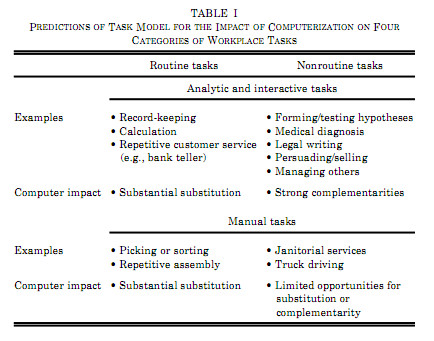
The second also comes from Paul Krugman, and I particularly like it for this table:
"This is real, and it calls some of our favorite platitudes into question," Krugman says.

Brad DeLong, on the other hand, has an excellent post in which economics and history triumph over cynicism (and yes, it's a lot like intellect and romance over brute force and cynicism):
We have already gone through the great transformation by which the general business of life--growing and processing our food, building our shelter, weaving our clothes, and telling ourselves stories for information and entertainment--has been extroardinarily [sic], comprehensively automated. And yet we have found things to do.
 Either way, I'd say this is the best argument yet for the long term viability of a career in the humanities!

Life-Saving Immorality?

Your taxpayer dollars at work.
Brad DeLong thinks that taxing people in order to prevent an asteroid from destroying the human race is entirely appropriate and moral. He quotes Bob Murphy, on the other hand, as disagreeing:
[T]here is a general moral prohibition against violating another person's rights.... Volokh's... point should be obvious: Just because an asteroid threatens to destroy all human life, that alone is not sufficient to justify violating people's rights. [...] The reason DeLong finds Volokh's views "insane" is that Volokh has elevated his precious political principles to such a height that they trump the survival of the human race. What an ideologue!
DeLong summarily rejects this sort of thinking, summarizing his view as follows:
[...] the sabbath was made for humanity; humanity was not made for the sabbath.
Commentor Daniel Kuehn has a lot to say in response to this position, and particularly to the logic of the position:
If you start where they do - axiomatically defining what a "right" is and defining "immorality" as being the violation of that right - then both the Volokh and Murphy version of the argument follows naturally.
The problem is not the logic itself - that logic is simple enough. The problem is their decision to apply that logic to this circumstance. Deductive logic is a tool - we have long since passed the point where we can claim that it deserves any deeper epistemological priority. [...]  Logic is not a tool for them, as most careful thinkers know it should be. For them it is a path, not to truth contingent on assumptions [I would prefer to refer to this as consistent reasoning or logical validity - N], but to some deeper absolute truth. [...] So to expand on your concluding thought, deductive logic is a tool for humanity, and not the other way around.
Tad Brennan points out that, far from being a primarily political debate, the conflict here is between purely deontological ethics and purely consequentialist ethics, and that the latter lends itself to some problems, as well:
If you eschew lexically-ordered side-constraints, then you have a very pure form of consequentialism. And that's not a bad thing! Some of my best friends espouse pure consequentialism! 
But pure consequentialism can generate some pretty repellent hypotheticals of its own (catalogued by Bernard Williams and others: false conviction of the innocent; harvesting organs from the unwilling; torture of children; etc. etc.).
When people recoil from the consequences of pure consequentialism and consider adopting categorical prohibitions on, e.g., the torture of children, this does not seem to me ipso facto insane.
Finding the right balance of ethical views for the Christian is never as simple and easy as it seems, which is why Christian maturity is a big deal. But this is a circumstance when, again, I don't think Christianity came come down on the side of moral libertarianism.

PS - For those looking for a quick summary of deontology vs. consequentialism in terms we can all understand, may I suggest Mark White, aka The Comics Professor, on the morality of Captain America, Iron Man, and Spiderman!

Japanese Earthquake-Tsunami Links

One week after the fact, I don't have a lot to say about the disaster, other than it is terrible. Please be praying for the people in Sendai and areas even closer to the epicenter.

I do, however, have some summary information I have been following.

Here is an amazing visual before and after comparison.

Ilan Noy provides a way to think about the economic impact of a disaster.

James Hamilton expands on this discussion of the economic impact, including some links of his own.

Will Wilkinson offers his summary of the economic disaster literature.

Christopher Beam on the lack of looting.

Bill McBride has several links on the nuclear concerns.

Robin  Hanson argues for a counter-intuitive response to the nuclear dangers.

Laura Freschi wants you to think carefully about your aid donations.

Finally, here's a brief video showing some of the impact of the Tsunami:

And a few for Economists

Paul Krugman prefers intuition over mathematics. Since I'm somewhat familiar with his work, I'm sure mathematics doesn't generally hurt, of course.

Turns out Krugman uses intuition to double check whether the math is silly. At OU we call this the "laugh test": if the conclusion makes you laugh, it doesn't matter how many proofs are in the paper.

Instrumental variables can, over time, be proven worthless. To me this suggests (1) instruments that seem appropriate only for a very specific context are probably the best, and (2) demonstrating causality from observations remains really hard, and will likely remain so.

Finally, one from an economist, but of more general interest: David Henderson's philosophy of teaching is love (which makes his sound a lot better than mine, huh?).

It's a Hard Life for the Humanities

A few links for those pursuing (or having previously pursued) the difficult road of a terminal degree in any field of the humanities, and I know a few of you read this blog.

Stanley Fish discusses the future of "humanist educators." The punchline:
It looks like the only way humanist educators and their students are going to get to the top is by hanging on to the coattails of their scientist and engineering friends as they go racing by.
Reasons to avoid grad school, mostly oriented toward humanities degrees. I like that "your office is gonna suck" is on the list.

If you do go, though, here are some blogs you might want to check out.

Speculative Fiction?

WANTED: Interdisciplinary Starship Pilot
Robin Hanson wonders about what kids are learning. In particular, are students focusing too much on their own disciplines, consequently losing the ability to think in an interdisciplinary fashion? Are students losing their ability to deal with deeper, meta- questions?  And, as Hanson brings up, if they are is this necessarily a bad thing?
I’d like to believe that we are in fact doing our students and the nation a disservice by marginalizing such skills. Unfortunately, I simply have little evidence with which to support such a judgment. [...] Just how many people should be thinking about what problems are important and why?
Bryan Caplan wonders where new jobs are really going to come from (he originally mused on this topic back in July). This time he considers Scott Sumner's answers:
Here's what I think most people still want:
1.  A bigger and nicer house, with granite counter-tops.
2.  More restaurant meals.
3.  More fun vacations.
That means we need more construction workers, and granite miners (quarriers?)  We need more cooks and waiters.  We need more hotel receptionists and maids.  More people to work on Carnival cruise ships.  I think our workforce is skilled enough to fill those jobs. 
I'd love to hear some reader thoughts and predictions on these topics. What will the jobs of the future be? And what sort of schooling will students need to do them? Should we be devoting more of our wealth to interdisciplinary schooling and liberal arts, and if so is the reason for business or pleasure?

Monologue

Here are a few links on communicating from the podium.

First, a speech without a slide show. Dr. Martin Luther King, Jr., did not need a PowerPoint presentation to make his audience see what he wanted them to see.
We all know MLK, Jr., was an expert at using words as a paintbrush. Seeing it in graphic form, though, shows just how frequently he resorted to visual language to hammer home his point. So next time you have to give a PowerPoint presentation or an address on the state of the country, remember: Think pink. Metaphorically speaking, of course.
When it comes to using PowerPoint, then, do it right or not at all.
The organisation makes . . . again, shall we just say the sort of consumer goods you and I use every day. We had already LEARNT, as evidenced by an eye-straining array of coloured graphics, that the MARGINS in the grommets division had been LEVERAGED by a FULL THREE PERCENTAGE POINTS, while TURNOVER in bent widgets . . .
Enough. The whole bloody thing took up 55 minutes of my life, as I can testify, because my watch was easily the most fascinating object in the room.
Interested in examples of good speeches? Here you go.

This Could Have Been Three Posts...

... if I had time to provide decent comments on each item, that is.  Instead of delving into my thoughts about the following links, though, I'll just put them up Marginal Revolution style.

Psychohistory, the sci-fi version of what I do for a living. For those with some knowledge of the history of macroeconomics, you'll notice that as early as 1942, Asimov saw the importance of the Lucas Critique, something economists didn't latch on to until 1976.
while one cannot foresee the actions of a particular individual, the laws of statistics as applied to large groups of people could predict the general flow of future events. [...] The character responsible for the science's creation, Hari Seldon, established two axioms:
  • that the population whose behaviour was modeled should be sufficiently large
  • that the population should remain in ignorance of the results of the application of psychohistorical analyses
That last bullet point is the one macroeconomists took nearly 35 years to figure out.

A mind-boggling "How to Deceive with Statistics" entry. The nature of averages suggests that your friends are cooler than you. The money quote:
Let’s imagine a small department offering three courses for the semester. One is a survey course with 80 students, one an upper-level course with 15 students, and one a seminar with five students. Now what is the average class size? Clearly, it is (80 + 15 + 5)/3, or 33.3 students. This is the number the department is likely to publicize.

But once again, let’s adopt the perspective of the average person and reexamine these numbers. Eighty of the 100 students find themselves in a class with 80 students, 15 find themselves in a class of 15 students, and five in a class of five students. Thus, the average student’s class size is (80 × 80 + 15 × 15 + 5 × 5)/­100, or 66.5 students. This number is less likely to be publicized by the department.
Did that just blow your mind? It did mine.

Theories of International Relations and Zombies. How is this *not* something I need to read?  A nice discussion by the author is available here. Max Fisher at the Atlantic Wire, capturing a lot of why I find zombies so fascinating, has this to say:
[...]the beauty of zombie theory is that it applies too [sic] all sorts of emerging trans-national security threats, including those we have yet to anticipate or imagine.
Yes. Zombies are really just a proxy for disasters and crises of a scale and nature we can't quite foresee.  Namely, the zombie apocalypse.  If someone wants to buy this book for me, I will put a detailed review up on this blog with a shout out / link to the website of your choice.

Wasting Time

I'll be doing first round job interviews this week, which consists of not too many interviews squeezed into several days.  If you, like me, find yourself with time to kill, here are a few websites to wile away the hours:

TV Tropes

If you've ever watched a television program or movie (or played a video game for that matter) and thought "didn't they do something like this on that other program?" the answer is yes. TV tropes will give the trope a name, tell you everywhere else it's been used, explain why it works the way it does, and what other tropes are similar but not quite identical.  This site is the ultimate encyclopedia of media and fiction clichés.

Difference Between

For those curious about the finer distinctions of modern linguistic usage, this site will clear it all up.

The Motivator

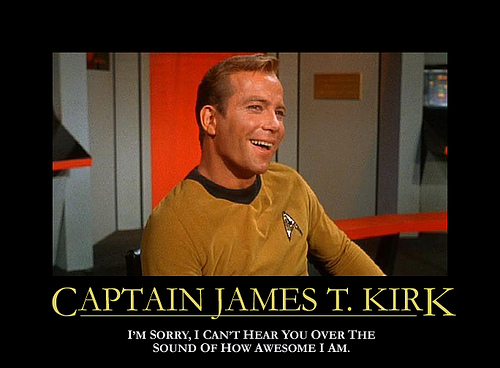
Do you enjoy those fake motivational posters that combine a photo with an unfortunately apt caption, like the one with Captain Kirk smirking that says "I'm Sorry, I can't hear you over the sound of how awesome I am"?  Well with the motivator, you can make your own.

Youtube

The standard, tried-and-true source.  Bouncing from one music video / comedy sketch / zombie preparedness video to another will cost you several hours, easily.

What Zombies Are For

 People think that zombie stories are about humans doing what it takes to survive. They’re not. Zombie stories are, it turns out, about humans doing what they mistakenly think they need to do to survive. As it turns out, they’re wrong.
This is the gist of a post at OverThinkingIt.com, one of my favorite group blogs, on what really drives zombie fiction.
Every zombie war is a war of attrition. It’s always a numbers game. And it’s more repetitive than complex. In other words, zombie killing is philosophically similar to reading and deleting 400 work e-mails on a Monday morning or filling out paperwork that only generates more paperwork, or following Twitter gossip out of obligation, or performing tedious tasks in which the only true risk is being consumed by the avalanche.
That's Chuck Klosterman at the New York Times offering his take on the attractiveness of the zombie apocalypse.

I think both these articles make good points, but I would add a dimension they don't quite address.  I think one aspect that really captures people's interest is the deep seated paranoia of it all. Zombies are just ordinary folk who turned on you, and anyone can, at any time, cease being your best friend and come after your flesh. On top of that, we have to consider that in any good zombie story, the zombies are not the real enemy. Zombies are hardly ever evil, after all; they're more a force of nature, a disease or a storm to be endured. No, to have true evil in a zombie apocalypse you have to have other people:
Beware of your fellow survivors. Sometimes, they may be the biggest threat to your survival. Other humans who want your supplies or who have lost their minds in the disaster could try to kill you. Never let everyone know about all of your supplies, and never let your guard down completely.
What do you do when you can't rely on your community?*  I think this is a fear a lot of people feel deeply, but don't quite know how to express. And like all unexpressed fears, it expands and fills us up unless we have an outlet for it, like zombie stories.  For me, I see the zombie apocalypse as the Great Disaster: our civilization cannot possibly survive it; at best the human race might survive to build a new one.  If we do survive, we have a chance to repeat the same mistakes or learn from them and try to create a utopia.  Most likely, we will try to create heaven in our own image and end up with a hellish dystopia for a troubles, but that's another strain of fiction for another time.

So how do we deal with a disaster from which there is no bouncing back? If we really think those around us could betray us at any time, can we ever come together to build something with the resources we have left? How bad do things have to get before our greed and fear and need to come out on top keeps everyone on the bottom?

Oddly enough, those are some of the main questions of my research as a development economist.  Maybe we should take zombies a bit more seriously after all!
*Add to this OTI's observation that our defensive paranoia is always wrong--we need community to survive, we need to let someone else save us--and you're dangerously close to every Apocalypse bearing a gospel message. One with shotguns.

Your Opinion

I'm leading a discussion for a graduate student discussion group next Sunday, and I need to decide what topic to present. Since my own research is not particularly general interest, I thought I'd get some thoughts on what my blog readers think would spark an interesting discussion. Therefore, I present Metadoxy's first ever Reader Poll:

For a look at possible reading material for mechanics and mystics, click here; for the purposes of education, click here. The How to Deceive with Statistics would focus on statistics education, such as in the video here (third video) from Arthur Benjamin. I've actually presented on The End of Civilization before, talking about William Burrows and the Alliance to Rescue Civilization; I'd probably take a more general "how should Christians think about and react to risks of global economic meltdowns / meteor strikes / climate disasters / (genetically engineered?) plagues / nuclear war" approach this time. Economic Growth vs. Human Progress would be a new topic, but would give us a chance to talk about the pros and cons of the modern age, as well as what our social and political goals should be in areas like foreign aid / immigration policy / national economic policy.

Please vote, the more feedback I get here the better decision I can make. Is there anything not in the poll that should be? Why did you vote the way you did? Please let me know in the comments!


Which Topic is Best for a Christian Grad Student Discussion?

Don't Be Too Certain

There's a fascinating graphic from Catherine Rampell that's been making the rounds on the economics blogs:
SmallBizProblems.jpg
So what's the biggest problem facing business right now? Paul Krugman points out that it's insufficient demand, and
[...] the best thing government could do to help business would be to spend more, increasing demand. The fact that it's not going to happen doesn't change the fact that it's the simple truth.
Unsurprisingly, Brad DeLong agrees with Krugman, and adds that anyone who disagrees is clearly incompetent.

Tyler Cowen, however, doesn't see it as that clear-cut:
I didn't read this graph the same way. I saw poor sales as a "biggest problem" for fifteen percent (or so) of small businesses in periods of full or near-full employment. I also see "poor sales" as a "biggest problem" for about thirty percent of small businesses today. That change -- about fifteen percent of the total -- struck me as relatively small and indeed puzzlingly small, if indeed we are in a liquidity trap and weak AD is the overwhelmingly dominant problem. [...] I do think weak AD is an important problem to be addressed, I just don't think the absolute levels here imply "end of story."

Russ Roberts adds (like the good Austrian economist that he is) that if taxes plus regulation were a single category, it would take over the top spot from poor sales. Finally, the award for best additional information goes, as it often does, to James Hamilton:
The statement that businesses aren't hiring is simply false. According to the Bureau of Labor Statistics' Job Openings and Labor Turnover Survey, the U.S. private sector hired 3.9 million new workers every month, on average, over the first 7 months of 2010.

But if that's true, then why isn't total employment booming? The answer is that, according to the same JOLTS data, some 3.8 million workers quit or lost their jobs each month on average during Jan-July. [...] the fact that small changes in net employment figures mask a dynamic economy in which there are huge gross changes in employment status for individuals and firms is quite indisputable.
Firms are firing a lot of people, probably because of poor sales. Firms are also hiring a lot of people, just not enough to mask the firings.

So what's the take-away point of all this?

I have to go back to Chris's fascinating post on the rhetoric of the "third way." Although I hate to contend with someone who quotes Lewis, this sort of thing is precisely why we should be reluctant to pick one side to fight for: reality involves a lot more dimensions than partisans can allow themselves to consider. In particular, once we've identified the "most important problem" that needs fixing, we tend to act far more certain in our own conclusions than the evidence allows. We should this pitfall whenever we find it in ourselves.

I know I'll get some flak for this, but I would contend avoiding certainty (in this sense) even extends to spiritual matters, if only because we need to avoid placing our confidence in a favorite interpretation of Scripture rather than in Christ himself. Humility requires that we be willing to let go of a firmly held position and accept "middle things" if we learn we're wrong. If that's true even in matter's of God's Word, how much more true is it for empirical matters like economic and political arguments.

Holding a view like this basically insures I'll never get a job with the CEA or NEC, but then who wants to be Larry Summers, anyway?
This man is always right. Right?

A Little Undead

Just a short post today providing a link to last week's Zombie Week at Tor.com.  A lot of the posts are linked to the original, but look through Sunday's posts to see a few more. The available points of interest include samples of fiction, roundtable discussions of all sorts, essays on the mechanics of writing zombies, essays on the mechanics of zombies themselves, and a lot more.  Take a look.

Also, I may have linked to this before, but I like the animation so I thought I'd throw it in for good measure:

Teachers Good and Evil

In my recent post on education, I stirred up considerable debate by saying that the goals of education are consumption, productivity, and signaling, and essentially rejecting any idea of character building or promoting virtue. I stand by my view, even though I know there are many teachers out there who care primarily about character and virtue, because from the perspective of the student becoming a better person is still only a desired goal if it allows you to communicate something (signaling), to do something (productivity), or if you simply value your own character and want to enjoy something (consumption). It's not the only way to break down these motivations, but I believe it is the most intellectually helpful way.

But I don't want this view to suggest that I think teaching is a mechanical process, in which relationships don't matter and values aren't influenced. Far from it. Within this framework it is still possible for teachers to promote good or evil toward their students. An example of the latter came up in a post by Albert Mohler, in which an English professor at Northwestern indicates his goal of indoctrinating students:
“The children of red states will seek a higher education,” he explains, “and that education will very often happen in blue states or blue islands in red states. For the foreseeable future, loyal dittoheads will continue to drop off their children at the dorms. After a teary-eyed hug, Mom and Dad will drive their SUV off toward the nearest gas station, leaving their beloved progeny behind.”
Then what? He proudly claims: “And then they are all mine.”
That is creepy. Not the fact that the worldview of the professor will affect the students; as Mohler points out:
All teaching involves ideology and intellectual commitments. There is no position of authentic objectivity. Every teacher, as well as every student, comes into the classroom with certain intellectual commitments.
It's not the fact that the teacher is sharing his own ideology---or even that he is trying to influence the ideology of his students---that makes this approach to teaching bad. It's the fact that "winning" the ideological war is the only objective expressed here. This professor doesn't care about the objectives of the students, and he doesn't even seem to care about the students' virtuous character. All he cares about is shifting the student's worldview to be more in line with his own.  That's not education. That's brainwashing.

In subtle contrast to this terrifying approach to teaching, Chris links to someone's personal account of having his worldview dismantled by a professor. But this wasn't the work of someone lying in wait to pounce on an unsuspecting eighteen-year-old (or at least, it doesn't seem so). This was the patient, relationship building of someone who genuinely wants a student to understand the world better:
It was John who—in the course of one extended conversation on the political thought of John Locke—broke through my well-armored adolescent Marxism and first introduced me to the challenges of intellectual history. He managed this by the simple device of listening very intently to everything I said, taking it with extraordinary seriousness on its own terms, and then picking it gently and firmly apart in a way that I could both accept and respect.
That is teaching. It is also a certain sort of liberalism: the kind that engages in good faith with dissenting (or simply mistaken) opinions across a broad political spectrum.
Was this second teacher also brainwashing his student? Possibly. But it is at least as possible that he was trying to help build the student's character, or make him a more productive thinker with the capacity to enjoy the subtleties of philosophical thought.

So we have here two cases of teachers who seem to be ignoring the student-perspective goals of consumption, productivity, and signaling. While I believe thinking about teaching in the way I do precludes the brainwashing of the first teacher, I hope I can say it doesn't prevent the care and relational efforts of the latter.
 

© Metadoxy
Revolution Elements by Blozard. Original WP theme by Jason Schuller | Distributed by Deluxe Templates