Showing posts with label all work and no play. Show all posts

Comic book suggestions bleg

First, a confession: I don't buy comics. I know, there goes my street cred. By 'comics,' though, I mean regular monthly issues of ongoing series. I prefer stand-alone graphic novels, limited series, or trade paperbacks (the comics industry term for volumes collecting a single story arc, usually of 4 to 8 issues, from an ongoing series).

That started to change around this time last year. For the first time. I decided I really wanted to pick up a series as it comes out rather than waiting for the collected volume: Hellboy in Hell #1!

Hellboy is such a great character. As Anung Un Rama, he was born to be the harbinger of the world's destruction and leader of the armies of hell, a monstrous Dark Age villain. Instead, Hellboy prefers to be more like a Golden Age hero, simple and chaste and uncomplicated... if he can get away with it. It's a great dynamic.

I also love Mike Mignola's art. It's difficult for me to explain why; aesthetic preferences aren't something I understand very well, even in myself. But something about the sharp angles, the extremes of light and dark, and the moody scenery really draw me in.

I bought the first four issues, and am excited to pick up #5 tomorrow!

At first, I thought this was the only comic that could convince me to pick up the regular issues. Then I heard about Sandman: Overture. For those of you that don't know, The Sandman was a series written by Neil Gaiman from 1989 to 1996, and is one of the best ongoing comic series ever made. I read the entire collected volumes through the public library last year, and it blew me away. When I heard that Gaiman and artist J.H. Williams III were writing a new 6-issue bimonthly series starting in October, there was no way I wasn't going to pick it up.

I've picked up a few other stray issues here and there trying to find more regular comics to follow, but so far nothing I've wanted to spend $3 or $4 on every month. A tight budget and specific tastes will do that, I suppose. Aquaman has a new writer at the end of the month, and I already know I like the artists, so I'll be trying that out, but beyond that I'm not sure where to look next.

Most of my current collection of trade paperbacks are from the 1980s--Alan Moore, Frank Miller, Mike Grell--and a few others with deep writers like Mark Waid. I like Paul Dini and Bruce Timm's Batman animation (but who doesn't?). I like Darwyn Cooke. I'm more of a DC guy than Marvel, although I really liked Chris Claremont's and Joss Whedon's X-Men and J. Michael Straczynski's Thor. The Walking Dead is fantastic, at least in collected form.

The point of all this, my friends, is that I'm looking for another monthly to pick up in December. I'd like to hear from any of you who have tried out recent titles. What are your favorites, and why? Know of anything that sounds like it would be my style? I'd like to try it out. Help me catch up to the new century in comics!

Friday Links

Actually, this is a pretty good idea.
The new Archbishop of Canterbury wants to help not-for-profit credit unions put payday lenders out of business:
I said to him quite bluntly, ‘We’re not in the business of trying to legislate you out of existence, we’re trying to compete you out of existence’.
He’s a businessman, he took that well.
Test scores are bad at predicting performance at Google... but probably not for the reason you think:
Google likely doesn’t have much variability among those hired with respect to test scores and grades. And when there is no variability, there is no correlation with anything. [Furthermore,...] If someone is hired despite their lower test scores, it usually means some compelling compensating characteristics made that person look like a good bet. That is why the correlation between a valid selection instrument and job performance can be dramatically depressed when only looking at the hired sample.
Finally, here's a pinterest page that blurs the line between pop culture and fine art.

Good show. Good coffee. (and a couple mentions of donuts, too)

A video of all the mentions of pie and coffee from a TV classic, Twin Peaks:

A Return to Blogging

Superman Returns?
After a few years without blogging on this page, I've decided to return. My intention is to put up links to articles, blog posts, and videos I find interesting. I'll also post my own thoughts on topics of interest from time to time. I'm planning to deal less with economics-related topics; I'll be leaning more heavily on topics like education, truth claims, mechanics and mystics, comic, and other fun tags from my new label cloud. (If you really want to hear my econ commentary, head over to my more academic blog, Subliminally Unemployed.)

As the first return post, I'll offer a movie review (poster provided) complete with spoilers below the jump break. But before I do, let me open this post with a request for requests: whether you're returning to this blog with me or starting it new, what would you like me to write about? Any articles you'd like me to comment on or share? Post your requests in the comments, and welcome to Metadoxy!

And by 'Life As Usual' I Meant...

... that I'll be on hiatus for the next four months. Apparently.

Not to go all Randy Quaid in Independence Day on you, but:


Yep. The plan is to post on a semi-regular basis, probably only about once a week.

So what's been keeping me busy this whole time? Well, let's see:
  • My family and I have moved to California
  • I am now a full time faculty member teaching three different courses
  • So my time has been pretty full with teaching, evaluation, and settling into life on the west coast
  • Also, I have a two-year-old daughter and an amazing and creative wife, so why wouldn't I be keeping busy?
I'm hoping to continue living up to the blog's tag line of "exercises in self-awareness," but I will probably be keeping it simpler overall. I'll be commenting on items from the Internet that get me thinking, posting links and videos, and with any luck I'll be putting some book reviews up as well!

Thanks for continuing to hang around even though nothing's been happening. Feel free to post requests or ideas in the comments. You can also look me up on Twitter or the Google+.

News in Brief

I just got my Ph.D. in Economics. Pretty pleased about it, to be honest. Life as usual to return presently. That is all.

Breakup Songs

Because a few recent songs focusing on the end of a relationship are just quality products. The music videos are below the fold/jump/whateveritscalled. (warning: language. For real. In the second song, mostly, but the song's just no good without them.)

Looks Like

Just a quick bit that I'd never really noticed before. For those of you of a Reformed and Presbyterian background, hopefully this will make you laugh.

Have you ever noticed that Tedd and Paul Tripp (pictured below)


Look an awful lot like Mario and Luigi?


 Spooky.

Wasting Time

I'll be doing first round job interviews this week, which consists of not too many interviews squeezed into several days.  If you, like me, find yourself with time to kill, here are a few websites to wile away the hours:

TV Tropes

If you've ever watched a television program or movie (or played a video game for that matter) and thought "didn't they do something like this on that other program?" the answer is yes. TV tropes will give the trope a name, tell you everywhere else it's been used, explain why it works the way it does, and what other tropes are similar but not quite identical.  This site is the ultimate encyclopedia of media and fiction clichés.

Difference Between

For those curious about the finer distinctions of modern linguistic usage, this site will clear it all up.

The Motivator

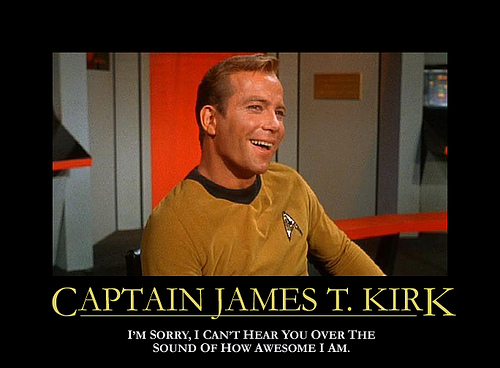
Do you enjoy those fake motivational posters that combine a photo with an unfortunately apt caption, like the one with Captain Kirk smirking that says "I'm Sorry, I can't hear you over the sound of how awesome I am"?  Well with the motivator, you can make your own.

Youtube

The standard, tried-and-true source.  Bouncing from one music video / comedy sketch / zombie preparedness video to another will cost you several hours, easily.

Skepticism about Scepticism

Would that be Meta-Scepticism? Sckepticism? Bueller?

In any case, this post is a response to a piece by the Venerable Gentleman in which he describes his attitude toward modern science, and nutritional science in particular.  Aside from a link to a story in the Atlantic, the post essentially consists of a rationale and a rejection. The rejection indicates that the Venerable Gentleman (VG hereafter) is unconvinced of the unhealthfulness of drinking, smoking, highly processed food products, or saturated fats of any sort; it also includes a passing stab at Pasteur's germ theory.

The rationale is a bit more forceful:
The physical sciences are indeed brilliant and beautiful in harness, yoked to goals above themselves. But when these are abandoned in the name of Progress, we arrive at the same result as that of the coachman who to speed his horses onward cut their traces: the situation is certainly a vast improvement from their perspective, but the passengers had rather hoped to arrive at Brighton before tea-time.
The argument is that the sciences must be reigned by the Queen of Sciences, Theology.  Unless it is thus bound, it's conclusions are of little value or interest to VG.

But frankly, I'm not convinced.  I don't for a moment believe VG consumes Velveeta because the science that tells him it's unsafe has galloped in unbridled fashion from its theological roots. Why not? Because the only reason we've come to believe Velveeta is food at all is that science told us so.

It was modern physical science, which VG argues has little value in its modernist form, which invented highly processed foods and trans-fats. It was modern physical science which convinced our parents and grandparents' generations that these new inventions were healthy and good, contributions to human advancement thanks to the scientific age. And it is modern physical science which continues to argue that the sources of culinary and olfactory satisfaction for hundreds of generations prior to this scientific era are now dirty, dangerous, and outdated; we should turn to the modern Prometheus's of dietary engineering to provide us new, more potent, more sterile, and more safe forms of food and drink.

No, if I may offer a not-too-seriously-suggested narrative of my own, VG distrusts claims against processed food because his mother gave it to him when he was a wee lad, and his mother wouldn't give him something unsafe. He distrusts claims against the vittles which he loves because he loves them, not because he believes them more moral in character. But these claims are largely made by those outside the mainstream of physical science, those who see science as serving Mammon (meaning corporate profits) as master, a critique far more in line with what VG offers than with his opponents.

Perhaps he has reason to distrust mainstream science, too. After all, his cigar-chomping lush of a grandfather (whose character and very existence I have totally fabricated here) lived to the age of 95 before dying in a sword fight with a pirate, so the causal effect cannot be all that strong, can it? (unless we consider drinking and smoking as contributing factors to encounters with pirates, which come to think of it...)  In any case, though, while VG is free to follow or ignore such advice as he pleases, I must insist that he not try to hide his preference behind the curtain of Theology. I'm on to you, wizard.

Taking Offense

After what was essentially a six-week hiatus, I thought I'd hit the ground running with something substantial:

If you met this fellow on the street, would you be offended? If he told you he didn't know what the symbol in his arm meant, he just thought it looked cool, would that make it OK?
Unless he's an actor in a movie or some sort of reenactment, I think we would all generally agree that wearing a swastika armband necessarily associates you with something decent folk don't want to be associated with.  In this sense, what you wear communicates something, whether the wearer intends to communicate it or not.

What about this?


Nobody really thinks that wearing a bomber jacket tells others that you have a pilot's license, or that you have destroyed enemy bunkers using military incendiary devices.  It's entirely plausible for someone to be a complete pacifist but still wear a jacket like this just because you think it looks cool.

So there seems to be a spectrum of association and message when it comes to things like clothing. Somewhere in the vast space between swastikas and bomber jackets, there is a line that, if crossed, moves you from wearing something "because you like it" to wearing something to "send a message." And it's really not a matter of intent: the swastika sends a particular message, period.

I bring this up because I have been thinking about the issue of offending others with something you see as harmless.  This article, in particular, got me wondering.  As an example, I know a lot of people who find this...


...to be a simple expression of support for their home state, states rights, or simply a rejection of an overly intrusive central government. On the other hand, basically every African-American I know looks at that shirt and sees this:


These white hooded figures are Boogey Man, a fear passed from parent to child over generations until it becomes ingrained in the society as the thing we must fear, not unlike the Nazis to Jewish communities. (As an aside, I have a friend of Jewish ethnic heritage who was once called a Nazi by a political science teacher. Bad form, political science teacher; very bad form indeed.)  When you fly your confederate flag, you are linking yourself to the KKK in the minds of most onlooking African-Americans as surely as if you were burning a cross in your front yard. It doesn't matter whether you intend it that way, just as it wouldn't matter if you wore a swastika armband to a bar mitzvah. You are doing something with a distinct meaning to another people group, and that meaning doesn't go away just because you don't see it.

Should the offense done to this people group be reason enough for you to eschew the confederate t-shirt? My instinct is to say yes; there are ways to express your group identity with other Southerners without hurting African-Americans, so the loving thing, the Christlike thing, to do is probably to avoid giving unnecessary offense.

But of course there must be a limit to the application of this logic, since every attire and activity risks offending someone.  Is the offense to animal rights activists sufficient reason to avoid something like this?

Aesthetic arguments are a separate matter.
I'm not sure, but again my intuition is to say the offense is not enough.  We aren't required to avoid all offense at all cost, and I'm not sure it is even possible to do so.  So if someone wants to wear a Victorian explorer outfit to a convention, are you aligning yourself with European imperialism?  If someone informs you that, as descendants of a subjugated people, they find your outfit offensive, do you owe an apology?

Is this man just having fun, or basking in retro-futuristic irony?
How should the second greatest commandment guide our willingness to invoke terrifying images or hurtful history upon those around us?  Where is the line beyond which our aesthetic choices begin to speak without our consent?  Or is this an instance where the mechanic is simply asking the wrong sort of question, where the mystic's way of thinking yields greater light?

I wish I had the answer to these questions.  I tend to think academics in the humanities over-play the idea of "the other," but on balance how we relate to "the other" is something most people should probably be more intentional about.

The Labor Market

I've been putting a lot of work into it, and thus have been unable to post for a while. This could continue for another week or two.  I apologize for the inconvenience, as I know you are all desperate to hear my ponderings on all matters. The truth is all the topics I planned to comment on before my recent job market blitz are now so stale that I will probably have to find new ones.

In the meantime, though, I thought some of you might find this piece at VoxEU interesting. It offers a plausible explanation and some additional evidence that increased immigration (legal or otherwise) does not hurt wages in the host country. On the contrary, if anything they seem to increase wages for native workers:
Several studies find that immigrants do not harm the wages and job prospects of native workers. This column seeks to explain these somewhat counterintuitive findings by emphasizing the scope for complementarities between foreign-born and native workers. Examining 14 European countries from 1996 to 2007, it finds that immigrants often supply manual skills, leaving native workers to take up jobs that require more complex skills – even boosting demand for them. Immigrants replace “tasks”, not workers.
Non-economists may find the material a bit dry, but I did want to offer their explanation:
In a recent working paper (D’Amuri and Peri 2010), we provide a potential explanation for this phenomenon, analysing European labour markets and immigration over the period 1996-2007. Our paper follows a similar analysis one of us did for the US (Peri and Sparber 2009). Rather than considering the labour market as made up of homogeneous and identical workers with potentially different skill levels, we consider that production is divided into a series of tasks that can be organised in a continuum spanning from simple-routine and prevalently manual tasks to complex-interactive and prevalently cognitive tasks.
Companies have to perform a range of these tasks in order to produce goods or services; hence the increased supply of some of them may increase the demand for others. For instance, for a construction company the supply of more construction workers performing manual tasks (such as installing dry-walls and raising foundations) generates the need for more construction supervisors, technicians, engineers, clerks, and sale representatives (as the company grows) who typically perform more interactive and complex tasks. As these tasks are all needed to produce final goods (they are “complementary” with each other), if immigrants and native workers specialise in different segments of the task-specialisation spectrum, then more immigrants can generate higher demand for natives.
This work is hardly the final word on the matter, but the simple fact that differences between workers matter means simple supply-demand logic isn't good enough to sort out the effect of more immigrant workers on native workers. The empirical evidence in the literature is pretty strong, so the burden of proof is really on those who want to say immigration hurts natives, rather than the other way around.
 

© Metadoxy
Revolution Elements by Blozard. Original WP theme by Jason Schuller | Distributed by Deluxe Templates