News in Brief
Some Insights from Practice Job Interviews
1a. Don't summarize your job paper too briefly
2. The fact that you can do Bayesian statistics is a selling point
2a. Don't sell the Bayesian stuff too hard; be as un-technical as possible
3. Relax and be yourself, you're trying to find a good match
3a. Relax and be whatever it is they want, you're trying to find a job
4. Ask questions about the interviewer to show interest
4a. Already know everything about the interviewer to show interest
5. Similarly, asking about the town shows interest
5a. Similarly, asking about the town shows lack of interest
6. If you're unclear, the interviewer might misunderstand you
6a. If you're clear, the interviewer might misunderstand you
7. Be energetic and animated
7a. But not too energetic and animated
8. Be careful about revealing personal information
8a. Reveal some personal information
9. Have a long list of courses you can teach and research ideas you might explore
10. More specifics are always better (as long as they aren't technical)
If I promise not to unionize, do you think they'll hire me at the Wendy's?
Taking Offense
![]() |
| If you met this fellow on the street, would you be offended? If he told you he didn't know what the symbol in his arm meant, he just thought it looked cool, would that make it OK? |
What about this?
Nobody really thinks that wearing a bomber jacket tells others that you have a pilot's license, or that you have destroyed enemy bunkers using military incendiary devices. It's entirely plausible for someone to be a complete pacifist but still wear a jacket like this just because you think it looks cool.
So there seems to be a spectrum of association and message when it comes to things like clothing. Somewhere in the vast space between swastikas and bomber jackets, there is a line that, if crossed, moves you from wearing something "because you like it" to wearing something to "send a message." And it's really not a matter of intent: the swastika sends a particular message, period.
I bring this up because I have been thinking about the issue of offending others with something you see as harmless. This article, in particular, got me wondering. As an example, I know a lot of people who find this...
...to be a simple expression of support for their home state, states rights, or simply a rejection of an overly intrusive central government. On the other hand, basically every African-American I know looks at that shirt and sees this:
These white hooded figures are Boogey Man, a fear passed from parent to child over generations until it becomes ingrained in the society as the thing we must fear, not unlike the Nazis to Jewish communities. (As an aside, I have a friend of Jewish ethnic heritage who was once called a Nazi by a political science teacher. Bad form, political science teacher; very bad form indeed.) When you fly your confederate flag, you are linking yourself to the KKK in the minds of most onlooking African-Americans as surely as if you were burning a cross in your front yard. It doesn't matter whether you intend it that way, just as it wouldn't matter if you wore a swastika armband to a bar mitzvah. You are doing something with a distinct meaning to another people group, and that meaning doesn't go away just because you don't see it.
Should the offense done to this people group be reason enough for you to eschew the confederate t-shirt? My instinct is to say yes; there are ways to express your group identity with other Southerners without hurting African-Americans, so the loving thing, the Christlike thing, to do is probably to avoid giving unnecessary offense.
But of course there must be a limit to the application of this logic, since every attire and activity risks offending someone. Is the offense to animal rights activists sufficient reason to avoid something like this?
![]() |
| Aesthetic arguments are a separate matter. |
![]() |
| Is this man just having fun, or basking in retro-futuristic irony? |
I wish I had the answer to these questions. I tend to think academics in the humanities over-play the idea of "the other," but on balance how we relate to "the other" is something most people should probably be more intentional about.
Losing LOST
Speaking of Making Distinctions
This terminology comes from a brilliant web posting by Andrea Donderi that's achieved minor cult status online. We are raised, the theory runs, in one of two cultures. In Ask culture, people grow up believing they can ask for anything – a favour, a pay rise– fully realising the answer may be no. In Guess culture, by contrast, you avoid "putting a request into words unless you're pretty sure the answer will be yes… A key skill is putting out delicate feelers. If you do this with enough subtlety, you won't have to make the request directly; you'll get an offer. Even then, the offer may be genuine or pro forma; it takes yet more skill and delicacy to discern whether you should accept."As Joel pointed out, the mechanic/mystic trait is closely associated with the kinds of objects or insights that they are good at dealing with. Similarly, the author suggests the asker/guesser trait is closely associated with the culture you come from. The real question for me, though, is how do I get a prominent blogger like Tyler Cowen to talk about mechanics and mystics?
Friday Video Extravaganza
Teaching Philosophy
Students are in the process of becoming who they will be for the rest of their lives. Although they sometimes don't realize who that is yet, I believe this means they should be shown the dignity of who they are and are becoming all the same. First and foremost, my students are adults. They have chosen to attend my classes, whether at the guidance of parents and councelors or at their own discretion. As a teacher, I want how I teach to be shaped by the goals the students have when they make this choice. As an economist, I know that these goals really fall into three broad categories: consumption, productivity, and signaling.
Students might be in my classes because they think it will be fun. Maybe they see economics coursework as part of the ``college experience.'' Perhaps they've noticed that economics comes up in every nightly news broadcast, or that every political and business decision has an economic element they'd like to know more about. In any case, some students come to my classes purely for their own enjoyment, information, and satisfaction; they've come to consume economics. What these students really want out of the course is real world examples, something that connects the abstract essence of economic thinking to the complex experience of life. They want me to be honest when I'm simplifying reality, and they want me to tell them when what we talk about is a good guide to understanding the world and when it's not.
Beyond their own enjoyment, students might actually come to college to learn something, to make themselves more productive. They want to improve their thinking skills so that they'll make better employees and better employers after they graduate. They are hoping that what they learn from me will help them get better, higher-paying jobs, and retain those jobs over time. These are the students who want to see how decisions are made, how to compare costs and benefits, and what sort of factors they need to consider when dealing with problems. They want to be able to look at a situation and understand not only which things they can see are really important, but also what important considerations may remain unseen. The theoretical building blocks of economics help these students translate bewildering real world problems into intellectually managable models. And of course, they need to translate the answers the models give back into real world solutions.
Finally, some students are already a cut above the rest. What these students really want is to be able to prove their skill, to signal to the job market their true abilities. They take economics courses because they're challenging. They hate grade inflation because it makes it harder for them to demonstrate their talent and effort. What these students need the most from me is honest grading and rigorous academic standards. They want me to expect a lot from them, because they know they have a lot to give. They want an A in Principles of Microeconomics to mean something.
Of course, the students I've outlined above are an abstraction from reality. Most students are motivated by a mixture of the three, and they may not even be sure which ones matter to them the most. I need to provide all of the benefits to all of my students, and let the individuals sort out which parts are most useful to them. Many students aren't thinking these things about my class as much as they are about their entire program of study, so I need to keep in mind what their backgrounds are like and where they plan to go after my course is over. But by beginning with these principles, I believe I can respect the interests and desires of my students and provide them with the education they are really looking for.
Why Do I Find Zombies Fascinating?
I particularly like this part of Grassie's introduction:
Like the White Queen in Lewis Carroll Through the Looking Glass, I find it useful to practice imagining these "impossibilities" a little bit each day. "When I was younger I always did it for a half an hour a day," the Queen tells Alice. "Why sometimes I believed as many as six impossible things before breakfast."1 It is not bad to think of these impossibly dark possibilities. [...] A little bit each day is a great way to focus life on really important matters.
The point of this thought experiment, however, is not to contemplate death and disaster, but to imagine survivors and continued life.That's pretty much what zombies are all about for me: what becomes important when the darkest catastrophe conceivable happens. And the end of civilized society, combined with the possibility that everyone you love could come back as your enemy, is about as dark a catastrophe as is conceivable, at least by me. Plus, there's the undisputed fact that survivor stories are fascinating.
TED Is a Friend of Mine
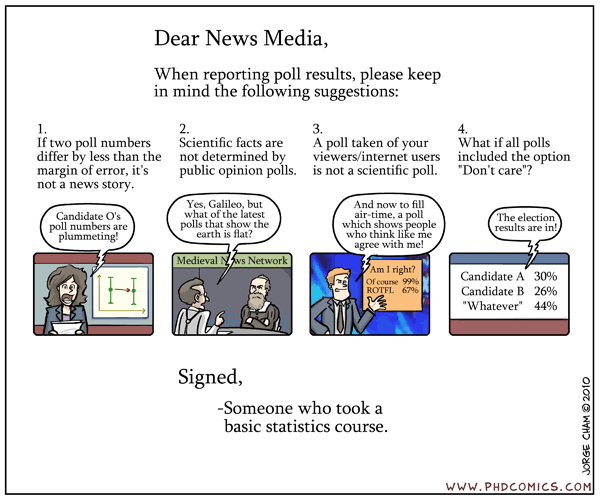
How to AVOID Deception with Statistics
The first one is especially important. When a candidate's approval rating drops by 3%, it didn't drop.
Last Night, I Wrestled With God
The gist of the story is this: I was preparing to do all kinds of good, useful things for the house, mostly cleaning-related. I was also looking forward to some time to sit and relax, since I had been walking or standing most of the day and was rather tired. Around 8 o'clock, just before said cleaning and relaxing was going to occur, my wife pointed out that the baby was tired, and we needed to do her bedtime routine. This part is fine, except that if we do the bedtime routine and she still doesn't fall asleep, the only effective way to get her to sleep (she really needs to sleep more) is for me to put her in the baby bjorn and wear her. Standing up. Until Jessie is ready to go to bed, which is usually around 10:30 or so.
Needless to say, I didn't want to give up the good things I was planning to do so I could stand around with the baby for two hours. I told my wife as much. Ultimately, though, we both knew that Lucy needed the sleep. So we did the bedtime routine, which includes me leading us in prayer. Except I didn't want to pray. I was mad at Jessie (but actually more mad at God). Mad that she would make me do this silly, uncomfortable thing instead of doing to useful and restful things I had planned. I'm not OK with this, I thought. Jessie has no right to ask this of me. It's too much.
I was suddenly reminded of something: "As Christ loved the Church, and gave himself up for her." What? I'm a loving husband; she's just asking too much. "As Christ loved the Church, and gave himself up for her." But she just doesn't want to have to deal with the baby for a couple hours. "As Christ loved the Church, and gave himself up for her." I'm tired. Why should I have to sacrifice that much? "As Christ loved the Church, and gave himself up for her."
Sacrificing "up to a point" might prove you're tougher than most, but it's not real sacrifice. It's not sacrifice if you can say after a point "That's too much!" True sacrifice means that it's not about your limits anymore. "As Christ loved the Church, and gave Himself up for her." Giving myself for my wife means I don't get to say she's asking too much of me. It's not about me. It's about me doing what she needs while I have breath.
Not to be too mystical, but I think God was speaking to me that night. I think he was reminding me of these important things, which I'd pretty much forgotten.
I apologized to Jessie. We prayed. I was prepared to do what I had to do.
A couple minutes later, Lucy fell asleep without the bjorn.
Truth Claim of the Day
Today's truth claim is a bit lengthy, as it represents (in my estimation, anyway) a rich, full, complex worldview in a few short lines:
You seem to have a misconception that as life advances, order increases. This hinges on one's definition of 'order'.A human being, considered as a closed system, is in a high state of entropy, a high state of disorder. We are a constant, unending, gigantic chemical reaction, and that means we are wasting a great deal of energy. A grown person, purely by virtue of being tens of kilos more of reactant material, is wasting more energy than a baby. Thus over time, the system 'a person' experiences increasing entropy. -- This is obviously a very simplified and abstracted example, but is necessary to demonstrate that a living being is not an ordered or order-increasing element of a system; life is the ultimate grower of disorder.
Life expands. When it has the potential to do so, it often does on an exponential scale. Everything that is life is powered by chemical energy, and so as life spreads, more and more energy is wasted. Life is like a naturally occuring function of the universe which _increases the rate of entropy_.
You could classify entropy-increasing mechanisms into various classes: Atomic Decay, Physical interaction (space rocks collide, cause heat), Chemical Interaction (oxidization of a material), Sustained Chemical Interaction (natural production of simple hydrocarbons), Simple life (mono or low-count cellular organisms, like algae), Complex life (like squirrels), and I believe, Spaceborne Life, which we will soon be.
With this examination, you could derive that as the universe ages, more complex and more powerful means of increasing entropy necessarily develop. Life (and we) are just a natural part of the process designed to guide the universe on its path to entropic maximum, as quickly as possible.
While I don't know how much I subscribe to the fact, one could make the argument that such a fascinating, sensible, and seemingly *purposeful* system is likelier to have a designer. A designer is by no means required, but still definitely not excluded.
Please, discuss. I'd especially be interested in hearing thoughts about the practical implications of thinking about Life in these terms. Not to bias the discussants with my own thoughts, but I'm seeing a fascinating fusion of Weston from Perelandra and the Joker from The Dark Knight. The context (among the flame-ish comments) is here.
Two Things the People Need
It's possible my analysis is just crap, since after all I'm no Hebrew scholar, but I feel like all the books in the Old Testament since Deuteronomy have been making two main points. First, God's people need a king. They can't be orderly on their own, and they can't protect themselves against the sinful designs of those both outside and inside the family without a single, powerful leader. Of course, they are terrible at choosing their king (i.e., they don't want God as their King), and thus God gives them Saul, who again proves they need a better king, David. Even David proves they need a better king, since David doesn't govern his own family that well, and thus cannot insure justice beyond his own lifetime. With Solomon comes peace and prosperity, but it is short-lived, and to get these benefits Solomon is sometimes a cruel task master, acting more like Pharaoh than God. And the kingdom is split after Solomon. The People Need a King.
Second, God's people need a temple. After all the intricate instruction for how to build the tabernacle, and all the victories bound to the Ark of the Covenant, once Israel occupies the land they start setting up alters and making sacrifices and having priests and "worshiping" God wherever and however they please. Unless I missed the part in the Law where it's a good idea to keep private priests in your home, ignoring the feasts God commanded, not feeling like traveling all the long way to wherever the Ark is, this is a problem. Even David isn't great on this front, what with transporting the Ark by oxcart and such. The people need to know where the dwelling place of God is, they need to see the cloud enter and live amid the people. They need a God-With-Us. But even once Solomon builds the Temple in Jerusalem, again the peace is short-lived. The kingdom is split and Jeroboam sets up rival temples. Israel is again left to wander about meeting with God in haphazard ways (or not at all). The People Need a Temple.
I'm sure there are more insights to come, but I can see now why Jesus is so concerned with the Kingdom and the Temple. The Church can't really be the people of God without them.
(I should have put links in this post, but I got lazy. I hope you don't mind. But if you do...)
Origins
To know someone, it's not enough to get some facts together. You need to understand what their life has been like. Why they choose what they choose and do what they do. And to know that you need to know how they came to be what they are.
The same is true for getting to know characters, and the why and how are especially true of superheroes. People in relatively ordinary situations reveal themselves over time, their quirks and habits congealing into a coherent identity. But the whole point of superheroes is that they are not in ordinary situations.
Superheroes are characters, just like in any other type of story. The best heroes are not those who are very different from the rest of us, but those who are the same. What makes this kind of story work, and why I enjoy them so much, is it puts relatively ordinary people in unthinkable situations, forcing them to grow and change into who they really are. In a superhero story there can be good guys, bad guys, and a whole lot of degrees in between, but the one thing no one can be is wishy-washy. Superheroes are born of extraordinary constraints, and constraints create choices.
I think it's because these kinds of stories are so tied to the constraints that makes the origin story so central to superheroes. It's not so much that the fact that this person can do things no one else can demands justification; we encounter uniqueness in people all the time, and it's not like other movies don't exaggerate reality. No, we need to see the origins of superheroes because the things that bind them to be heroes are why the choose what they do. The origin story is the superhero's story.
Just in case you aren't convinced yet, consider this: the fact that Peter Parker got bitten by a radioactive/genetically engineered/totemically possessed spider is not why he does what he does. Peter Parker is Spider Man because when he tried to just be a dude, his uncle was murdered. Peter believes what he does about the spider because he experienced what he did about his family. With or without magic pixie dust, that story would have been the origin of something.
A few weeks ago I found a 5 issue origin story for the superhero Daredevil at the thrift store, written by Frank Miller no less (you may know him for the original graphic novel of 300, as well as his directing work on Sin City and The Spirit). Really well done. I'm sure it helps that Miller was a regular writer for Daredevil in the early 80s, but he seems to get why the character does what he does. Miller knows Daredevil's story. And most really don't get it, 'cuz was that movie ever bad!
All this is to say, I guess, that I really like superhero stories, especially origin stories. I like getting what a character is about, knowing what they'll do next because I know who they are (as opposed to be because of a rehashed plot). I'd love to see movies of characters like Thor, Punisher, The Spectre, Daredevil, Superman, Wonder Woman, Green Lantern, Green Arrow, and a whole bunch of others. But the creators have to know the characters, understand what they are about. And to do that, the creators have to be able to tell the origin story. So here's hoping for a host of awesome Superhero Origin movies in the future!
Here's some good (or at least entertaining) origin movies / comics for you:
Batman Begins
Unbreakable
Batman: Year One
Daredevil: The Man Without Fear
The Matrix
Darkman
Iron Man
Heroes: Season 1
Here's Hoping on the Wolverine Movie!
PS- This made me laugh.
I Know Jesus Christ
On the plus side, I came to realize some things about myself. When he asked me how I could be so sure of what I believe, I did not say it was because of the logical consistency of the Christian system (I believe it is logically consistent, but so are a lot of things). I said I was sure because I know Jesus Christ. He didn't understand what that meant, which is fair since it's not an easy thing to explain. But I've been thinking about it, and I'd like to try.
"I know Jesus Christ" is not all that different than if I were to say "I know Joel P.", which is the kind of thing people say all the time. What does it mean to say I know someone? Does it mean I have conversed with him on a variety of issues? Does it mean I have driven him to pick up his girlfriend at the airport? Does it mean I have sung karaoke with him the night before his wedding?
I think the statement "I know Joel P." is a claim about someone's story: I know Joel's story. I know things about Joel's past, even before I knew him; similarly, he knows things about mine. I don't know everything about his past, but I know enough to understand him to some extent. Not only that, but I have become a part of Joel's story, and he a part of mine. When certain parts of Joel's story are told now, I will come up. Joel comes up when I tell parts of my own story. Even though I don't see or directly interact with Joel right now, I don't need convinced of who he is. I know Joel P.
It's not so different when I say I know Jesus Christ. I know about his past before I came along. Not only that, but Jesus Christ lives, and his story still continues. I have become a part of His story, and he of mine. I am as confident of who He is as I am of who Joel is. I know Jesus Christ.
A Noir Interpretation
This is, however, something of a prequel to the BioGrecoGirl trilogy. Kinda like this is a prequel to the Star Wars Trilogy. As with that other prequel, most of you will, after having read this, prefer to pretend it doesn't exist. As a writer (but not a story writer), I guess that's the risk you take.
Part Zero: When the Narrator Wasn't Looking
TeaBrewster walked along the foggy path towards the glassy spires of Catlett Citadel. He knew the resident of the citadel would be able to tell him what he needed to know. Stepping forward resolutely (imagine the opposite of this), he heard the echos of haunting organ music as he stepped inside the massive structure. He stepped into the large, open foyer as fog billowed in behind him.
"Father Aldrich?" TB said, hoping to be heard over the organ music.
"Aldrich?" he repeated.
"Go. Away," a clear voice called through the music.
"I need your help," TB said.
"I have not offered my help," the voice replied. "I am... preoccupied."
"I need to talk to him," TB said. "I need to talk to the Instructor."
The music died away. TB heard footsteps from high above him, in the organ balcony. He looked up.
There stood Father Aldrich (picture the guy on the left), looking down at him in the dim light. "Do you really?" FA asked.
"Yes," TB said. "He sent for me. He wants me to come to the Hidden Hall, but..."
"But no one can find the Hall unless they've been brought there."
"Exactly."
Father Aldrich paused in a very noir manner. "I'll take you," he finally said. "We'll just say you owe me one."
They set off together, walking past the Physical Sciences Center and within sight of the library clock tower. After some time, they came upon a dull, unassuming building and entered. They walked up to the elevator, only to discover that they would have to climb the stairs instead. As they entered the hallway leading to the Instructor's office, the background music took a more modern turn. FA knocked on the office door.
"Enter."
FA opened the door and motioned for TB to precede him. As TB did, he saw a bearded man sitting at a desk, smoking a pipe. (It felt a bit like this, but hopefully nothing like this.)
"TB, I've been expecting you," the Instructor said. "You look drained, would you like a cup of coffee?"
"Is it decaf?"
The Instructor and FA glanced at each other briefly.
"Just have the one, it can't hurt that much," FA said.
"Alright, but I've got to watch my caffeine intake," TB said as he sat down. The Instructor rose from his desk and began pouring a cup of coffee.
"You're wondering why I've asked you here," the Instructor said as he handed TB the cup. "You see, I'm working on a project for a very important client, and I could use your help. My client is conducting vital research in the area of ultrasonics. However, to continue this research, I need to get a component for a new device they've developed."
"What sort of device?" asked TB, who was already more than half-way through his cup of coffee and feeling very energized.
"That's not really important right now. The important part is the component, a bathroom iPod stereo deck. Do you know where I can get such a component?" the Instructor asked.
"BGG has one," TB said. "She always keeps it in her lab coat pocket. Not that she'd part with it, I suspect." TB downed the last of his coffee. "This coffee is amazing."
"It's a special blend."
"Have another," FA said as he refilled TB's cup.
"What do you think it would take to convince her to give it up?" the Instructor asked.
"You'd probably have to take it from her," TB replied, "and she and her friends would stop you before you could do that, anyway."
"No one is suggesting taking it by force and violence," FA said.
"Her friends would stop us, wouldn't they," the Instructor said.
"Yeah. Between the Schupakinator and SeamsJess, you'd have your hands full," TB said. "I'd help them."
"As you should," the Instructor said. "Let me warm that up for you," he said, pouring more coffee into TB's cup.
"Thanks. This stuff is amazing. I mean amazing, I really like it it really provides just the right pick me up you know what I mean?" TB's words began to run together with frantic energy.
"We will certainly pass on the compliments," FA said.
"Now, I'm sure by now you're wondering who this client is," the Instructor began.
"Not really, do you have any more coffee?" TB asked. His cup was somehow empty again, clutched in his twitching hand.
"No," the Instructor said.
"What do you mean 'no'?" TB said angrily. "I need more *coffee*!"
"I'd love to accommodate you, but I'm afraid the Schupakinator took the last of it," the Instructor said.
"She did," TB said. "She did. Well, well. Took the last of my coffee. We'll just see about that!"
TB got up suddenly, throwing his chair against the wall, nearly hitting FA. Like a bolt of lightning, TB shot down the stairs in search of the one who had deprived him of more caffeine.
"That was quite a brew you gave him," FA said.
"I had some help with it. It's like trucker coffee, but with extra kick," the Instructor said. "He's had the caffeine equivalent of a dozen cups just now, which should take care of the Schupakinator. I trust you can get me the component now?"
"What about her other allies? "FA asked. "What about SeamsJess?"
The Instructor folded his hands as he sat behind his chair. "Leave her to me," the Instructor said knowingly. "Soon it won't matter if they all know that the Instructor is just one guise of mine."
"As is the Economist of Evil."
"Of course," the Economist of Evil said. "Remember, we need the component delivered to the movie theater."
"This had better work," FA said. "I have no problem getting the component for you, but I have no intention of actually killing anyone for this project. I'm not a villain, whatever BGG or anyone else may think."
"You will have to trust me," EE said.
"Assuming you are no villain, yourself. You still have not told me what the device being built is."
"All in due time, FA," EE said. "There are still too many variables to divulge that information."
"Very well. I will met you at the pond," FA said. "If you'll excuse me, I have two more movements to play."
As FA shut the door behind himself, EE muttered under his breath, "Be careful what you assume, Justin. I never said I wasn't a villain."