Showing posts with label suggestions. Show all posts

Comic book suggestions bleg

First, a confession: I don't buy comics. I know, there goes my street cred. By 'comics,' though, I mean regular monthly issues of ongoing series. I prefer stand-alone graphic novels, limited series, or trade paperbacks (the comics industry term for volumes collecting a single story arc, usually of 4 to 8 issues, from an ongoing series).

That started to change around this time last year. For the first time. I decided I really wanted to pick up a series as it comes out rather than waiting for the collected volume: Hellboy in Hell #1!

Hellboy is such a great character. As Anung Un Rama, he was born to be the harbinger of the world's destruction and leader of the armies of hell, a monstrous Dark Age villain. Instead, Hellboy prefers to be more like a Golden Age hero, simple and chaste and uncomplicated... if he can get away with it. It's a great dynamic.

I also love Mike Mignola's art. It's difficult for me to explain why; aesthetic preferences aren't something I understand very well, even in myself. But something about the sharp angles, the extremes of light and dark, and the moody scenery really draw me in.

I bought the first four issues, and am excited to pick up #5 tomorrow!

At first, I thought this was the only comic that could convince me to pick up the regular issues. Then I heard about Sandman: Overture. For those of you that don't know, The Sandman was a series written by Neil Gaiman from 1989 to 1996, and is one of the best ongoing comic series ever made. I read the entire collected volumes through the public library last year, and it blew me away. When I heard that Gaiman and artist J.H. Williams III were writing a new 6-issue bimonthly series starting in October, there was no way I wasn't going to pick it up.

I've picked up a few other stray issues here and there trying to find more regular comics to follow, but so far nothing I've wanted to spend $3 or $4 on every month. A tight budget and specific tastes will do that, I suppose. Aquaman has a new writer at the end of the month, and I already know I like the artists, so I'll be trying that out, but beyond that I'm not sure where to look next.

Most of my current collection of trade paperbacks are from the 1980s--Alan Moore, Frank Miller, Mike Grell--and a few others with deep writers like Mark Waid. I like Paul Dini and Bruce Timm's Batman animation (but who doesn't?). I like Darwyn Cooke. I'm more of a DC guy than Marvel, although I really liked Chris Claremont's and Joss Whedon's X-Men and J. Michael Straczynski's Thor. The Walking Dead is fantastic, at least in collected form.

The point of all this, my friends, is that I'm looking for another monthly to pick up in December. I'd like to hear from any of you who have tried out recent titles. What are your favorites, and why? Know of anything that sounds like it would be my style? I'd like to try it out. Help me catch up to the new century in comics!

Good show. Good coffee. (and a couple mentions of donuts, too)

A video of all the mentions of pie and coffee from a TV classic, Twin Peaks:

Theories of International Politics and Zombies by Daniel Drezner

When I heard about this book, I was convinced it was something I needed to read, but had no idea when I'd have the time or funding to do so. Fortunately for me, my friend (and now soon-to-be military chaplain) Matt Moynihan decided to buy the book and give it to me. Thanks, Moyni! My review falls after the jump break.

Doctor Who, the Popular Musical

Below the fold (jumpbreak? I never know what to call it...) are some videos featuring one of my current favorite shows and a couple of my current favorite bands.

And a few for Economists

Paul Krugman prefers intuition over mathematics. Since I'm somewhat familiar with his work, I'm sure mathematics doesn't generally hurt, of course.

Turns out Krugman uses intuition to double check whether the math is silly. At OU we call this the "laugh test": if the conclusion makes you laugh, it doesn't matter how many proofs are in the paper.

Instrumental variables can, over time, be proven worthless. To me this suggests (1) instruments that seem appropriate only for a very specific context are probably the best, and (2) demonstrating causality from observations remains really hard, and will likely remain so.

Finally, one from an economist, but of more general interest: David Henderson's philosophy of teaching is love (which makes his sound a lot better than mine, huh?).

It's a Hard Life for the Humanities

A few links for those pursuing (or having previously pursued) the difficult road of a terminal degree in any field of the humanities, and I know a few of you read this blog.

Stanley Fish discusses the future of "humanist educators." The punchline:
It looks like the only way humanist educators and their students are going to get to the top is by hanging on to the coattails of their scientist and engineering friends as they go racing by.
Reasons to avoid grad school, mostly oriented toward humanities degrees. I like that "your office is gonna suck" is on the list.

If you do go, though, here are some blogs you might want to check out.

This Could Have Been Three Posts...

... if I had time to provide decent comments on each item, that is.  Instead of delving into my thoughts about the following links, though, I'll just put them up Marginal Revolution style.

Psychohistory, the sci-fi version of what I do for a living. For those with some knowledge of the history of macroeconomics, you'll notice that as early as 1942, Asimov saw the importance of the Lucas Critique, something economists didn't latch on to until 1976.
while one cannot foresee the actions of a particular individual, the laws of statistics as applied to large groups of people could predict the general flow of future events. [...] The character responsible for the science's creation, Hari Seldon, established two axioms:
  • that the population whose behaviour was modeled should be sufficiently large
  • that the population should remain in ignorance of the results of the application of psychohistorical analyses
That last bullet point is the one macroeconomists took nearly 35 years to figure out.

A mind-boggling "How to Deceive with Statistics" entry. The nature of averages suggests that your friends are cooler than you. The money quote:
Let’s imagine a small department offering three courses for the semester. One is a survey course with 80 students, one an upper-level course with 15 students, and one a seminar with five students. Now what is the average class size? Clearly, it is (80 + 15 + 5)/3, or 33.3 students. This is the number the department is likely to publicize.

But once again, let’s adopt the perspective of the average person and reexamine these numbers. Eighty of the 100 students find themselves in a class with 80 students, 15 find themselves in a class of 15 students, and five in a class of five students. Thus, the average student’s class size is (80 × 80 + 15 × 15 + 5 × 5)/­100, or 66.5 students. This number is less likely to be publicized by the department.
Did that just blow your mind? It did mine.

Theories of International Relations and Zombies. How is this *not* something I need to read?  A nice discussion by the author is available here. Max Fisher at the Atlantic Wire, capturing a lot of why I find zombies so fascinating, has this to say:
[...]the beauty of zombie theory is that it applies too [sic] all sorts of emerging trans-national security threats, including those we have yet to anticipate or imagine.
Yes. Zombies are really just a proxy for disasters and crises of a scale and nature we can't quite foresee.  Namely, the zombie apocalypse.  If someone wants to buy this book for me, I will put a detailed review up on this blog with a shout out / link to the website of your choice.

A Benediction for a New Year

From Neil Gaiman, no less:


I'm thinking we don't place enough value on spoken blessings. These things matter.

(Thanks to Jessie and Katie for drawing this to my attention.)

Wasting Time

I'll be doing first round job interviews this week, which consists of not too many interviews squeezed into several days.  If you, like me, find yourself with time to kill, here are a few websites to wile away the hours:

TV Tropes

If you've ever watched a television program or movie (or played a video game for that matter) and thought "didn't they do something like this on that other program?" the answer is yes. TV tropes will give the trope a name, tell you everywhere else it's been used, explain why it works the way it does, and what other tropes are similar but not quite identical.  This site is the ultimate encyclopedia of media and fiction clichés.

Difference Between

For those curious about the finer distinctions of modern linguistic usage, this site will clear it all up.

The Motivator

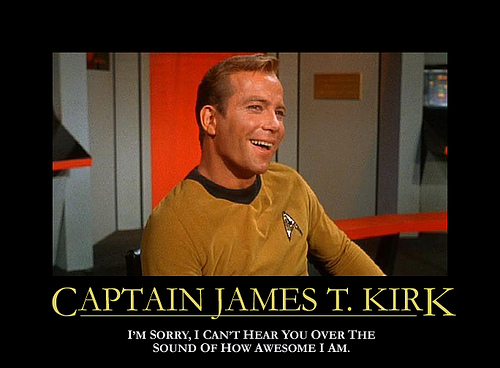
Do you enjoy those fake motivational posters that combine a photo with an unfortunately apt caption, like the one with Captain Kirk smirking that says "I'm Sorry, I can't hear you over the sound of how awesome I am"?  Well with the motivator, you can make your own.

Youtube

The standard, tried-and-true source.  Bouncing from one music video / comedy sketch / zombie preparedness video to another will cost you several hours, easily.

Some Insights from Practice Job Interviews

1.   Keep the summary of your job paper brief
1a. Don't summarize your job paper too briefly

2.   The fact that you can do Bayesian statistics is a selling point
2a. Don't sell the Bayesian stuff too hard; be as un-technical as possible

3.   Relax and be yourself, you're trying to find a good match
3a. Relax and be whatever it is they want, you're trying to find a job

4.   Ask questions about the interviewer to show interest
4a. Already know everything about the interviewer to show interest
 
5.   Similarly, asking about the town shows interest
5a. Similarly, asking about the town shows lack of interest

6.   If you're unclear, the interviewer might misunderstand you
6a. If you're clear, the interviewer might misunderstand you

7.   Be energetic and animated
7a. But not too energetic and animated

8.   Be careful about revealing personal information
8a. Reveal some personal information

9.   Have a long list of courses you can teach and research ideas you might explore

10. More specifics are always better (as long as they aren't technical)


If I promise not to unionize, do you think they'll hire me at the Wendy's?

A Little Undead

Just a short post today providing a link to last week's Zombie Week at Tor.com.  A lot of the posts are linked to the original, but look through Sunday's posts to see a few more. The available points of interest include samples of fiction, roundtable discussions of all sorts, essays on the mechanics of writing zombies, essays on the mechanics of zombies themselves, and a lot more.  Take a look.

Also, I may have linked to this before, but I like the animation so I thought I'd throw it in for good measure:

Teachers Good and Evil

In my recent post on education, I stirred up considerable debate by saying that the goals of education are consumption, productivity, and signaling, and essentially rejecting any idea of character building or promoting virtue. I stand by my view, even though I know there are many teachers out there who care primarily about character and virtue, because from the perspective of the student becoming a better person is still only a desired goal if it allows you to communicate something (signaling), to do something (productivity), or if you simply value your own character and want to enjoy something (consumption). It's not the only way to break down these motivations, but I believe it is the most intellectually helpful way.

But I don't want this view to suggest that I think teaching is a mechanical process, in which relationships don't matter and values aren't influenced. Far from it. Within this framework it is still possible for teachers to promote good or evil toward their students. An example of the latter came up in a post by Albert Mohler, in which an English professor at Northwestern indicates his goal of indoctrinating students:
“The children of red states will seek a higher education,” he explains, “and that education will very often happen in blue states or blue islands in red states. For the foreseeable future, loyal dittoheads will continue to drop off their children at the dorms. After a teary-eyed hug, Mom and Dad will drive their SUV off toward the nearest gas station, leaving their beloved progeny behind.”
Then what? He proudly claims: “And then they are all mine.”
That is creepy. Not the fact that the worldview of the professor will affect the students; as Mohler points out:
All teaching involves ideology and intellectual commitments. There is no position of authentic objectivity. Every teacher, as well as every student, comes into the classroom with certain intellectual commitments.
It's not the fact that the teacher is sharing his own ideology---or even that he is trying to influence the ideology of his students---that makes this approach to teaching bad. It's the fact that "winning" the ideological war is the only objective expressed here. This professor doesn't care about the objectives of the students, and he doesn't even seem to care about the students' virtuous character. All he cares about is shifting the student's worldview to be more in line with his own.  That's not education. That's brainwashing.

In subtle contrast to this terrifying approach to teaching, Chris links to someone's personal account of having his worldview dismantled by a professor. But this wasn't the work of someone lying in wait to pounce on an unsuspecting eighteen-year-old (or at least, it doesn't seem so). This was the patient, relationship building of someone who genuinely wants a student to understand the world better:
It was John who—in the course of one extended conversation on the political thought of John Locke—broke through my well-armored adolescent Marxism and first introduced me to the challenges of intellectual history. He managed this by the simple device of listening very intently to everything I said, taking it with extraordinary seriousness on its own terms, and then picking it gently and firmly apart in a way that I could both accept and respect.
That is teaching. It is also a certain sort of liberalism: the kind that engages in good faith with dissenting (or simply mistaken) opinions across a broad political spectrum.
Was this second teacher also brainwashing his student? Possibly. But it is at least as possible that he was trying to help build the student's character, or make him a more productive thinker with the capacity to enjoy the subtleties of philosophical thought.

So we have here two cases of teachers who seem to be ignoring the student-perspective goals of consumption, productivity, and signaling. While I believe thinking about teaching in the way I do precludes the brainwashing of the first teacher, I hope I can say it doesn't prevent the care and relational efforts of the latter.

Astro-physics

Seriously, modern physics and astronomical sciences hurt my brain. Here are four reasons why.

Time travel could be real, involve portals

Excerpt:
Einstein’s theory’s of relativity only precludes travel at the speed of light, he never said anything about travel faster than light. Of course it will still take an incredible amount of energy, but crucially not an infinite amount.

Now it turns out that a little technique called quantum tunneling is used by electrons orbiting around atoms to instantly move from point A to point B without passing through the space in between.
If we could utilize a similar process and "quantum tunnel" through the barrier of the speed of light, we might just be able to travel faster than light, but never actually have to travel at the speed of light to get there.
It only looks like gravity smashed your face into that sidewalk

Excerpt:
“For me gravity doesn’t exist,” said Dr. Verlinde, who was recently in the United States to explain himself. Not that he can’t fall down, but Dr. Verlinde is among a number of physicists who say that science has been looking at gravity the wrong way and that there is something more basic, from which gravity “emerges,” the way stock markets emerge from the collective behavior of individual investors or that elasticity emerges from the mechanics of atoms.
Afraid of an asteroid strike? That's small potatoes

Excerpt:
Astronomers using NASA's Hubble Space Telescope have detected a blue star called HE 0437-5439 they say was unceremoniously expelled from the Milky Way and is now hurtling through space at 1.6 million miles an hour. Scientists say his rates as one of the fastest of the 16 so-called hypervelocity stars they've discovered since 2005.
Aliens probably use text message acronyms, too

Excerpt:
''Whatever the life form, evolution selects for economy of resources,'' said Gregory Benford. ''Broadcasting is expensive, and transmitting signals across light years would require considerable resources.''
Writing in the journal Astrobiology, the Benfords claim that an alien civilisation would strive to reduce costs, limit waste and make its signalling technology efficient.

The Man of Steel: A Fanboy Wishlist

In case you didn't know this about me, I like comic books. Not all comic books, of course, but I do like superheroes and the interesting questions they allow me to explore. I like the greats from the 1980s, work by Frank Miller and Alan Moore. I really liked Batman Begins, and I really liked The Dark Knight.  Superman Returns, not so much. (yes, I'm more of a DC guy)

So I've been thinking recently about what kind of Superman movie I'd like to see now that Christopher Nolan is supervising the project (although he won't be directing). I wrote a partial script for a Superman movie while I was taking a sci-fi film class as an undergrad. Yes, it was my final project; yes, I got an A; and yes, I know how cool it is too game the system by getting upper-division honors credit to watch and write about Blade Runner. The script focused on the alienness and humanity of Superman in the context of a Nazi death camp; if I had to sum it up in a sentence, I'd say "the last son of Krypton finds his humanity fighting for what's right, as a brilliant German scientist (reminiscent of Mengele) loses his humanity fighting for what he thinks is right."

But that's not the movie we're going to get, and no doubt all the better for the box office hopes of The Man of Steel. No, Superman generally needs to live in a modern context for the big screen. So given that restriction, I thought I'd waste my time and yours (not much of it, don't worry) talking about what I'd like to see in the upcoming movie, even it's never going to happen.

First let me say what I don't want to see:


I was a huge fan of the first year of Smallville, although it lost a lot of its appeal for me after that. I like Tom Welling as a young Clark Kent, and I've got nothing against Erica Durance as Lois. But no. Please, please no.

Now that we've got that out of the way, I think I can best communicate what I'd be looking for with some cast and crew ideas before presenting the premise of the movies (yes, as per the modern standard, there must be three in the series). Due to length, I'll put it below the jump.

Well, at Least I Got a Friday Post Up

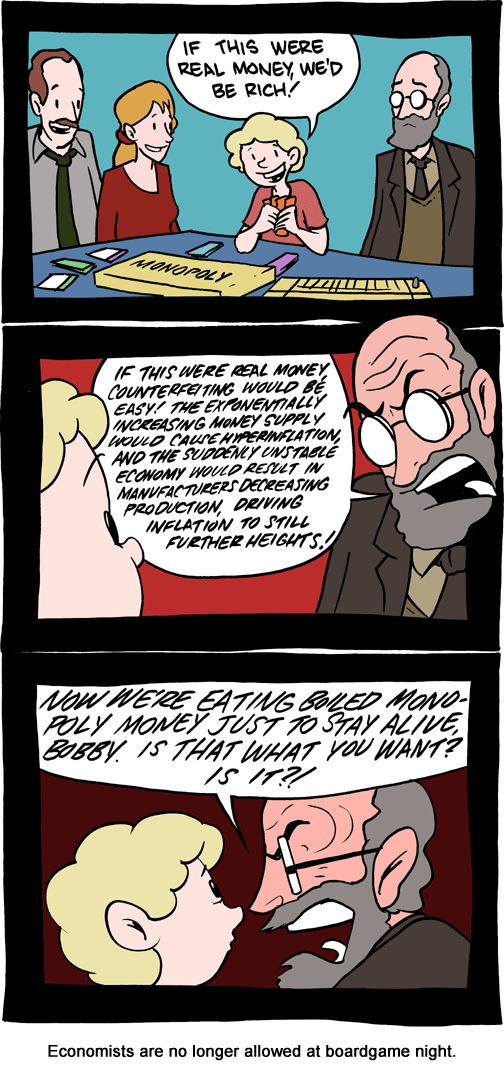
I've been immersed in teaching economic growth and trying to pull my research together, so my posting has been sporadic lately. And I'm in a wedding this weekend, which means I need to get weekend stuff done during the week. So I don't have a Video Extravaganza for you. All I've really got for you is a cartoon about how much fun I am to have around:

(courtesy of Saturday Morning Breakfast Cereal via behavioral economist Jodi Beggs)

I can link to a few videos I've been watching lately (they won't let me embed):

Old Spice Guy Sent Roses to Alyssa Milano

Old Spice Guy Offers Political Advice

(for those who don't know Old Spice Guy, aka actor Isaiah Mustafa, check out this commercial, and its sequel)

I Do the Maths

This semester I'm teaching Intermediate Macroeconomics for the first time. It's a tough course to teach, since I'm trying to present some of the key ideas in my field of research without (a) overwhelming the students with details they won't understand, or (b) lying to them about what real economists think and do.

I devoted a bit over half an hour of class time last week to explaining why we use so much algebra (and a little calculus, although we don't call it that) in the course. Rather than rhapsodize over the beauty and power of systems of non-linear difference equations, I decided to have them read a couple blog posts by one of the most famous development economists to grace the blogosphere, Dani Rodrik. In his first post, Rodrik uses a simple anecdote to illustrate the central reason economists translate the real world into the toy world of mathematics:
The moral of the story is that if you are smart enough to be a Nobel-prize winning economist maybe you can do without the math, but the rest of us mere mortals cannot. We need the math to make sure that we think straight--to ensure that our conclusions follow from our premises and that we haven't left loose ends hanging in our argument.
Of course, there are still points in our reasoning when economists are still vulnerable to bad logic. In particular, economists can make major blunders when identifying the most relevant parts of the real world--the parts that need to be included in the model--and when translating the implications of the models back into real world terms.  But this system is still much better than simply describing arguments in way that leaves room for sloppiness throughout the process. While we're in the mathematics of the model, we know that every result must certainly follow from the premises.

A key question I wanted my students to think about was this: Philosophers, Literary Analysts, and Journalists all make their living by presenting arguments. So why aren't they concerned about bad logic and loose ends? One student suggested the key was one of Rodrik's statements:
In explaining our extensive and demanding curriculum, I emphasize that development is too important to be left to mushy thinking.
 Essentially, the student said, economics matters more than those others. While I would disagree with this to a certain extent--journalism certainly matters because it influences public opinion, and philosophy matters because it influences future economists*--I do think there is a sense in which the consequences of bad economic policy, the inevitable result of sloppy thinking, are more costly and immediate than the consequences of bad thinking in many other disciplines.


*I don't mention literary analysts here because I don't know enough about them to know who they influence and how bad thinking in literary criticism matters. I assume it's got to matter to someone at least... right?

The second of Rodrik's posts essentially answers some criticisms of the first. Being an empirical macroeconomist, I was pleased to see Rodrik mention how much cooler we are than pure theorists; that's how I chose to read that particular comment, anyway. I also think he sums up pretty well the technical demands that are really at play when we do mathematical economics:
What matters most is a certain habit of mind--of being able and willing to break a complicated problem into its constituent parts and then put it back together. 
These are the skills I'm really trying to teach my students. Finally, I have to mention the commenter Rodrik quotes who wants to see some more humility in mathematical economic theory:
I am not supportive of economists who then forget that they have a "model", an abstraction of the world, and begin to believe that their model is the world. I find very few economists that are humble enough to admit that about their analysis.
Like Rodrik, I hope I am always humble enough to distinguish what models are helpful for and what they are not. If our interest is to help the people of less developed countries, formal economic analysis is only one component in the complex process of promoting growth. It's an important one, at least I think it is. But a sense of professional perspective is indispensable.

(Since this is an important topic to understanding how I do this, I'm going to cross post it at that other blog I contribute to. They probably won't mind.)

Materialism?

In anticipation of going on the job market late this fall, I'm planning to make a few upgrades. In particular, I need to get a computer that will allow me to work while traveling, an expansion of my professional wardrobe, and new shoes. I'm thinking of going a bit crazy on all counts.


Computer

I've been doing some looking around, and the main computers I'm considering right now are as follows:

Lenovo IdeaPad S10-3


Toshiba Mini NB305-N410


ASUS Eee PC 1001P


Any tips or comments on these or other models with similar specs & price range would be appreciated.


Wardrobe

I need to get a couple suits for my job market interviews at the AEA meetings in January. I want to really convey my competence, but let people know I'm still fun. Maybe I should get something like these:

This is The Doctor.

Doctor? Doctor who?


My wife favors the three-piece suit, though. We'll see where I end up on this. (As an aside, I'd take that overcoat if it comes in my length, too. I'm a fan of outerwear.)


Shoes

My current pair (yes, I usually own one pair of every-day shoes at a time) have gotten pretty worn in the sole.  For as long as I can remember I've either worn all-white shoes or all-black shoes (except for one pair of brown shoes my wife talked me into), and always with a (partially) leather upper.

I'm thinking of really changing it up and getting something like these:


I will probably not wear them to the job interviews. Probably.

They Don't Want Pity

I have several friends, and one in particular, who are pursuing careers in the humanities, so this article caught my attention. Apparently, academics of the humanitarian bent don't enjoy being told their job prospects are not good:
Apparently, though my program is excellent, I will be among the snookered, vagabond English adjunct scholars milling around the countryside, doomed to a life of the vicissitudes of enrollment and discretionary spending. Or, more likely, I will pursue my second career choice: swamp hermit. I will scream my Lacanian analyses at unsuspecting families hiking through my territory. There will be some dignity in my bog.
Did you notice the academic/humanities vocabulary? To thine own self be true, unemployed scholar.

The main thrust of the article is that graduate students need to broaden their horizons beyond professorships at research universities (and that departments and advisors should be more encouraging of those who pursue these paths). The author very much wants PhDs to be applying to jobs in public schools and nonprofit organizations. Even more than that, though, the author wants those offering guidance to warmly say:
Yeah, you're all screwed in terms of work for a research institution, but there are these other things out there that are great options. Your degree is not useless, and you are doing valuable work.
The problem with this, of course, is that there is little reason for getting a PhD in a humanities field to do a nonacademic job. Public schools and nonprofits would be equally well served by those with a masters degree (or less), so the extra investment in the dissertation is essentially wasted effort. Despite the desires of the author, for the positions she is describing her degree is precisely useless. Not that she wants pity:
We, the humanities graduate students of the United States of America, do not want your pity, or your smug, self-congratulatory admonishments of our choices. What we want is your help formulating a path that will lead us into careers where we can be useful, not exploited.
I think she fails to realize that most commentators aren't admonishing or offering pity. They are trying their hardest to do exactly as she asks. The path to a useful career for most in the humanities is to stop sinking more time into a dissertation that will not avail them; "avoid the sunk cost fallacy" might be the best advice they can get.

Now, I don't want to be too down on graduate work in the humanities. I think there will always be a demand for teachers in these areas for consumption and signaling reasons (as an aside, I find that I've only blogged about these functions of university in passing commentary before. Perhaps I should discuss them in more detail?). For foreign language studies, there may even be some productivity gains due to learning Spanish or Chinese or even Italian that result. As such, I think there is certainly a place for academic pursuit of these disciplines, especially at the best departments. But in general I find it's not a good idea to try for the terminal degree unless you are willing to make some major sacrifices for your love of the discipline. If you've spent a couple of years working on a degree and you don't absolutely love it, poverty and all, do yourself a favor and drop out. You can prove your worth  to society in some better way, and without spending years of your life hating it.

Modern Day Patrons?

First off, sorry for not posting much for a few weeks. Illness and travel got in the way. I am planning to be back on a regular schedule at this point, though, which means full posts on Mondays and Thursdays, with video collections on Fridays. My inconsistency would no doubt be remedied if I had enough followers to make some money on this blogging gig, but as the following will point out, it's easier theorized than actualized.

We live in a tough world for professional content creators: authors, photographers, filmmakers, and the like. We've been hearing for years that journalists are an endangered species, and in a world where novels are self-publishable and available on e-book readers for under $10, it's not hard to imagine a world where everyone is an amateur story-teller but nobody can make a living doing it. And while there are some safe havens for those with a truly creative flair, even in those cases very few can do so for a living.

It's as if we live in a world where the superstars make more money than they know what to do with, and everyone else works for the Man, transforming these creative minds into mere evening hobbyists.

In response to this mainstream narrative, there are those out there favoring a different approach to professional creativity. They say you don't have to be a megastar to support yourself and your family, you just need 1,000 True Fans. What exactly is a "True Fan," you may ask?
 A True Fan is defined as someone who will purchase anything and everything you produce. They will drive 200 miles to see you sing. They will buy the super deluxe re-issued hi-res box set of your stuff even though they have the low-res version. They have a Google Alert set for your name. They bookmark the eBay page where your out-of-print editions show up. They come to your openings. They have you sign their copies. They buy the t-shirt, and the mug, and the hat. They can't wait till you issue your next work. They are true fans.
This is an appealing idea to an artist, since it gives you an audience that genuinely appreciates what you like to create, and the marketing level is manageable at an individual level.
True Fanship is doable. Pleasing a True Fan is pleasurable, and invigorating. It rewards the artist to remain true, to focus on the unique aspects of their work, the qualities that True Fans appreciate. 
The key challenge is that you have to maintain direct contact with your 1,000 True Fans. They are giving you their support directly. [...]  The technologies of connection and small-time manufacturing make this circle possible.
How is this an effective way to make a decent income? The idea is that, on average, your True Fans will spend "one day's wages per year" on what you create. The article suggests this is about $100 per year, leaving you with $100,000 per year to cover your living and production expenses. It's a chance to turn the demise of many professional content-producing institutions into an opportunity.

Of course, there's the practical question of whether the theoretical structure works in practice. According to the follow-up post, The Case Against, it can, but usually doesn't:
What my research tells me: there are very few artists making their entire living selling directly to True Fans. The few that are, are selling high-priced goods, like paintings, rather than low-priced goods like CDs. But there are many that partially fund their livelihood with direct True Fans. However, most of these artists make it very clear in their notes to me: It takes a lot of time to find, nurture, manage, and service True Fans yourself. And, many artists don't have the skills or inclination to do so.  The fact that very few creators wholly sustain themselves with direct True Fans may be because it is a job few want to do for very long.  
The results reminded me of this piece by Cowen and Tabarrok of Marginal Revolution. The paper focuses on the complex trade-offs between pleasing customers and pleasing yourself in how you do your job. It also points out that artists are most inclined to pursue their own tastes when their final product is hard to market to the masses--paintings are usually avante-garde, but movies are usually popular.

All things considered, it's a pretty interesting way to use the technology of tomorrow to simulate the patronage system of yesterday. I think I'll stick with working for the Man, though.

The Mighty Warrior

As I was reading this post at OverthinkingIt.com, it occurred to me that I was woefully unaware of the classic samurai pictures of Akira Kurosawa. I'd seen Seven Samurai once before, and knew it well enough to recognize that Perich was on to something magical by rewriting Star Wars Episode I, but that was it. I had always wanted to see Rashomon since it was one of the first movies to tell the same story from many different perspectives (a devise I rather enjoy), so I decided to see if the Netflix Watch Instantly menu included any of these movies.

I was pleased to discover they had not one or two, but five on hand. So while I still haven't seen Kurosawa's Shakespearean adaptations Throne of Blood or Ran, I can now say that I've seen a good share of the movies that inspired generations of American nerds to take Japanese in college.

One of the things I picked up on is how well made the movies are. Kurosawa had a knack for making his characters' personalities clear without making them one-dimensional or boring. He took time to reveal the identities of all seven samurai as they defend the villagers, and he built up the romantic B plot in a way that felt true. The use of swipes could have been choppy and annoying, but it never was (I hardly noticed it, actually).

I was also quite surprised at how good these actors are. Kurosawa uses four or five of the same actors in every one of his Samurai movies, it seems, but every time they come across as clear and distinct characters. I was particularly impressed by Tatsuya Nakadai, who played two different principle soldier enemies against Toshirô Mifune's character Sanjuro, and yet managed to keep the characters distinct; Unosuke is downright creepy in Yojimbo, while Muroto is scary but maintains a strange sense of dignity.

But what I really noticed was how Kurosawa portrays samurai. The samurai in Rashomon is not an admirable character, being upstaged by the common bandit Tajomaru (the samurai gets killed over and over in the retelling of the story, and I don't even remember his name). However, his pride and poise in adversity are starkly contrasted with many of the samurai in Seven Samurai. Heihachi joins the band because he is broke, Gorobei joins because he finds the leader (Kambei) an interesting character, and Kyuzo joins simply as an opportunity to hone his swordsmanship. Samurai seem to be a rag-tag lot in Kurosawa's mind.

The first truly noble samurai who demonstrates the power one would expect of the great heroes of Japanese legend is General Rokurota Makabe in The Hidden Fortress. Makabe is devoted to saving Princess Yuki, willing to give up his life or the lives of his loved ones to protect her. Although he manipulates the two peasants into helping them, Makabe is always honorable, even in how he treats the enemy General. Here, perhaps, is the ultimate picture of what a samurai should be... except Makabe begins the story as a failure. He has to rescue the princess precisely because he failed to defeat the invading army. And in the post-World War II age, perhaps that is how many Japanese saw the samurai and their culture: honorable, but defeated from the beginning.

Yet the most powerful expression of the samurai comes in the unnamed hero of Yojimbo and Sanjuro. Well, perhaps I shouldn't say unnamed. He gives his family name as Kuwabatake in the first film and Tsubaki in the second, in both cases simply picking the name of something he's looking at. In both he says his given name is Sanjuro, but this actually just means Thirty-something. He even says in the dialogue in both films "but I'm nearly forty." So he has a label for the sake of the movie, but it's quite clear that he's making it up.

Anyway, Sanjuro is a classic mercenary who follows a moral code. In the first movie, he destroys the gambling clans that are destroying the town purely  by accident. During the opening credits he is a wandering ronin, and he chooses which path to follow by throwing a stick in the air and seeing which way it points when it lands. He makes just enough money to stay fed, and everything else he does seems to be for sport. He fights for the good guys when he can identify them (as in Sanjuro), but has no trouble stirring up trouble when it suits him. As the Chamberlain's wife says, he is like a naked sword: he cuts well, but often cuts when he should have stayed sheathed. "Killing people is a bad habit," she says to him, and he seems to agree. It doesn't stop him from continuing, though, as it wouldn't stop most people.

Maybe that's Kurosawa's message about samurai after all. Samurai can make a fascinating subject because of the drama and spectacle, but in the end they're just human beings like the rest of us.

(As a special bonus, I'm putting a video of Sanjuro's bad-assery below the jump.)


© Metadoxy
Revolution Elements by Blozard. Original WP theme by Jason Schuller | Distributed by Deluxe Templates