Showing posts with label vigilante. Show all posts

The Dark Knight Rises

On Wednesday Warner Bros. announced the villains and casting for Christopher Nolan's sequel to 'The Dark Knight.' Since a lot of the tone and even plot of the movie depend on these roles, I feel compelled to comment. [Warning: if you haven't seen 'Batman Begins' and 'The Dark Knight,' what are you doing reading blogs?!? Go watch them. For the rest of you, spoilers below.]

First, the obvious:
CATWOMAN
We all knew Catwoman was going to be one of the major villains.  The previous film ended with Batman heartbroken, without a love interest, on the run from the law.  It also featured low-budget Bat-imitators.  The stage was perfectly set for this character. In Frank Miller's Batman: Year One, Selina Kyle is a street prostitute who decides that if someone can dress up like a bat and fight crime, she can put on a costume and make a living off of the mob royalty of Gotham.  I'd love to see Selina use her new found wealth to position herself as a high class call girl, thus bringing her in contact with Bruce Wayne. Maybe she'll see through the billionaire-playboy act, or maybe she'll just take him for an easy mark.  In any case, it's hard to argue that being without a love interest and on the outs with the law won't leave Batman tempted to join a woman with the grit, intelligence, and skill to match him.  It's a moral dilemma Bale's Batman needs to face before we're done, in my view.

And who did they cast for this iconic role?

ANNE HATHAWAY

I'll admit, this is not the casting I expected. Selina Kyle is basically a classic noir femme fatale in a costume, and Anne Hathaway has never struck me as a femme fatale.  She has the physique for the role, and I'm pretty sure she has some background in films requiring some stuntwork.  But I'm not convinced she can sell a Tim Sale version of the character.

So I'm not convince here, yet. But you know who else I was skeptical of? Heath Ledger.
That's Best Supporting Actor Heath Ledger to the rest of us.
So we'll wait and see on Selina Kyle. I am willing to be convinced.

Now, Catwoman is a great villain, but certainly couldn't carry a blockbuster movie on her own. So who is going to be the big-bad villain?

BANE
That... was unexpected.  The stage seemed perfectly set for someone much like the Batman--but without his unwillingness to kill criminals--to enter the scene.  Someone like the Reaper, for example, who was rumored to be one of the villains considered for Batman Begins. Personally, I really wanted Nolan to steal a bit from Frank Miller's The Dark Knight Returns. I have in mind the first half of the last chapter, in which the city is plunged into chaos, and a large gang of teens called the Sons of Batman are getting ready to meet out their own version of justice when Batman shows up and decides to claim them as his own army. He brings order to the city, even though he is being hunted by the police.  When the new commissioner (Gordon has retired by this point) is asked "Shouldn't we bring him in?" She replies "No... he's too big..." He truly does become a legend larger than just one man, which would nicely bookend some of the key ideas from Batman Begins.

With a villain like Bane, though, I really don't know what direction they'll go with it.  He's a great villain, despite his appearance.  When he was introduced, he masterminded wave after wave of Batman's toughest enemies facing him, wearing the Bat down until Bane could face him at his weakest. As the picture above shows, Bane actually won, leaving Batman bound to a wheelchair for a time.  He also was one of only a few enemies Batman has had who figured out that he and Bruce Wayne were the same man.  The character is a pretty long way from the last version to make it on screen.  I really don't know what direction Nolan is going with this one.

It turns out Christopher Nolan picked someone he's worked with before to fill out Bane's wrestling mask:

TOM HARDY
 OK, I have no idea how he's going to pull off Bane, but casting Tom Hardy as the villain opposite Christian Bale's Batman is going to be awesome.  The pic is from Hardy's role in Inception, which he handled quite well.  He has a physical presence that should work well in a Batman movie, and I thought his performance was one of the better ones in the movie.  If we can get a scene between Hardy and Bale as electric as the interrogation scene between Bale and Ledger from The Dark Knight, the movie will be worth the price of admission right there.

So I don't really know what to make of the casting and villain choices at this point, at least beyond the non-committal, Spock-like response "fascinating."  I'll definitely be seeing this one in theaters... but you probably knew that already.

The Man of Steel: A Fanboy Wishlist

In case you didn't know this about me, I like comic books. Not all comic books, of course, but I do like superheroes and the interesting questions they allow me to explore. I like the greats from the 1980s, work by Frank Miller and Alan Moore. I really liked Batman Begins, and I really liked The Dark Knight.  Superman Returns, not so much. (yes, I'm more of a DC guy)

So I've been thinking recently about what kind of Superman movie I'd like to see now that Christopher Nolan is supervising the project (although he won't be directing). I wrote a partial script for a Superman movie while I was taking a sci-fi film class as an undergrad. Yes, it was my final project; yes, I got an A; and yes, I know how cool it is too game the system by getting upper-division honors credit to watch and write about Blade Runner. The script focused on the alienness and humanity of Superman in the context of a Nazi death camp; if I had to sum it up in a sentence, I'd say "the last son of Krypton finds his humanity fighting for what's right, as a brilliant German scientist (reminiscent of Mengele) loses his humanity fighting for what he thinks is right."

But that's not the movie we're going to get, and no doubt all the better for the box office hopes of The Man of Steel. No, Superman generally needs to live in a modern context for the big screen. So given that restriction, I thought I'd waste my time and yours (not much of it, don't worry) talking about what I'd like to see in the upcoming movie, even it's never going to happen.

First let me say what I don't want to see:


I was a huge fan of the first year of Smallville, although it lost a lot of its appeal for me after that. I like Tom Welling as a young Clark Kent, and I've got nothing against Erica Durance as Lois. But no. Please, please no.

Now that we've got that out of the way, I think I can best communicate what I'd be looking for with some cast and crew ideas before presenting the premise of the movies (yes, as per the modern standard, there must be three in the series). Due to length, I'll put it below the jump.

Is Economist Robin Hanson a Supervillain?

Robin Hanson of GMU has a recent post arguing that survivalists play an extremely valuable role in society, despite the conventional view that they are crackpots.  He seems to be doing so because he sees them as kindred spirits to those who, like Hanson himself, wish to be preserved via cryonics. Their brilliance remains unappreciated by a society that values signals and expressions of loyalty to particular groups above actually doing things to save lives both now and in the distant future. (Of course, one could view Hanson's posts as merely attempts to signal that these views belong in the "intellectually respected" club, but if we all spend all our time accusing each other of signaling, what kind of signal would that send?)

I go back and forth in my view of survivalists themselves. I think it's pretty clear that they overestimate the risks they are reacting to, and their political and social beliefs are often difficult to comprehend. On the other hand, talking about the end of the world can make for fascinating reading, and I sometimes I think society in general underestimates the chances that things could go terribly, horribly wrong.

But the debate over survivalists isn't what struck me about this post. What struck me is Hanson's argument for why the survivalists might not be as nutty as they seem:
The world faces existential risk, i.e., a risk that the world will die.  Such a death is bad not only for those who live here now, but also for vast future generations who might descend from us now.  Cultures and ethnicities face related risks.  By preparing to save themselves under various disaster scenarios, survivalists also tend to make their culture, ethnicity, and world a bit less likely to die.  An effort for which future generations should be quite grateful. [emphasis added]
Hanson's argument is that survivalists might not be much benefit to society right now--in fact, they probably hold current society in disdain and avoid outsiders where possible. But the true beneficiaries of their peculiar brand of risk aversion are the untold future generations who might not exist without the efforts of lunatics and maniacs.

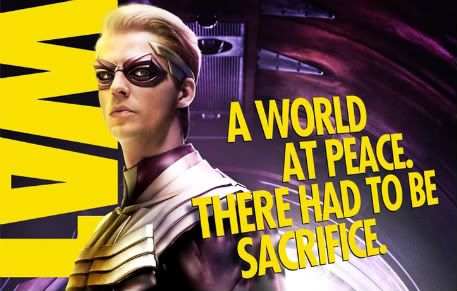
I've heard this argument before, of course. The stakes are described in the graphic novel Watchmen:
Each step had to be taken carefully, constantly striving to keep in mind the enormous scale of what was at stake! The Earth. Humanity. All we've ever known... "end of the world" does the concept no justice. The world's present would end. Its future, immeasurably vaster, would also vanish. Even our past would be cancelled. Our struggle from the primal ooze, every childbirth, every personal sacrifice rendered meaningless, leading only to dust, tossed in the void-winds.
Save for Richard Nixon, whose name adorns a plaque upon the moon, no human vestige would remain. Ruins become sand, sand blows away... all our richness and color and beauty would be lost... as if it had never been.
That's right, Robin Hanson is channeling the World's Smartest Man, Adrian Veidt, also called Ozymandias.

But the parallels don't stop there. Hanson prides himself on seeing the world differently from most people, realizing that most of our beliefs about the world are wrong when we get a more external perspective. Homo Hypocritus, he calls the human race. Man the hypocrite. Ozymandias agrees: "Hitler said people swallow lies easily, provided they're big enough."

Which of the two, Hanson or Veidt, said this?
An intractable problem can only be resolved by stepping beyond conventional solutions.
Or this?
I have a passion, a sacred quest, to understand everything, and to save the world.
They could have come from the same mind, if not the same voice.

But what does Adrian Veidt do in Watchmen? Oh yes. Saves the world. Through mass murder. Not that anyone who could do anything about it found out until after the fact:
"Do it?"  Dan, I'm not a Republic Serial villain. Do you seriously think I'd explain my master stroke if there remained the slightest chance of you affecting its outcome? I did it thirty-five minutes ago.
Robin Hanson wants to save the world, but how? By educating people? Maybe. Maybe something else. "Canaan is devastated, Ashkelon is fallen, Gezer is ruined, Yendam is reduced to nothing, Israel is desolate and her seed is no more, and Palestine has become a widow for Egypt... All the countries are unified and pacified," says mighty Ozymandias.

Now, I have no reason to believe Robin Hanson is planning to clone human psychics or wipe out whole cities. But then no one had reason to believe Ozymandias was really the world's greatest supervillain, either. Just because I might over-estimate the probability doesn't mean the risk isn't there.

I guess that makes me a survivalist after all.

A Proper Welcome


I've been thinking about immigration issues lately. In particular, the recent suggested challenge to Arizona's new immigration status enforcement law has me wondering why our attitude toward illegal immigrants is what it is. Certainly, they are breaking the law, and breaking the law should have consequences. But I find it incredible to suggest that the primary motive is due to a "law and order" position, because the same attitude is not applied symmetrically throughout the legal system.

There is no similar outrage that speeders or runners of red lights go un-ticketed. It's not a matter of the relative seriousness of the crimes, either, since traffic violations are much more likely to lead to third-party injuries or death than immigration violations. There is substantial overlap between the most vocal hard-liners on immigration and those willing to disrupt business activities at abortion clinics, despite the fact that abortions are quite legal. And let's not forget that tax evasion is only a big deal when the person doing it is famous and belongs to a political party one dislikes. So although I won't speculate on what the true motives behind the deeply emotional reactions really are, I don't think it's primarily about upholding the current legal code.

A couple of the more specific statements in this regard that I often hear are (1) "They should wait in line like all the hard-working citizens who played by the rules!" and (2) "They'll bring violence, drugs, and prostitution, destroying the American dream!" (Both actually came up in a Ray Stevens music video recently emailed to me. As the video contains a blend of bad jokes, misinformation, and borderline racist visual gags, I will not link.)

There are a couple of recent articles from Reason magazine that should put these claims to rest. The first points out that those "hard-working citizens who played by the rules" either started out privileged or just plain got lucky:
What's the best-case immigration scenario? Five or six years: If you are the spouse or a minor child of a U.S. citizen, you should be able to enter the country and get a green card. Then, after three to five years, you can apply to become a citizen.
Unskilled workers just have to hope they get lucky. That's because only 10,000 green cards are given to these workers each year and "the wait time approaches infinity." Skilled workers may have better chances, but still face strict caps, thousands of dollars in fees, and an 11 to 16 year wait to obtain a green card and gain U.S. citizenship.
The costs and restrictions, combined with the fact that there is no "line" for people to really wait in year after year, are designed so that except for a remarkably small number of lucky ducks, the only people who can find a better life in America are those who already have things really good somewhere else. David Beckham didn't have any trouble immigrating, since the system makes it easy for people to bring their millions of dollars with them. (Take a look at the chart discussed in the article for a more complete picture of the process)

The second article points out that in cities with very high illegal immigration populations, crime is actually lower than in those without them:
Here's the surprise: There were just 18 murders in El Paso last year, in a city of 736,000 people. To compare, Baltimore, with 637,000 residents, had 234 killings. In fact, since the beginning of 2008, there were nearly as many El Pasoans murdered while visiting Juarez (20) than there were murdered in their home town (23).
[...] Numerous studies by independent researchers and government commissions over the past 100 years repeatedly and consistently have found that, in fact, immigrants are less likely to commit crimes or to be behind bars than are the native-born. This is true for the nation as a whole, as well as for cities with large immigrant populations such as Los Angeles, New York, Chicago, and Miami, and cities along the U.S.-Mexico border such as San Diego and El Paso.
And just in case you don't see the connection between large immigrant populations and large illegal immigrant populations, sociologist Rubén Rumbaut makes the case explicit: "The evidence points overwhelmingly to the same conclusion: Rates of crime and conviction for undocumented immigrants are far below those for the native born, and that is especially the case for violent crimes, including murder." Economists, criminologists, and sociologists who study immigration, documented and otherwise, all point out the same thing: people willing to leave their families and risk their personal well-being in order to make enough money to provide a better life for their children--which characterizes those coming here illegally as much as those coming legally--are very unlikely to be prone to criminality.

So hopefully this clears up some stereotypes about the people at the center of the immigration debate. Of course there will always be anecdotes to the contrary, and I don't mean to make light of those. But if we're going to pre-judge people we don't know and have no intention of understanding at an individual level, lets at least make the right assumptions on average.

Why is understanding why we think the way we do on this issue so important to me? For one thing, for Christians at least, how we treat foreigners and outsiders--people who obviously don't deserve the perks this country provides--says a lot about how we view ourselves.

Is this "love your neighbor" or "love your enemy"?

For another, the article points out that the attitude we take towards illegal immigrants may actually cause them to be either beneficial or harmful to country:
You don't see "Latinos Need Not Apply" or "No Mexicans" signs posted on public buildings the way you did with the Italians and the Irish, two groups who actually were disproportionately likely to turn to crime. The implication makes sense: An immigrant group's propensity for criminality may be partly determined by how they're received in their new country.
[...] "Most people in Washington really don't understand life on the border," El Paso Mayor John Cook told the Post. "They don't understand our philosophy here that the border joins us together, it doesn't separate us."
Food for thought.

Friday Video Extravaganza

Hit the jump for a couple of life lessons.


© Metadoxy
Revolution Elements by Blozard. Original WP theme by Jason Schuller | Distributed by Deluxe Templates