
This post was prompted by this review of Ron Paul's End the Fed and a subsequent online discussion. By virtue of my economics background, a friend asked me to chime in on why Ron Paul's solution to various economic problems should be discarded as easily as his opponents suggest.
In order to understand how a central bank affects the economy through its control of money, we first need to understand money itself. Therefore, this first post will explore the nature of money, as well as some historical facts regarding modern forms of it. Much of what follows builds on Walton and Rockoff's History of the American Economy tenth edition.
The first thing we need to realize about money is that money is not paper and coins; in the 1930s Germany had paper and coins that failed as money. It is not something that has "intrinsic value" (whatever that means); if anything has intrinsic value, it would be human lives, but using them as money is generally frowned upon. Money is also not "legal tender"; legal tender is just a nice label by governments to indicate what sorts of goods they'll help you try to use as money by getting Big Brother on anyone who disagrees about whether it's money.
Money is a good that provides certain functions to those in an economy who want to engage in trade. If you live by yourself, surrounded by no one, and you subsist on your own produce, then money doesn't mean anything to you. Money only becomes useful when you have something someone else wants, or they have something you want. That is, money functions as a medium of exchange. To get a sense of why people might use a good as a medium of exchange, consider an economy in which there are a several goods you might want.
In order to understand how a central bank affects the economy through its control of money, we first need to understand money itself. Therefore, this first post will explore the nature of money, as well as some historical facts regarding modern forms of it. Much of what follows builds on Walton and Rockoff's History of the American Economy tenth edition.
The first thing we need to realize about money is that money is not paper and coins; in the 1930s Germany had paper and coins that failed as money. It is not something that has "intrinsic value" (whatever that means); if anything has intrinsic value, it would be human lives, but using them as money is generally frowned upon. Money is also not "legal tender"; legal tender is just a nice label by governments to indicate what sorts of goods they'll help you try to use as money by getting Big Brother on anyone who disagrees about whether it's money.
Money is a good that provides certain functions to those in an economy who want to engage in trade. If you live by yourself, surrounded by no one, and you subsist on your own produce, then money doesn't mean anything to you. Money only becomes useful when you have something someone else wants, or they have something you want. That is, money functions as a medium of exchange. To get a sense of why people might use a good as a medium of exchange, consider an economy in which there are a several goods you might want.

Yes, like that. Now, suppose you want all of these, but all you have right now is the wheel of cheese. You've got plenty of cheese. More cheese than you could possibly want for yourself... as if that were possible. Maybe you'd be willing to give up some of your cheese if you could have some bread instead. You can then engage in a direct trade of one good for another, barter. Or rather, you could, if you could find someone with bread who would rather have cheese.
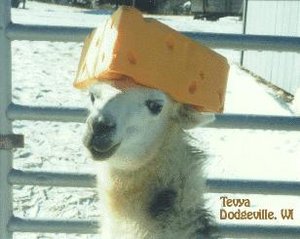
It turns out, you can't. You find a guy who would rather have a stylish hat than his bread, though. Problem is, you don't have a hat, you have cheese. Despite the best efforts of Wisconsin, cheese doesn't work well as a hat. What you're missing here is what we call a double coincidence of wants: for the trade to happen, you have to have what the other guy wants, and the other guy has to have what you want. Otherwise, no deal.
Now, you could try to get what the breadman wants--a hat. Now instead of looking for a market between bread and cheese, you need to look for a market between hats and cheese. Maybe you find a guy with a hat who wants beer. So you look for a market between beer and cheese. This continues until you find someone who wants your dang cheese, then you trade your way back to the guy with bread. It's like a convoluted video game.
In fact, in order to successfully barter, you need to be able to participate in a market for every combination of two goods. If there are 6 goods in the world, that's 15 different markets. If there were 100 goods (and of course there are a lot more than that), that's 4,950 separate markets!
 It gets pretty ugly.
This is a pretty good description of early colonial America. Traders in furs, corn, cows, whiskey, and any other good tried to trade back and forth with everyone else. It got pretty annoying, especially since you had to travel from on buyer to the next, making the act of getting from cheese to bread quite costly.
For this reason, people started to convert goods into a common good, which would then be easily exchangeable for any other goods you could think of. One of the earliest monies used was polished beads called Wampum, although a number of other goods were used, especially (in Virginia and Maryland) tobacco. Everyone generally agreed that they would trade their goods for tobacco, thus making it the medium of exchange. Why did everyone agree to this? Paradoxically, because they believed they would be able to exchange it for any other good they wanted. That's right. Tobacco (and any other good, actually) became money because people believed it was money. And having money made life a lot easier.

But using tobacco as money presented problems, because money does more than just function as a medium of exchange. Because it is generally accepted in exchange, money also functions as a convenient unit of account, or numeraire in economics jargon, for representing the value of all other goods. You know how much a hat costs because you know how much money the seller wants to exchange for it.
Tobacco presented a problem here, because not all tobacco is created equal. And that's bad, because if you use a good for money that others use as the good itself, then what the money will buy is related to (but not necessarily the same as) what users of the good would trade for other goods. If the goods that function as money aren't all the same, this can cause serious trouble and confusion in trading (we'll come back to this at a later date). In order to use money as a unit of account, you need to be able either to easily differentiate the quality of the good or to only use a good which is standardized.
Tobacco also presents a third problem, because part of the reason you might sell a good for money is so that you can spend the money tomorrow. In this way, money acts as a store of value, particularly one that is easily and quickly converted into any other good you want. Goods used to store value that are better at being converted into other goods are said to be liquid: they flow easily. Money is as liquid as you can get, so tobacco (as money) should make a great liquid store of value. The problem is, tobacco goes bad after a while. It rots, or to use a more general term, it depreciates and loses value.
In order to find a good that would work well as a medium of exchange, unit of account, and store of value, the American colonies eventually came to accept the Spanish dollar, or "piece of eight" (so called because it was worth eight Spanish "bits"; that's where the phrase shave and a haircut... two bits comes from), as money. They chose Spanish over English money because the Spanish dollar was made of silver, while the British pound was made of gold, a metal in very short supply in the colonies (it's hard to have a medium exchange if no one has any to exchange).
However, because the British colonial system was essentially designed to extract precious metal-based currencies from its colonies, even the silver Spanish coins became difficult to come by. It was around this time that many colonial governments (and private citizens to some extent) decided to reinvent something previously created by the Chinese: paper notes that could be exchanged for money. Because these notes could supposedly be exchanged for money at any time, people began to use them in exchange instead of silver coins. They also held onto the notes as a store of value, and since the notes had numbers written on them indicating how much money the were worth, they were held as a store of value.
That's right, folks: paper money is an All-American invention.
Next week we'll look at some of the problems of this new paper money, as well as some of the attempts to solve these problems in the history of banking in the US.


 Posts
Posts



2 comments:
::mean angry voice:: And two bits!
This is fabulous. I laughed out loud *and* I learned some stuff. That's the best way.
When I was in... oh, middle school/early high school, my brothers and I, having been forbidden by our parents to sell things to each other, decided to use our vast stores of play money to buy and sell things among ourselves. As you can imagine, this worked great for about a week, until we all had everything we wanted. Then we realized that selling things for play money would do us absolutely no good outside our own home, and we stopped. Economic lesson learned.
This is great, Norman! It's scope is large enough to get the big pictures, has a good translation from technical to layman's terms and the narrative form made it enjoyable to read.
Looking forward to this week's post...
Post a Comment