Breakup Songs

Because a few recent songs focusing on the end of a relationship are just quality products. The music videos are below the fold/jump/whateveritscalled. (warning: language. For real. In the second song, mostly, but the song's just no good without them.)

Mechanics and Mystics, Less Seriously

Everything I Know I Learned From Sesame Street (apparently). Check out this video of a Mechanic and a Mystic interpreting a large blue circle. I'll let you guess which one is which.

For the Mechanic who loves working in the kitchen, here's a cutting board specially tuned to the mechanic's mindset.

Our New Computer Overlords

Three links on how computers will replace our white-collar labor force long before robots steal our blue-collar jobs.

The first comes from Paul Krugman:
Anyway, I decided to write the piece around a conceit: that information technology would end up reducing, not increasing, the demand for highly educated workers, because a lot of what highly educated workers do could actually be replaced by sophisticated information processing — indeed, replaced more easily than a lot of manual labor.
[...] In my mind this raises several questions. One is whether emphasizing education — even aside from the fact that the big rise in inequality has taken place among the highly educated — is, in effect, fighting the last war. Another is how we have a decent society if and when even highly educated workers can’t command a middle-class income.
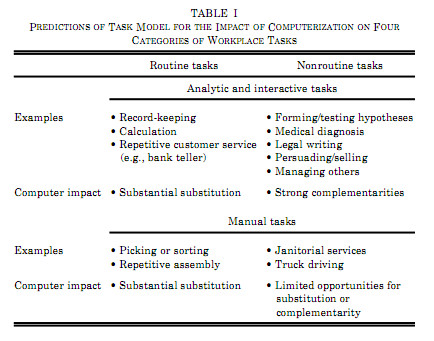
The second also comes from Paul Krugman, and I particularly like it for this table:
"This is real, and it calls some of our favorite platitudes into question," Krugman says.

Brad DeLong, on the other hand, has an excellent post in which economics and history triumph over cynicism (and yes, it's a lot like intellect and romance over brute force and cynicism):
We have already gone through the great transformation by which the general business of life--growing and processing our food, building our shelter, weaving our clothes, and telling ourselves stories for information and entertainment--has been extroardinarily [sic], comprehensively automated. And yet we have found things to do.
 Either way, I'd say this is the best argument yet for the long term viability of a career in the humanities!

Life-Saving Immorality?

Your taxpayer dollars at work.
Brad DeLong thinks that taxing people in order to prevent an asteroid from destroying the human race is entirely appropriate and moral. He quotes Bob Murphy, on the other hand, as disagreeing:
[T]here is a general moral prohibition against violating another person's rights.... Volokh's... point should be obvious: Just because an asteroid threatens to destroy all human life, that alone is not sufficient to justify violating people's rights. [...] The reason DeLong finds Volokh's views "insane" is that Volokh has elevated his precious political principles to such a height that they trump the survival of the human race. What an ideologue!
DeLong summarily rejects this sort of thinking, summarizing his view as follows:
[...] the sabbath was made for humanity; humanity was not made for the sabbath.
Commentor Daniel Kuehn has a lot to say in response to this position, and particularly to the logic of the position:
If you start where they do - axiomatically defining what a "right" is and defining "immorality" as being the violation of that right - then both the Volokh and Murphy version of the argument follows naturally.
The problem is not the logic itself - that logic is simple enough. The problem is their decision to apply that logic to this circumstance. Deductive logic is a tool - we have long since passed the point where we can claim that it deserves any deeper epistemological priority. [...]  Logic is not a tool for them, as most careful thinkers know it should be. For them it is a path, not to truth contingent on assumptions [I would prefer to refer to this as consistent reasoning or logical validity - N], but to some deeper absolute truth. [...] So to expand on your concluding thought, deductive logic is a tool for humanity, and not the other way around.
Tad Brennan points out that, far from being a primarily political debate, the conflict here is between purely deontological ethics and purely consequentialist ethics, and that the latter lends itself to some problems, as well:
If you eschew lexically-ordered side-constraints, then you have a very pure form of consequentialism. And that's not a bad thing! Some of my best friends espouse pure consequentialism! 
But pure consequentialism can generate some pretty repellent hypotheticals of its own (catalogued by Bernard Williams and others: false conviction of the innocent; harvesting organs from the unwilling; torture of children; etc. etc.).
When people recoil from the consequences of pure consequentialism and consider adopting categorical prohibitions on, e.g., the torture of children, this does not seem to me ipso facto insane.
Finding the right balance of ethical views for the Christian is never as simple and easy as it seems, which is why Christian maturity is a big deal. But this is a circumstance when, again, I don't think Christianity came come down on the side of moral libertarianism.

PS - For those looking for a quick summary of deontology vs. consequentialism in terms we can all understand, may I suggest Mark White, aka The Comics Professor, on the morality of Captain America, Iron Man, and Spiderman!

Japanese Earthquake-Tsunami Links

One week after the fact, I don't have a lot to say about the disaster, other than it is terrible. Please be praying for the people in Sendai and areas even closer to the epicenter.

I do, however, have some summary information I have been following.

Here is an amazing visual before and after comparison.

Ilan Noy provides a way to think about the economic impact of a disaster.

James Hamilton expands on this discussion of the economic impact, including some links of his own.

Will Wilkinson offers his summary of the economic disaster literature.

Christopher Beam on the lack of looting.

Bill McBride has several links on the nuclear concerns.

Robin  Hanson argues for a counter-intuitive response to the nuclear dangers.

Laura Freschi wants you to think carefully about your aid donations.

Finally, here's a brief video showing some of the impact of the Tsunami:

Talking about Sex

(The title alone should really boost my pageviews, right?)

Actually, I don't have much to say, but Ross Douthat and Matthew Schmitz do.

Here's Douthat:
Did the social trends of the last 50 years bring about “unprecedented gender equality”? Absolutely. Did they bring about “unprecedented personal fulfillment”? Well … for some people they did. But it’s very easy to find indicators that paint a more complicated picture. [...]
The crucial question, to my mind, is whether all of the social changes that swept America in the 1960s and the 1970s are a package deal. [...] Many progressives and feminists have committed themselves to an absolute defense of everything that changed during the sexual revolution, out of a fear that one concession will cost women every gain.
And here's Schmitz:
the failure of American men to compete academically with their female peers has created a gender imbalance that leaves women at a disadvantage in the sexual marketplace. It is a particularly bitter irony that the societal neglect of the young American male has now become a significant threat to the happiness and well-being of the young American female. If we are to “take back the night,” we may have to first recapture a compelling vision of masculinity that makes education and achievement attractive to a lost generation of young men.
[...]Indeed, our current preoccupation with keeping sex sanitary, salutary, and unencumbered by anything resembling a moral judgment has led to a narrow focus on preventing pregnancy and sexually transmitted infections, and an effective denial of the regret and depression that follow many sexual encounters. Facing up to the psychological problems associated with casual sex (which are far more common among women) will require the medical profession to decide whether it is possible to withhold judgment without denying necessary care.
Both articles are well worth reading.
 

© Metadoxy
Revolution Elements by Blozard. Original WP theme by Jason Schuller | Distributed by Deluxe Templates