
I've gone back and forth on how to write up this week's lecture. The focus has been on some technical issues which I don't feel can be communicated well in print without taking the form of a textbook, and I'm going to have you read a textbook, you may as well just buy a copy of Krugman and Wells for yourself! However, since my goal in these posts is to get across the key ideas we are covering, I will discuss two here: budget constraints and utility.
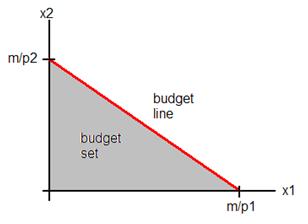
After the last few weeks' discussion of supply, demand, and the gains from trade, it is important to realize that all of the claims about how the market price leads to such nice outcomes depends on the idea that supply tells us about the opportunity cost of inputs, and that demand tells up about how much buyers value the end product. In order to see why the demand curve means what we said it does, we need to examine how consumers make the decisions they do. To understand this, we need to answer two questions: (1) What is feasible? What options are available to me? and (2) What is desirable? What satisfies my goals?
Answering the first is relatively straightforward. To think about it in simple terms, we need only make a few simplifying assumptions. While they sound ridiculous (and they are!), the theory of consumer choice does not require them; they just makes things easy to talk about and draw on a graph. So for simplicity will talk about the world as having only 1 time period, after which everything ends. There is no saving for later, there is no borrowing, there is no negotiating for higher wages, there is no leaving something for posterity--there is now, and only now. Second, we say there are only two goods in the world. There is no third way. Since Valentimes is upon us, we'll go with lame $1 per pound cherry chocolates and Equate-brand $0.50 per pair boxers, since that's what people buy as gifts (Don't they? I don't know because my wife is too cool for valentimes).
The question "What is desirable?" takes a bit more work to think about. After all, philosophers have been trying to explain human desires for millennia. As a description of human desires and behavior, economists first tried to understand why we like one thing more than another by saying we like whatever gives us the most utility. Utility is just the personal, subjective sense of satisfaction people get from doing things--in short, utility is the satisfaction of desire. While this isn't the most clever way to avoid philosophical troubles, it's remarkably effective. Utility also had the bonus of being measured by the cleverly named units 'utils.' Economists figured once we sorted out how to measure utility and compare it across people, we'd have this "human choice" think pretty well licked. They came up with utility functions, which they assumed would increase as we got to consume more stuff, but increasing by less and less the more we already had. This particular version of diminishing returns was referred to as diminishing marginal utility, marginal just being economics code for "the last one," in this case marginal utility being the extra utility from the very last unit of a good consumed.
Of course, economists eventually figured out that utility cannot be measured the way weight can, and no human being ever counts utils in making decisions. What humans do, though, is they can tell whether they like one option better than another, or the other better than the first, or if it doesn't make any difference. So economists modified their utility theory to use indifference curves, which represent on a utility function the same thing elevation lines represent on a hill. An indifference curve shows any combination of our two goods (lame chocolates and cheap boxers, remember?) that the buyer thinks are just as good as each other. If asked to choose between to combinations on the same indifference curve, the buyer won't care... because they're indifferent.

These indifference curves are how economists represent human desires. The consumer will make a choice, then, that gets to the best possible indifference curve that's still in the feasible set. But that's a topic for next week.


 Posts
Posts


0 comments:
Post a Comment